File:Enclave_exclave_diagram.svg · Wikimedia Commons · See Wikimedia Commons
enclave or exclave
Sign in to saveAlso known as enclave and exclave, enclave and/or exclave, enclave/exclave
geographic descriptions of territories
Wikidata facts
- Instance of
- binary opposition
- Has part
- exclave
Show 3 more facts
- Commons category
- Exclaves and enclaves
- topic's main category
- Category:Enclaves and exclaves
- has list
- list of enclaves and exclaves
Sources (1)
via Wikidata · CC0
~15 min read
Encyclopedic overview
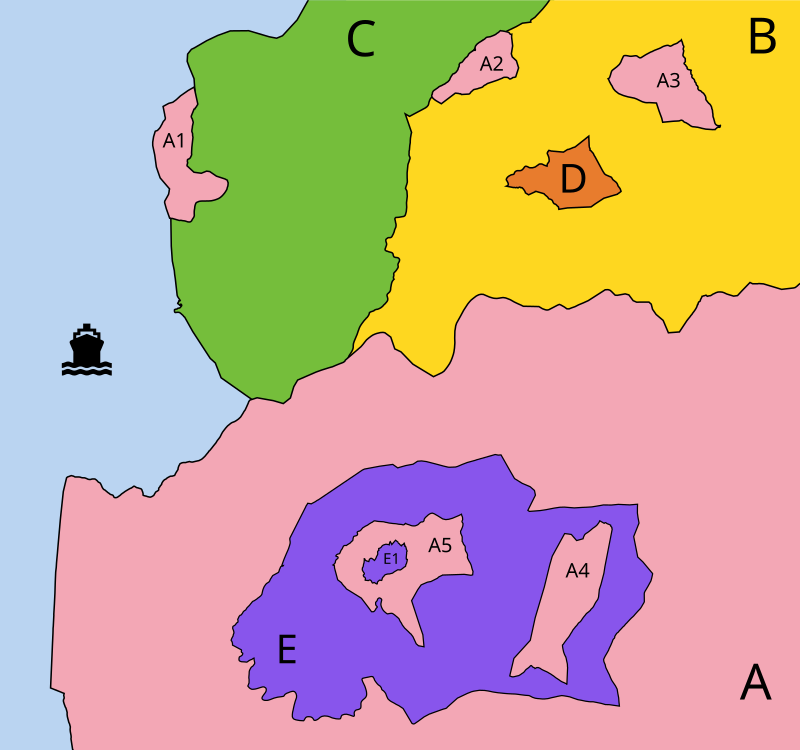
An enclave is a territory that is entirely surrounded by the territory of only one other state or entity. An enclave can be an independent territory or part of a larger one. Enclaves may also exist within territorial waters. Enclave is sometimes used improperly to denote a territory that is only partly surrounded by another state. Enclaves that are not part of a larger territory are not exclaves. Three such sovereign states exist globally: Lesotho (enclaved by South Africa), San Marino and Vatican City (both enclaved by Italy).
An exclave is a portion of a state or district geographically separated from the main part, by some surrounding alien territory. Many exclaves are also enclaves, but an exclave surrounded by the territory of more than one state is not an enclave. The Azerbaijani exclave of Nakhchivan is an example of an exclave that is not an enclave, as it borders Armenia, Iran, and Turkey.
Excerpted from Wikipedia’s “enclave or exclave” article, available under the CC BY-SA 4.0 licence.