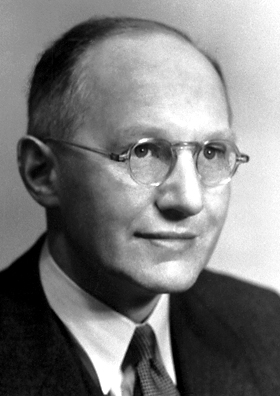
File:Ernest_Walton.jpg · Wikimedia Commons · See Wikimedia Commons
Ernest Walton
Sign in to saveAlso known as Ernest Thomas Sinton Walton
Irish physicist and Nobel laureate (1903-1995)
Ernest Walton was an Irish physicist who won the Nobel Prize for his groundbreaking work in nuclear physics during the early 20th century. His contributions to understanding atomic structure and nuclear reactions helped advance the field of physics and earned him recognition as one of the most important scientists of his era.
AI-generated from the Wikipedia summary — may contain errors.
In the Vinony graph
Vinony catalogs Ernest Walton in its Nobel Prize in Physics collection (230 entries). It also appears in Nobel Laureates.
Within Vinony's link graph, Ernest Walton is referenced by 433 other articles, and connects out to atom, atomic nucleus and Doctor of Philosophy.
Vinony files it under 1903 births, 1995 deaths and 20th-century Anglo-Irish people.
Its subject is documented across 79 Wikipedia language editions.
Nobel Prize
- The Nobel Prize in Physics1951
“for their pioneer work on the transmutation of atomic nuclei by artificially accelerated atomic particles”
Shared · 1/2 portion
Wikidata facts
- Instance of
- human
- Given name
- Ernest
- Family name
- Walton
- Gender
- male
- Citizenship
- Irish Free State
- Place of birth
- Abbeyside
- Place of death
- Dublin
- Occupation
- university teacher
- Employer
- Trinity College, Dublin
- Languages spoken
- English language
- Native language
- English language
- Religion
- Methodism
- Award
- Hughes Medal
- Doctoral advisor
- Ernest Rutherford
- Field of work
- particle physics
- Image
- Ernest Walton.jpg
Show 11 more facts
- on focus list of Wikimedia project
- Wikipedia:Vital articles/Level/4
- Commons category
- Ernest Walton
- date of death
- 1995-06-25
- date of birth
- 1903-10-06
- maintained by WikiProject
- WikiProject Mathematics
- Erdős number
- 7
- nominated for
- Nobel Prize in Physics
- place of burial
- Deans Grange Cemetery
- name in native language
- Ernest Thomas Sinton Walton
- birth name
- Ernest Thomas Sinton Walton
- interested in
- physics
via Wikidata · CC0
~9 min read
Encyclopedic overview
Ernest Thomas Sinton Walton (6 October 1903 – 25 June 1995), commonly abbreviated as E. T. S Walton, was an Irish experimental physicist and academic. He shared the 1951 Nobel Prize in Physics with John Cockcroft "for their pioneer work on the transmutation of atomic nuclei by artificially accelerated atomic particles." According to their Nobel Prize speech: "Thus, for the first time, a nuclear transmutation was produced by means entirely under human control."
Walton was a key member of the nuclear physics faculty at the University of Cambridge, where he worked with Cockcroft and Ernest Rutherford. He then spent the majority of his career in Ireland, after returning from England in 1934. He remained active as a member of the teaching faculty at Trinity College Dublin, where he served as the Erasmus Smith's Professor of Natural and Experimental Philosophy from 1946 until his retirement in 1974, after which he continued to be associated with the physics department at the college. Along with William Rowan Hamilton, Walton is regarded as one of the most influential Irish physicists.
Excerpted from Wikipedia’s “Ernest Walton” article, available under the CC BY-SA 4.0 licence.
Gallery (2)
Available in 79 languages
- Español
- Français
- Deutsch
- 中文
- 日本語
- Русский
- Português
- Italiano
- العربية
- हिन्दी
- Armenian
- Asturian
- azb
- Bahasa Indonesia
- Bangla
- Basque
- Belarusian
- Bulgarian
Show 60 more
- Catalan
- Central Kurdish
- Croatian
- Czech
- Danish
- Egyptian Arabic
- Esperanto
- Estonian
- Finnish
- Galician
- Georgian
- Greek
- Haitian Creole
- Hakka Chinese
- Hebrew
- Hungarian
- Ido
- Irish
- Kannada
- Kazakh
- Kurdish
- Latin
- Latvian
- Macedonian
- Malagasy
- Malay
- Marathi
- Mazanderani
- Mingrelian
- Nederlands
- Newari
- Norwegian
- Norwegian Nynorsk
- Occitan
- Polski
- Punjabi
- Romanian
- Sanskrit
- Scots
- Serbian
- Serbian (Latin)
- simple
- Slovak
- Slovenian
- Svenska
- Swahili
- Tatar
- Tiếng Việt
- Türkçe
- Ukrainian
- Urdu
- Uzbek
- Waray
- Western Panjabi
- Wu Chinese
- Yoruba
- zh_min_nan
- zh_yue
- فارسی
- 한국어
via Wikidata sitelinks · CC0