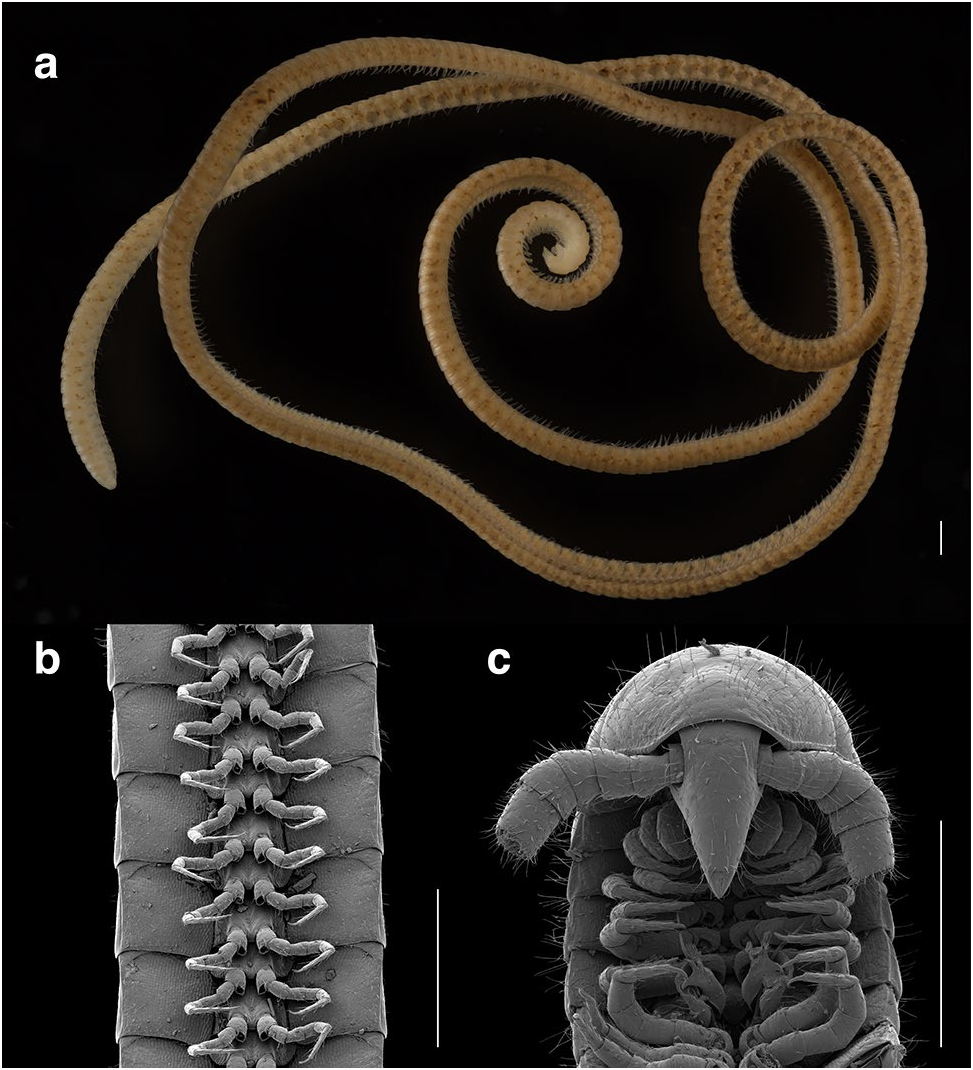
Marek, Paul E.;Buzatto, Bruno A.;Shear, William A.;Means, Jackson C.;Black, Dennis G.;Harvey, Mark S.;Rodriguez, Juanita
Eumillipes
Sign in to saveEumillipes is a genus of millipede in the family Siphonotidae. This genus contains a single species, Eumillipes persephone, known from the Eastern Goldfields of Western Australia. This millipede can have as many as 1,306 legs, which makes this species the animal with the most legs on Earth and the first millipede discovered to have 1,000 legs or more.
Species
GENUS
- KingdomAnimalia
- PhylumArthropoda
- ClassDiplopoda
- OrderPolyzoniida
- FamilySiphonotidae
via GBIF
~4 min read
Encyclopedic overview
5 sectionsContents
- Discovery
- Etymology
- Description
- Conservation
- References
Eumillipes is a genus of millipede in the family Siphonotidae. This genus contains a single species, Eumillipes persephone, known from the Eastern Goldfields of Western Australia. This millipede can have as many as 1,306 legs, which makes this species the animal with the most legs on Earth and the first millipede discovered to have 1,000 legs or more.
==Discovery== This genus and its type species was first described in 2021 by a team led by the American myriapodologist Paul E. Marek of Virginia Tech. The original description of this species is based on specimens discovered in drill holes bored by mining companies searching for minerals in the Great Western Woodlands of Australia. These companies hire environmental consultants to study the impact of mining on wildlife. As one of these consultants, the biologist Bruno A. Buzatto lowered traps baited with damp leaf litter into drill holes and retrieved eight specimens, including a male holotype, three adult paratypes (two female and one male), and three juveniles. These specimens were collected from three drill holes at depths ranging from 15 meters (50 ft) to 60 meters (200 ft). Five specimens were collected from 60 meters underground, including a female paratype with 1,306 legs, discovered in August 2020. The type specimens are deposited in the Western Australian Museum in Perth, Australia. == Etymology == The genus name Eumillipes comes from Ancient Greek εὖ (eû), meaning "true", Latin mīlle, meaning "thousand", and pēs, meaning "foot", and thus, "true thousand feet". As the first millipede discovered with more than 1,000 legs, this millipede lives up to its name. The specific name persephone is a reference to the Greek goddess of the same name, who was the queen of the underworld, alluding to the subterranean lifestyle of this millipede.
Excerpted from Wikipedia’s “Eumillipes” article, available under the CC BY-SA 4.0 licence.