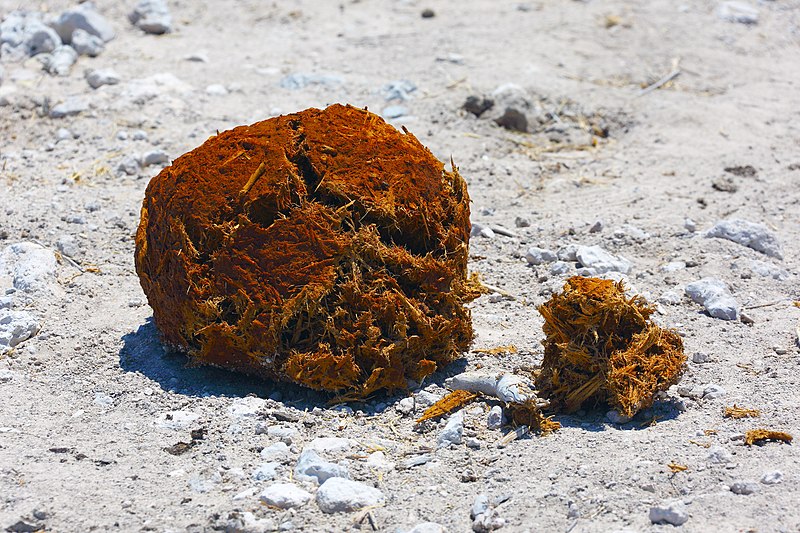
File:Elephant_feces_in_the_wildlife.jpg · Wikimedia Commons · See Wikimedia Commons
ontlasting
Sign in to saveAlso known as faeces, excrement, stool, poo, fecal matter, kak, poop, dung
menselijke en dierlijke vaste uitscheiding
Feces are the solid or semi-solid waste that your body produces after digesting food—they consist mainly of undigested food that was broken down by bacteria in your large intestine, along with small amounts of metabolic waste and dead cells from your gut lining. Understanding feces matters because they represent what your digestive system couldn't use and need to be eliminated from your body.
AI-generated from the Wikipedia summary — may contain errors.
Research
149,375 papers- Faeces transplantation—new wonder medicine?Tidsskrift for den Norske laegeforening : tidsskrift for praktisk medicin, ny raekke · 2014Valeur J, Midtvedt TDOI: 10.4045/tidsskr.14.1261
- The meaning of oral bacteria in faeces.Nature microbiology · 2024DOI: 10.1038/s41564-024-01692-z
- Haemophili in faeces.Journal of medical microbiology · 1981Palmer GGDOI: 10.1099/00222615-14-1-147
- Klebsiella in faeces.Lancet (London, England) · 1970Thom BTDOI: 10.1016/s0140-6736(70)92845-x
- Review of synthetic human faeces and faecal sludge for sanitation and wastewater research.ReviewWater research · 2018Penn R, Ward BJ, Strande L et al.DOI: 10.1016/j.watres.2017.12.063
- Rational protocols for testing faeces in the investigation of sporadic hospital-acquired diarrhoea.ReviewThe Journal of hospital infection · 2001Gopal Rao G, Ozerek AE, Jeanes ADOI: 10.1053/jhin.2000.0845
- DNA typing from human faeces.International journal of legal medicine · 1996Hopwood AJ, Mannucci A, Sullivan KMDOI: 10.1007/BF01369817
- [Have Faeces].Archives des maladies de l'appareil digestif et des maladies de la nutrition · 1945JUDA A
via PubMed
Wikidata facts
- Image
- Łajno końskie 400.jpg
- Has use
- dry animal dung fuel
Show 6 more facts
- different from
- human feces
- Commons category
- Feces
- topic's main category
- Category:Feces
- Commons gallery
- Feces
- Unicode character
- 💩
- studied by
- biology
via Wikidata · CC0
Article · Nederlands
Ontlasting of feces (Latijn: faeces) is het onverteerde restant van ingenomen voedsel, dat, met geregelde tussenpozen (als uitwerpselen), via de endeldarm en de anus (aars) uit het lichaam wordt verwijderd (defecatie). Alle organismen met een maag-darmstelsel produceren ontlasting. Bij zoogdieren zoals de mens bevat de ontlasting naast onverteerbare voedselresten vooral bacteriën (ongeveer de helft van het gewicht), afgeschilferde darmwandcellen (tot 10 gram per dag) en enkele stoffen die door het lichaam in de darm worden afgescheiden, zoals galkleurstoffen: zonder die kleurstoffen zou ontlasting grijswit zijn.
Abstract from DBpedia / Wikipedia · CC BY-SA
Gallery (14)
Available in 111 languages
- Español
- Français
- Deutsch
- 中文
- 日本語
- Русский
- Português
- Italiano
- العربية
- हिन्दी
- Afrikaans
- Albanian
- ami
- Aymara
- Azerbaijani
- Bahasa Indonesia
- Bangla
- Basque
Show 92 more
- bat_smg
- Belarusian
- Bikol
- Bosnian
- Breton
- Bulgarian
- Burmese
- Catalan
- Cebuano
- Central Kurdish
- Chuvash
- Colognian
- Croatian
- Czech
- Danish
- Egyptian Arabic
- eml
- Esperanto
- Estonian
- Filipino
- Finnish
- Galician
- Ganda
- Greek
- Guarani
- Hakka Chinese
- Hausa
- Hebrew
- Hungarian
- Icelandic
- Ido
- Iloko
- Inuktitut
- Irish
- Kannada
- Kyrgyz
- Latin
- Latvian
- Lithuanian
- Lombard
- Luxembourgish
- Macedonian
- Malagasy
- Malay
- Malayalam
- Marathi
- mnw
- Moroccan Arabic
- Nederlands
- Nepali
- Norwegian
- Norwegian Nynorsk
- Occitan
- Polski
- Quechua
- rki
- Romanian
- Scots
- Scottish Gaelic
- Serbian
- Serbian (Latin)
- Shona
- simple
- Sinhala
- Slovak
- Slovenian
- Somali
- Sundanese
- Svenska
- szy
- Tachelhit
- Tamil
- Telugu
- Tiếng Việt
- Toki Pona
- Türkçe
- Turkmen
- Tyap
- Ukrainian
- Urdu
- Walloon
- Welsh
- Western Frisian
- Wu Chinese
- Yiddish
- zh_min_nan
- zh_yue
- Zhuang
- Zulu
- فارسی
- ไทย
- 한국어
via Wikidata sitelinks · CC0