File:Assorted_forks.jpg · Wikimedia Commons · See Wikimedia Commons
Also known as forks
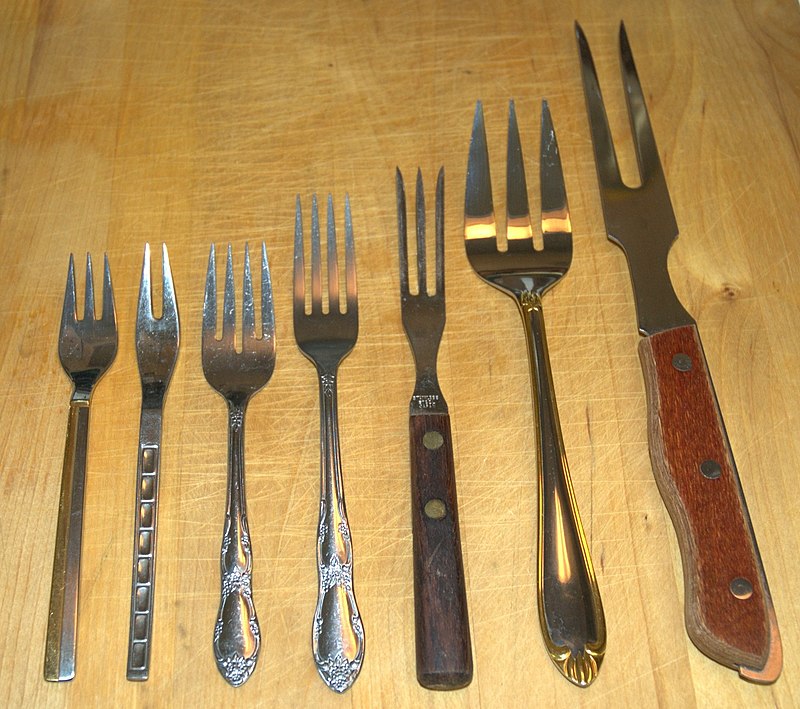
thumb|From left to right: pastry fork, relish fork, [[salad fork, dinner fork, cold cuts fork, serving fork, carving fork]] In cutlery or kitchenware, a fork (from 'pitchfork') is a utensil, now usually made of metal, whose long handle terminates in a head that branches into several narrow and often slightly curved tines with which one can spear foods either to hold them to cut with a knife or to lift them to the mouth.
A fork is a eating utensil with a handle that ends in several narrow, slightly curved prongs called tines, used to spear and hold food while cutting it or to lift it to your mouth. Forks come in various types for different purposes—from dinner forks for everyday meals to specialized forks for specific foods like salad or carving—making them essential tools for eating and food preparation.
AI-generated from the Wikipedia summary — may contain errors.
Wikidata facts
- Image
- Assorted forks.jpg
- Has use
- eating
Show 5 more facts
- Commons category
- Eating forks
- described by source
- Encyclopædia Britannica 11th edition
- on focus list of Wikimedia project
- Wikipedia:Vital articles/Level/4
- Commons gallery
- Eating fork
- topic's main category
- Category:Forks
Sources (3)
via Wikidata · CC0
Article · 中文
在當代,叉子是日常西洋食具,輔助用者將食物帶到口中,亦可在烹飪或切割食物時抓住食物,免得食物移動。叉子一端讓人握著,另一端有二至多條分支,用來插入或盛住食物。一般來說,叉子為金屬製成,在公元四世紀的東羅馬帝國才在西方世界出現。最早的餐叉起源不明,但在青海宗日遺址中,曾出土馬家窯文化骨質餐叉,長度為25.7厘米,有三齒,齒長9厘米。隨後,在甘肅的齊家文化遺址中出土了距今約4000年的骨製餐叉,並未有證據表明在中國出土的古代餐叉與西方當今使用餐叉的發明有直接關聯。之後,在當今河南洛陽就一次性出土了戰國時代的51件骨質餐叉,皆為雙齒圓柄,12厘米左右。
Abstract from DBpedia / Wikipedia · CC BY-SA
Gallery (30)
Available in 103 languages
- Español
- Français
- Deutsch
- 中文
- 日本語
- Русский
- Português
- Italiano
- العربية
- Albanian
- Aragonese
- Armenian
- Asturian
- Atikamekw
- Azerbaijani
- Bahasa Indonesia
- Bangla
- Basque
Show 84 more
- bat_smg
- be_x_old
- Belarusian
- Betawi
- Bikol
- Breton
- Bulgarian
- Burmese
- Catalan
- Central Kurdish
- Croatian
- Czech
- Danish
- Egyptian Arabic
- eml
- Esperanto
- Estonian
- Filipino
- Finnish
- Galician
- Greek
- Haitian Creole
- Hausa
- Hebrew
- Hungarian
- Iban
- Icelandic
- Ido
- Irish
- Javanese
- Kabyle
- Kazakh
- Kurdish
- Latin
- Latvian
- Lingua Franca Nova
- Lithuanian
- Lombard
- Luxembourgish
- Macedonian
- Malagasy
- Malay
- Manx
- nds_nl
- Nederlands
- Northern Frisian
- Norwegian
- Norwegian Nynorsk
- Occitan
- olo
- Pashto
- Polski
- Quechua
- roa_rup
- Romanian
- rsk
- Sardinian
- Serbian
- Serbian (Latin)
- Sicilian
- simple
- Slovak
- Sundanese
- Svenska
- Swahili
- Tamil
- Tibetan
- Tiếng Việt
- Türkçe
- Tuvinian
- Ukrainian
- Uzbek
- Venetian
- Walloon
- Waray
- West Flemish
- Wolof
- Wu Chinese
- Zaza
- zh_min_nan
- zh_yue
- فارسی
- ไทย
- 한국어
via Wikidata sitelinks · CC0