File:Cake_quarters.svg · Wikimedia Commons · See Wikimedia Commons
fraction
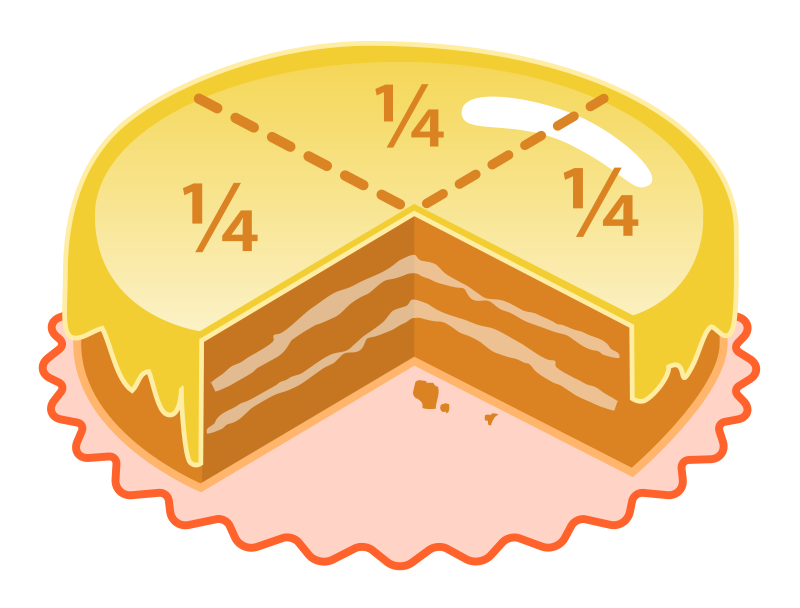
Sign in to savethumb|A cake with one quarter (one fourth) removed. The remaining three fourths are shown by dotted lines and labeled by the .
A fraction represents a part of a whole, like when a cake is divided into equal pieces and you take some of them—for example, three fourths means you have three out of four equal slices. Fractions matter because they help us describe and work with amounts that aren't whole numbers, which comes up constantly in cooking, measurements, money, and many other everyday situations.
AI-generated from the Wikipedia summary — may contain errors.
Wikidata facts
- Subclass of
- mathematical notation
- Has part
- denominator
- Image
- Cake fractions.svg
Show 8 more facts
- Commons category
- Fractions
- topic's main category
- Category:Fractions (mathematics)
- Stack Exchange tag
- math.stackexchange.com/tags/fractions
- TeX string
- \frac{}{}
- different from
- nominative case
- topic has template
- Template:Fraction
- on focus list of Wikimedia project
- Wikipedia:Vital articles/Level/4
- maintained by WikiProject
- WikiProject Mathematics
via Wikidata · CC0
~45 min read
Encyclopedic overview
37 sectionsContents
- Vocabulary
- Forms of fractions
- Simple, common, or vulgar fractions<span class="anchor" id="Simple fraction"></span><span class="anchor" id="Common fraction"></span><span class="anchor" id="Vulgar fraction"></span>
- Proper and improper fractions
- Reciprocals and the invisible denominator
- Ratios
- Decimal fractions and percentages
- Mixed numbers
- Historical notions
- Egyptian fraction
- Complex and compound fractions
- Arithmetic with fractions
- Equivalent fractions
- Simplifying (reducing) fractions <span class="anchor" id="Simplification"></span><span class="anchor" id="Reduction"></span>
- Comparing fractions
- Addition
- Adding unlike quantities
- Subtraction
- Multiplication
- Multiplying a fraction by another fraction
- Multiplying a fraction by a whole number
- Multiplying mixed numbers
- Division
- Converting between fractions and decimal notation
- Converting repeating digits in decimal notation to fractions
- Fractions in abstract mathematics
- Algebraic fractions
- Radical expressions
- Typographical variations
- History
- In formal education
- Primary schools
- Documents for teachers
- See also
- Notes
- References
- External links
thumb|A cake with one quarter (one fourth) removed. The remaining three fourths are shown by dotted lines and labeled by the .
A fraction (from , "broken") represents a part of a whole or, more generally, any number of equal parts. When spoken in everyday English, a fraction describes how many parts of a certain size there are, for example, one-half, eight-fifths, three-quarters. A simple fraction (examples: and ) consists of an integer numerator, displayed above a line (or before a slash like ), and a non-zero integer denominator, displayed below (or after) that line. If these integers are positive, then the numerator represents a number of equal parts, and the denominator indicates how many of those parts make up a unit or a whole. For example, in the fraction , the numerator 3 indicates that the fraction represents 3 equal parts, and the denominator 4 indicates that 4 parts make up a whole. The picture to the right illustrates of a cake.
Excerpted from Wikipedia’s “fraction” article, available under the CC BY-SA 4.0 licence.
Gallery (10)
Available in 105 languages
- Español
- Français
- Deutsch
- 中文
- 日本語
- Русский
- Português
- Italiano
- العربية
- हिन्दी
- Afrikaans
- Albanian
- Armenian
- Assamese
- Asturian
- Aymara
- Azerbaijani
- Bahasa Indonesia
Show 86 more
- Bangla
- Bashkir
- Basque
- be_x_old
- Belarusian
- Bikol
- blk
- Breton
- Bulgarian
- Burmese
- Catalan
- Central Kurdish
- Chuvash
- Croatian
- Czech
- Danish
- Esperanto
- Estonian
- Fijian
- Filipino
- Finnish
- Galician
- Gan Chinese
- Ganda
- gcr
- Greek
- Hebrew
- Hungarian
- Icelandic
- Ido
- Jamaican Creole English
- Javanese
- Kabyle
- Kannada
- Kikuyu
- Kyrgyz
- Latin
- Latvian
- Lingua Franca Nova
- Lithuanian
- Lojban
- Lombard
- Low German
- Macedonian
- Malagasy
- Malay
- Malayalam
- Maltese
- Nederlands
- Newari
- Northern Frisian
- Norwegian
- Norwegian Nynorsk
- Occitan
- Oromo
- Polski
- Quechua
- Romanian
- rsk
- Scottish Gaelic
- Serbian
- Serbian (Latin)
- Shona
- Sicilian
- simple
- Slovak
- Slovenian
- Svenska
- Tamil
- Telugu
- Tiếng Việt
- Türkçe
- Turkmen
- Ukrainian
- Urdu
- Uyghur
- Uzbek
- Waray
- Welsh
- Wu Chinese
- Xhosa
- Yiddish
- zh_yue
- فارسی
- ไทย
- 한국어
via Wikidata sitelinks · CC0