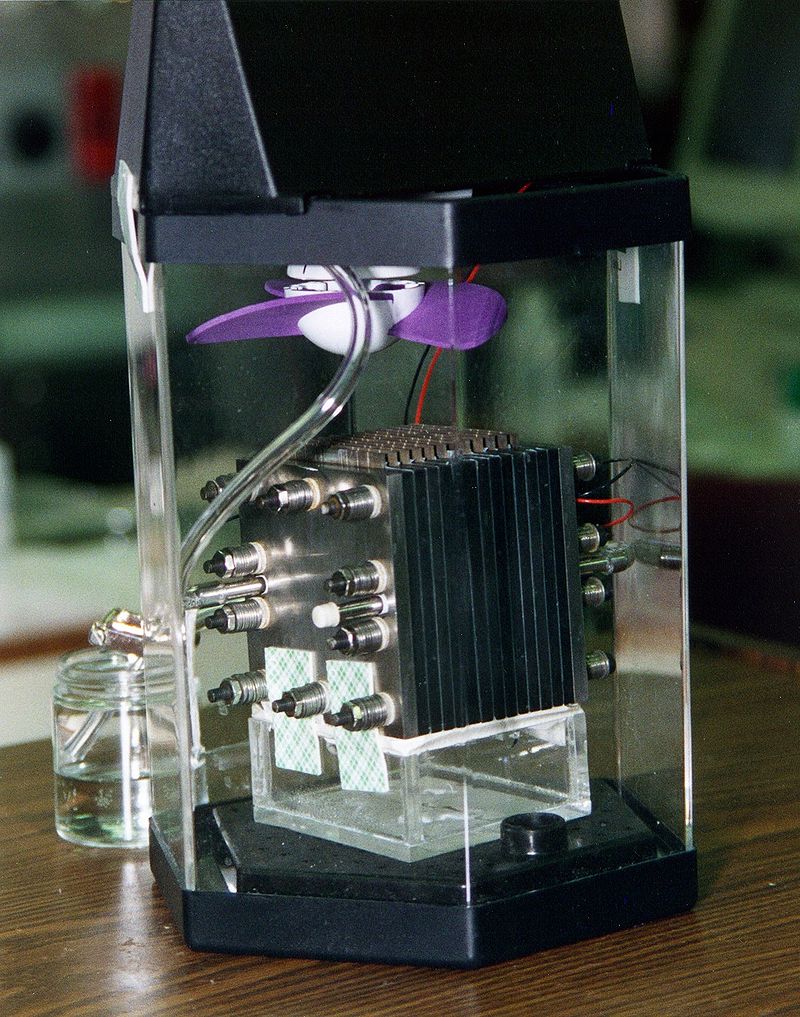
File:Fuel_cell_NASA_p48600ac.jpg · Wikimedia Commons · See Wikimedia Commons
fuel cell
Sign in to saveAlso known as FC
electrochemical cell that converts chemical energy into electricity by oxidizing a fuel
A fuel cell is a device that converts chemical energy directly into electricity through a chemical reaction, typically by combining hydrogen fuel with oxygen. Fuel cells matter because they can generate power cleanly and efficiently for applications like vehicles and power generation, producing only water as a byproduct when hydrogen is used.
AI-generated from the Wikipedia summary — may contain errors.
Wikidata facts
- Subclass of
- galvanic cell
- Image
- Fuel cell NASA p48600ac.jpg
Show 4 more facts
- Commons category
- Fuel cells
- topic's main category
- Category:Fuel cells
- Commons gallery
- Fuel cell
- time of discovery or invention
- 1842-00-00
via Wikidata · CC0
~40 min read
Encyclopedic overview
Demonstration model of a direct methanol fuel cell (black layered cube) in its enclosure Scheme of a proton-conducting fuel cell
A fuel cell is an electrochemical cell that converts the chemical energy of a fuel (often hydrogen) and an oxidizing agent (often oxygen) into electricity through a pair of redox reactions. Fuel cells are different from most batteries in requiring a continuous source of fuel and oxygen (usually from air) to sustain the chemical reaction, whereas in a battery the chemical energy usually comes from substances that are already present in the battery. Fuel cells can produce electricity continuously for as long as fuel and oxygen are supplied.
Excerpted from Wikipedia’s “fuel cell” article, available under the CC BY-SA 4.0 licence.
Gallery (12)
Available in 65 languages
- Español
- Français
- Deutsch
- 中文
- 日本語
- Русский
- Português
- Italiano
- العربية
- हिन्दी
- Afrikaans
- Armenian
- Bahasa Indonesia
- Bangla
- Basque
- Bosnian
- Bulgarian
- Burmese
Show 46 more
- Catalan
- Central Kurdish
- Croatian
- Czech
- Danish
- Esperanto
- Estonian
- Finnish
- Greek
- Haitian Creole
- Hebrew
- Hungarian
- Interlingua
- Irish
- Kannada
- Lingua Franca Nova
- Malayalam
- Mongolian
- Moroccan Arabic
- Nederlands
- Nepali
- Norwegian
- Norwegian Nynorsk
- Occitan
- Polski
- Romanian
- Serbian
- Serbian (Latin)
- simple
- Slovak
- Slovenian
- Svenska
- Tamil
- Telugu
- Tiếng Việt
- Türkçe
- Ukrainian
- Urdu
- Waray
- Welsh
- Wu Chinese
- zh_min_nan
- zh_yue
- فارسی
- ไทย
- 한국어
via Wikidata sitelinks · CC0