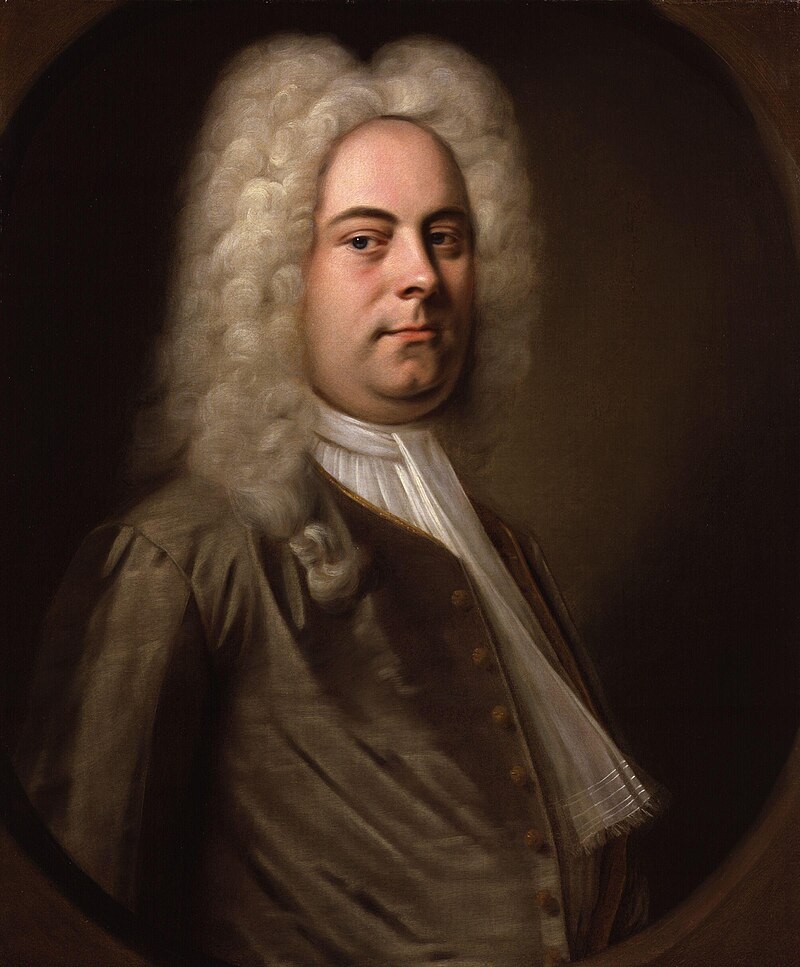
File:George_Frideric_Handel_by_Balthasar_Denner.jpg · Wikimedia Commons · See Wikimedia Commons
George Frideric Handel
Sign in to saveAlso known as Handel, G. F. Händel, Georg Friedrich Händel, George Frideric, Händel, G. F. Handel, George Frederick Handel
German-British Baroque composer (1685–1759)
OverviewAI-generated
George Frideric Handel was a male composer active in the fields of music, opera, composition music, oratorio, and serious music. His professional work period began in 1702. He is associated with the nationalities of GB, DE, IT, ITA, and GBR, and spoke German, English, and other languages.
Handel was born in 1685 and died in 1759. He was buried on 1759-04-20. The catalog of his works includes 36 items. His legacy is documented in 46 sources.
Synthesized by Vinony from 13 facts across 3 sources: Wikidata, VIAF, Europeana Sparql. Generated from structured data (not the Wikipedia text) and checked against those facts — may still contain errors.
Film & TV
Halle an der Saale, Germany
Georg Friedrich Händel was a German, later British, Baroque composer who spent the bulk of his career in London, becoming well known for his operas, oratorios, anthems, concerti grossi and organ concertos. (via Wikipedia)
via TMDB
Authority record · VIAF
- Lifespan
- 1685–1759
- Nationality
- GB, DE, IT, ITA, GBR
- Role / Field
- Compositores, Compositeurs, Composers, Composer, Vijolnieks, Music
- Language
- ger, eng, zxx, deu
- Gender
- Male
Recorded by 46 libraries
via VIAF · OCLC
Wikidata facts
- Instance of
- human
- Gender
- male
- Citizenship
- Holy Roman Empire
- Place of birth
- Halle (Saale)
- Place of death
- Westminster
- Father
- Georg Händel
- Occupation
- university teacher
- Position held
- organist
- Educated at
- Martin Luther University Halle-Wittenberg
- Languages spoken
- Italian
- Native language
- German
- Religion
- Lutheranism
- Notable work
- Concerti grossi, Op. 6
- Student of
- Friedrich Wilhelm Zachow
- Genre
- coronation anthem
- Movement
- Baroque music
- Instrument
- oboe
- Official website
- gfhandel.org
- Image
- George Frideric Handel by Balthasar Denner.jpg
- Residence
- Republic of Venice
Show 19 more facts
- place of burial
- Poets' Corner
- Commons category
- Georg Friedrich Händel
- date of birth
- 1685-03-05
- topic's main category
- Category:George Frideric Handel
- date of death
- 1759-04-14
- Commons Creator page
- Georg Friedrich Händel
- Commons gallery
- Georg Friedrich Händel
- list of works
- list of compositions by George Frideric Handel
- name in native language
- George Frideric Handel
- birth name
- Georg Friedrich Händel
- influenced by
- Domenico Scarlatti
- writing language
- English language
- date of burial or cremation
- 1759-04-20
- start of work period
- 1702-00-00
- P8168
- Dance of the Death
- related category
- Category:Compositions by George Frideric Handel
- medical condition
- epilepsy
- P12749
- Heinrich Ahrens
- catalogue raisonné
- Händel-Werke-Verzeichnis
Sources (7)
via Wikidata · CC0
Works in European collections
36 objects attributed to George Frideric Handel, held across European museums, libraries & archives · via Europeana
Handel's sacred oratorio The Messiah [Música notada]: composed in the year 1741
Where'er you walk [Música notada] :]from Semele/1743
Fragment du 1st. Haendel concert [Noted music]
Andante et Musette du IVe. concerto de Haendel [Música notada]
Fragment du Ve. concerto de Haendel [Música notada]
Musette du VIe. concert [Music noticed]
Air varié du XIIe. concerto [Música notada]
Allegro, Air & Final [Music Noted]
Waft her, angels [Música notada] :]from the oratorio of Jephtha
Where'er you walk : from "Semele"
Air de Suzanne d'après Haendel [Música notada]
Largo du 2me. concerto pour hautbois de Haendel [Música notada]
Arioso de Haendel [Música notada] : Ode à Ste. Cécile avec accompagnement de violin, violoncelle, orgue et piano
Giuda Maccabeo. Choeur de guerriers [Música notada]
Compositions pour piano.. Cah. IV,, Fughettes
Air de Rinaldo [Música notada]
Samson [Música notada] :]an oratorio in score
Judas Macchabaeus [Música notada] :]an oratorio in score as it was originally perform'd
Gloire à Dieu [Música notada] :]choeur triomphal de Judas Machabée
The foudre in main [Music Noted]:] choeur de Samson
Gavotte [Música notada]
Le forgeron [Música notada] : air
God save the Queen [Música notada] :]chant national anglais

Largo/(Handel)

Honor and Arms/(Trade)

The Messiah: Choir: 1st part, “Because it is us a child born” (For unto us a child is born)/(G. F. Händel)

Messiah: Behold the lamb of God/(Trade)

The Messiah: Sinfonia (introduction); 1st part/(G. F. Händel)

Arioso: (Cantata con stromenti) Thank you, Lord/(Handel)

Largo (recitative and aria: Zartes Blätterdach...): from the opera “Xerxes”/Musik: Händel. Text: Reinhard

Psalm 112: 1st part/Handel

Largo: from Xerxes/(trade)

Samson: Total eclipse "No Sun! No Moon! "/ Trade

All Thale: aria from the oratorio “Der Messias”/(G. F. Händel)

“Cantata con stromenti”: Arioso (thank you, Lord)/(Handel)

The Messiah: Choir: 1st part, “Because it is us a child born” (For unto us a child is born)/(G. F. Händel)
~40 min read
Encyclopedic overview
George Frideric (or Frederick) Handel (/ˈhændəl/ HAN-dəl; baptised Georg Fried[e]rich Händel, German: [ˈɡeːɔʁk ˈfʁiːdʁɪç ˈhɛndl̩] ; 5 March [O.S. 23 February] 1685 – 14 April 1759) was a German-British Baroque composer well-known for his operas, oratorios, anthems, concerti grossi, and organ concerti.
Born in Halle, Handel spent his early life in Hamburg and Italy before settling in London in 1712, where he spent the bulk of his career and became a naturalised British subject in 1727. He was strongly influenced both by the middle-German polyphonic choral tradition and by composers of the Italian Baroque. In turn, Handel's music forms one of the peaks of the "high baroque" style, bringing Italian opera to its highest development, creating the genres of English oratorio and organ concerto, and introducing a new style into English church music. He is consistently recognised as one of the greatest composers of his age.
Excerpted from Wikipedia’s “George Frideric Handel” article, available under the CC BY-SA 4.0 licence.
Gallery (13)
Available in 138 languages
- Español
- Français
- Deutsch
- 中文
- 日本語
- Русский
- Português
- Italiano
- العربية
- Afrikaans
- Albanian
- Albanian
- Amharic
- Aragonese
- Armenian
- Assamese
- Asturian
- Aymara
Show 119 more
- azb
- Azerbaijani
- Bahasa Indonesia
- Bangla
- Bashkir
- Basque
- bat_smg
- Bavarian
- be_x_old
- Belarusian
- Bislama
- Bosnian
- Breton
- btm
- Bulgarian
- Buriat
- Burmese
- Catalan
- cdo
- Central Kurdish
- Chechen
- Cornish
- Croatian
- Czech
- Danish
- Egyptian Arabic
- Esperanto
- Estonian
- Faroese
- Fiji Hindi
- Finnish
- Galician
- Georgian
- Greek
- Guarani
- Hakka Chinese
- Hebrew
- Hungarian
- Icelandic
- Ido
- Iloko
- Interlingua
- Interlingue
- Irish
- Jju
- Kabardian
- Kanuri
- Kara-Kalpak
- Kazakh
- kbp
- Kyrgyz
- Latin
- Latvian
- Ligurian
- Limburgish
- Lithuanian
- Lombard
- Low German
- Luxembourgish
- Macedonian
- Madurese
- Malagasy
- Malay
- Malayalam
- Manx
- Marathi
- Mingrelian
- Mongolian
- nds_nl
- Nederlands
- Norwegian
- Norwegian Nynorsk
- Obolo
- Occitan
- Pampanga
- Picard
- Piedmontese
- Polski
- Punjabi
- Quechua
- Romanian
- Rusyn
- Sardinian
- Saterland Frisian
- Scots
- Scottish Gaelic
- Serbian
- Serbian (Latin)
- Sicilian
- simple
- Sindhi
- Slovak
- Slovenian
- Svenska
- Swahili
- Tajik
- Tamil
- Tatar
- Tiếng Việt
- Türkçe
- Ukrainian
- Urdu
- Uzbek
- Venetian
- Veps
- Volapük
- Waray
- Welsh
- Western Frisian
- Western Panjabi
- Wu Chinese
- Yakut
- Yiddish
- zh_classical
- zh_min_nan
- zh_yue
- فارسی
- ไทย
- 한국어
via Wikidata sitelinks · CC0