File:6n-graf.svg · Wikimedia Commons · See Wikimedia Commons
graph
Sign in to saveAlso known as network, graphs, graph (graph theory), graph (network), points and lines, simple undirected graph, undirected simple graph, 2-hypergraph
mathematical structure made of vertices connected in pairs by edges
A graph is a mathematical structure that consists of points (called vertices) connected to each other by lines (called edges). Graphs are useful for representing and analyzing relationships between things, such as social connections, computer networks, or transportation routes.
AI-generated from the Wikipedia summary — may contain errors.
Wikidata facts
- Has part
- node
- Image
- Graph example (Graph theory).png
- Said to be same as
- mixed graph
Show 10 more facts
- Stack Exchange tag
- or.stackexchange.com/tags/graphs
- has characteristic
- graph property
- Commons category
- Graph (discrete mathematics)
- facet of
- discrete mathematics
- topic's main category
- Category:Graphs
- different from
- chart
- studied by
- graph theory
- topic has template
- Template:Infobox graph
- on focus list of Wikimedia project
- Wikipedia:Vital articles/Level/4
- maintained by WikiProject
- WikiProject Mathematics
Sources (2)
via Wikidata · CC0
~20 min read
Encyclopedic overview
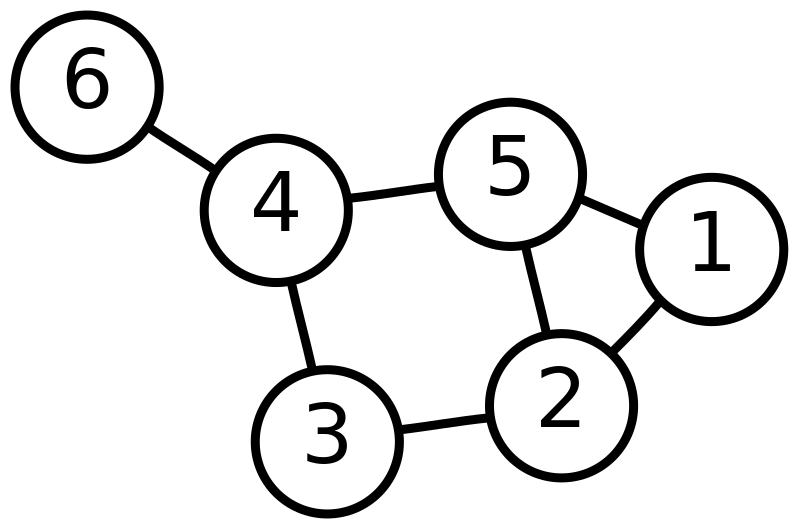
A graph with six vertices and seven edges
In discrete mathematics, particularly in graph theory, a graph is a structure consisting of a set of objects where some pairs of the objects are in some sense "related". The objects are represented by abstractions called vertices (also called nodes or points) and each of the related pairs of vertices is called an edge (also called link or line). Typically, a graph is depicted in diagrammatic form as a set of dots or circles for the vertices, joined by lines or curves for the edges.
Excerpted from Wikipedia’s “graph” article, available under the CC BY-SA 4.0 licence.
Gallery (6)
Available in 67 languages
- Español
- Français
- Deutsch
- 中文
- 日本語
- Русский
- Português
- Italiano
- العربية
- Albanian
- Armenian
- Asturian
- Azerbaijani
- Bahasa Indonesia
- Bangla
- Bashkir
- Basque
- Belarusian
Show 48 more
- Bulgarian
- Catalan
- Central Kurdish
- Chuvash
- Croatian
- Czech
- Danish
- Esperanto
- Estonian
- Filipino
- Finnish
- Galician
- Greek
- Hebrew
- Hungarian
- Icelandic
- Ido
- Kazakh
- Latvian
- Lithuanian
- Lombard
- Macedonian
- Malayalam
- Marathi
- Nederlands
- Norwegian Nynorsk
- Piedmontese
- Polski
- Romanian
- Serbian
- Serbian (Latin)
- simple
- Slovak
- Slovenian
- Svenska
- Tamil
- Tiếng Việt
- Türkçe
- Ukrainian
- Urdu
- Welsh
- Wu Chinese
- Yiddish
- zh_min_nan
- zh_yue
- فارسی
- ไทย
- 한국어
via Wikidata sitelinks · CC0