File:6n-graf.svg · Wikimedia Commons · See Wikimedia Commons
Graph
Sign in to saveAlso known as network, graphs, graph (graph theory), graph (network), points and lines, simple undirected graph, undirected simple graph, 2-hypergraph
mathematisches Objekt, das aus durch Kanten verbundenen Knoten besteht
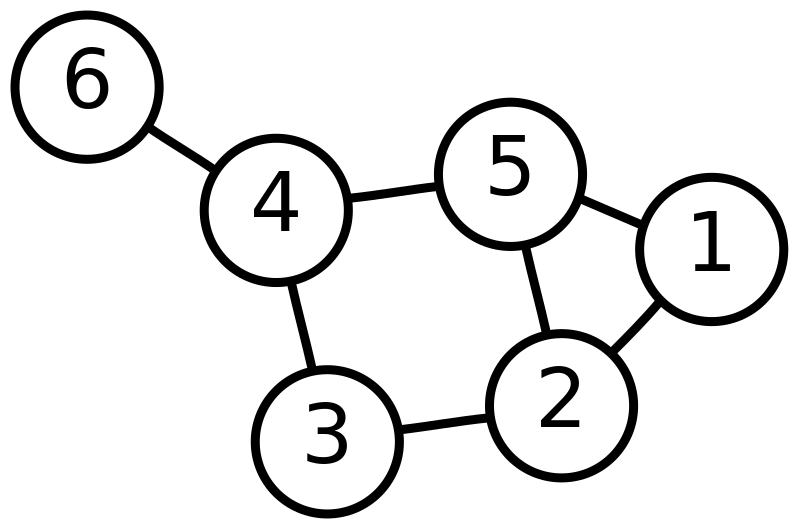
A graph is a mathematical structure that consists of points (called vertices) connected to each other by lines (called edges). Graphs are useful for representing and analyzing relationships between things, such as social connections, computer networks, or transportation routes.
AI-generated from the Wikipedia summary — may contain errors.
Wikidata facts
- Has part
- node
- Image
- Graph example (Graph theory).png
- Said to be same as
- mixed graph
Show 10 more facts
- Stack Exchange tag
- or.stackexchange.com/tags/graphs
- has characteristic
- graph property
- Commons category
- Graph (discrete mathematics)
- facet of
- discrete mathematics
- topic's main category
- Category:Graphs
- different from
- chart
- studied by
- graph theory
- topic has template
- Template:Infobox graph
- on focus list of Wikimedia project
- Wikipedia:Vital articles/Level/4
- maintained by WikiProject
- WikiProject Mathematics
Sources (2)
via Wikidata · CC0
Article · Deutsch
Ein Graph ist in der Graphentheorie eine abstrakte Struktur, die eine Menge von Objekten zusammen mit den zwischen diesen Objekten bestehenden Verbindungen repräsentiert. Die mathematischen Abstraktionen der Objekte werden dabei Knoten (auch Ecken) des Graphen genannt. Die paarweisen Verbindungen zwischen Knoten heißen Kanten (manchmal auch Bögen). Die Kanten können gerichtet oder ungerichtet sein. Häufig werden Graphen anschaulich gezeichnet, indem die Knoten durch Punkte und die Kanten durch Linien dargestellt werden. Anschauliche Beispiele für Graphen sind ein Stammbaum oder das U-Bahn-Netz einer Stadt (siehe Abbildungen). Bei einem Stammbaum stellt jeder Knoten ein Familienmitglied dar und jede Kante ist eine Verbindung zwischen einem Elternteil und einem Kind. In einem U-Bahn-Netz stellt jeder Knoten eine U-Bahn-Station dar und jede Kante eine direkte Zugverbindung zwischen zwei Stationen.
Abstract from DBpedia / Wikipedia · CC BY-SA
Gallery (6)
Available in 67 languages
- Español
- Français
- Deutsch
- 中文
- 日本語
- Русский
- Português
- Italiano
- العربية
- Albanian
- Armenian
- Asturian
- Azerbaijani
- Bahasa Indonesia
- Bangla
- Bashkir
- Basque
- Belarusian
Show 48 more
- Bulgarian
- Catalan
- Central Kurdish
- Chuvash
- Croatian
- Czech
- Danish
- Esperanto
- Estonian
- Filipino
- Finnish
- Galician
- Greek
- Hebrew
- Hungarian
- Icelandic
- Ido
- Kazakh
- Latvian
- Lithuanian
- Lombard
- Macedonian
- Malayalam
- Marathi
- Nederlands
- Norwegian Nynorsk
- Piedmontese
- Polski
- Romanian
- Serbian
- Serbian (Latin)
- simple
- Slovak
- Slovenian
- Svenska
- Tamil
- Tiếng Việt
- Türkçe
- Ukrainian
- Urdu
- Welsh
- Wu Chinese
- Yiddish
- zh_min_nan
- zh_yue
- فارسی
- ไทย
- 한국어
via Wikidata sitelinks · CC0