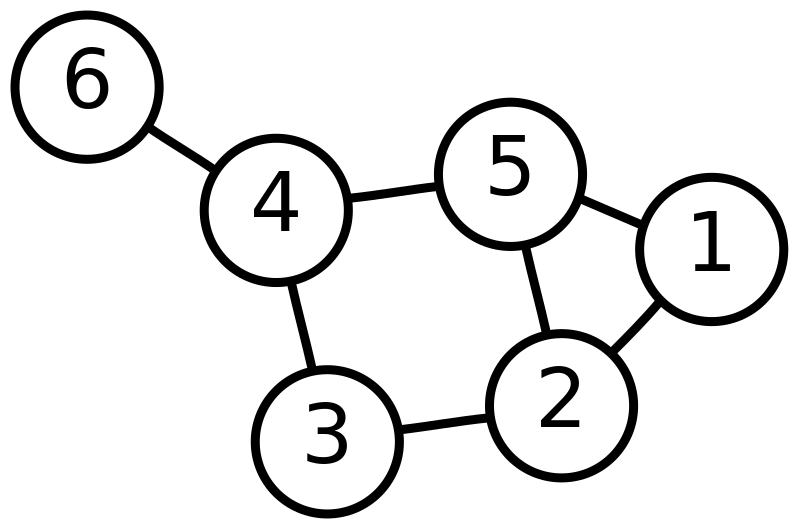
File:6n-graf.svg · Wikimedia Commons · See Wikimedia Commons
Also known as network, graphs, graph (graph theory), graph (network), points and lines, simple undirected graph, undirected simple graph, 2-hypergraph
由点和边组成的数学结构
A graph is a mathematical structure that consists of points (called vertices) connected to each other by lines (called edges). Graphs are useful for representing and analyzing relationships between things, such as social connections, computer networks, or transportation routes.
AI-generated from the Wikipedia summary — may contain errors.
Wikidata facts
- Has part
- node
- Image
- Graph example (Graph theory).png
- Said to be same as
- mixed graph
Show 10 more facts
- Stack Exchange tag
- or.stackexchange.com/tags/graphs
- has characteristic
- graph property
- Commons category
- Graph (discrete mathematics)
- facet of
- discrete mathematics
- topic's main category
- Category:Graphs
- different from
- chart
- studied by
- graph theory
- topic has template
- Template:Infobox graph
- on focus list of Wikimedia project
- Wikipedia:Vital articles/Level/4
- maintained by WikiProject
- WikiProject Mathematics
Sources (2)
via Wikidata · CC0
Article · 中文
在离散数学中,图(Graph)是用于表示物体与物体之间存在某种关系的结构。数学抽象后的“物体”称作节点或顶点(英語:Vertex,node或point),节点间的相关关系则称作边。在描绘一张图的时候,通常用一组点或小圆圈表示节点,其间的边则使用直线或曲线。 图中的边可以是有方向或没有方向的。例如在一张图中,如果节点表示聚会上的人,而边表示两人曾经握手,则该图就是没有方向的,因为甲和乙握过手也意味着乙一定和甲握过手。相反,如果一条从甲到乙的边表示甲欠乙的钱,则该图就是有方向的,因为“曾经欠钱”这个关系不一定是双向的。前一种图称为无向图,后一种称为有向图。 图是图论中的基本概念。1878年,詹姆斯·西尔维斯特首次使用“图”这一名词:他用图来表示数学和化学分子结构之间的关系(他称为“化学图”,英語:chemico-graphical image)。
Abstract from DBpedia / Wikipedia · CC BY-SA
Gallery (6)
Available in 67 languages
- Español
- Français
- Deutsch
- 中文
- 日本語
- Русский
- Português
- Italiano
- العربية
- Albanian
- Armenian
- Asturian
- Azerbaijani
- Bahasa Indonesia
- Bangla
- Bashkir
- Basque
- Belarusian
Show 48 more
- Bulgarian
- Catalan
- Central Kurdish
- Chuvash
- Croatian
- Czech
- Danish
- Esperanto
- Estonian
- Filipino
- Finnish
- Galician
- Greek
- Hebrew
- Hungarian
- Icelandic
- Ido
- Kazakh
- Latvian
- Lithuanian
- Lombard
- Macedonian
- Malayalam
- Marathi
- Nederlands
- Norwegian Nynorsk
- Piedmontese
- Polski
- Romanian
- Serbian
- Serbian (Latin)
- simple
- Slovak
- Slovenian
- Svenska
- Tamil
- Tiếng Việt
- Türkçe
- Ukrainian
- Urdu
- Welsh
- Wu Chinese
- Yiddish
- zh_min_nan
- zh_yue
- فارسی
- ไทย
- 한국어
via Wikidata sitelinks · CC0