File:6n-graf.svg · Wikimedia Commons · See Wikimedia Commons
grafo
Sign in to saveAlso known as network, graphs, graph (graph theory), graph (network), points and lines, simple undirected graph, undirected simple graph, 2-hypergraph
concepto en matemáticas y ciencias de la computación
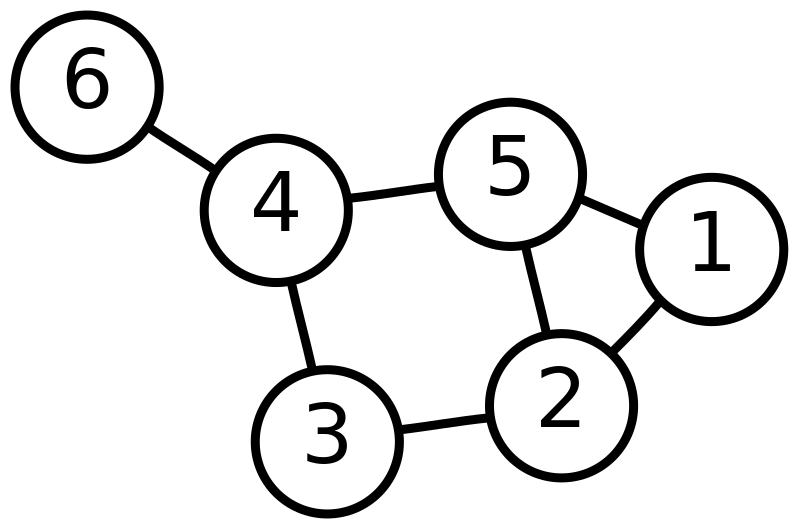
A graph is a mathematical structure that consists of points (called vertices) connected to each other by lines (called edges). Graphs are useful for representing and analyzing relationships between things, such as social connections, computer networks, or transportation routes.
AI-generated from the Wikipedia summary — may contain errors.
Wikidata facts
- Has part
- node
- Image
- Graph example (Graph theory).png
- Said to be same as
- mixed graph
Show 10 more facts
- Stack Exchange tag
- or.stackexchange.com/tags/graphs
- has characteristic
- graph property
- Commons category
- Graph (discrete mathematics)
- facet of
- discrete mathematics
- topic's main category
- Category:Graphs
- different from
- chart
- studied by
- graph theory
- topic has template
- Template:Infobox graph
- on focus list of Wikimedia project
- Wikipedia:Vital articles/Level/4
- maintained by WikiProject
- WikiProject Mathematics
Sources (2)
via Wikidata · CC0
Article · Español
En matemáticas y ciencias de la computación, un grafo (del griego grafos: dibujo, imagen) es un conjunto de objetos llamados vértices o nodos unidos por enlaces llamados aristas o arcos, que permiten representar relaciones binarias entre elementos de un conjunto.Son objeto de estudio de la teoría de grafos. Típicamente, un grafo se representa gráficamente como un conjunto de puntos (vértices o nodos) unidos por líneas (aristas o arcos). Desde un punto de vista práctico, los grafos permiten estudiar las interrelaciones entre unidades que interactúan unas con otras. Por ejemplo, una red de computadoras puede representarse y estudiarse mediante un grafo, en el cual los vértices representan terminales y las aristas representan conexiones (las cuales, a su vez, pueden ser cables o conexiones inalámbricas). Prácticamente cualquier problema puede representarse mediante un grafo, y su estudio trasciende a las diversas áreas de las ciencias exactas y las ciencias sociales.
Abstract from DBpedia / Wikipedia · CC BY-SA
Gallery (6)
Available in 67 languages
- Español
- Français
- Deutsch
- 中文
- 日本語
- Русский
- Português
- Italiano
- العربية
- Albanian
- Armenian
- Asturian
- Azerbaijani
- Bahasa Indonesia
- Bangla
- Bashkir
- Basque
- Belarusian
Show 48 more
- Bulgarian
- Catalan
- Central Kurdish
- Chuvash
- Croatian
- Czech
- Danish
- Esperanto
- Estonian
- Filipino
- Finnish
- Galician
- Greek
- Hebrew
- Hungarian
- Icelandic
- Ido
- Kazakh
- Latvian
- Lithuanian
- Lombard
- Macedonian
- Malayalam
- Marathi
- Nederlands
- Norwegian Nynorsk
- Piedmontese
- Polski
- Romanian
- Serbian
- Serbian (Latin)
- simple
- Slovak
- Slovenian
- Svenska
- Tamil
- Tiếng Việt
- Türkçe
- Ukrainian
- Urdu
- Welsh
- Wu Chinese
- Yiddish
- zh_min_nan
- zh_yue
- فارسی
- ไทย
- 한국어
via Wikidata sitelinks · CC0