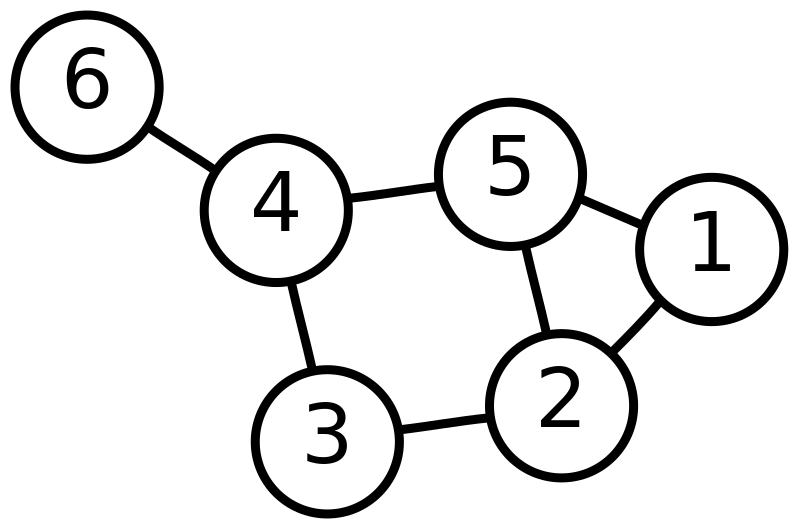
File:6n-graf.svg · Wikimedia Commons · See Wikimedia Commons
Also known as network, graphs, graph (graph theory), graph (network), points and lines, simple undirected graph, undirected simple graph, 2-hypergraph
離散数学
A graph is a mathematical structure that consists of points (called vertices) connected to each other by lines (called edges). Graphs are useful for representing and analyzing relationships between things, such as social connections, computer networks, or transportation routes.
AI-generated from the Wikipedia summary — may contain errors.
Wikidata facts
- Has part
- node
- Image
- Graph example (Graph theory).png
- Said to be same as
- mixed graph
Show 10 more facts
- Stack Exchange tag
- or.stackexchange.com/tags/graphs
- has characteristic
- graph property
- Commons category
- Graph (discrete mathematics)
- facet of
- discrete mathematics
- topic's main category
- Category:Graphs
- different from
- chart
- studied by
- graph theory
- topic has template
- Template:Infobox graph
- on focus list of Wikimedia project
- Wikipedia:Vital articles/Level/4
- maintained by WikiProject
- WikiProject Mathematics
Sources (2)
via Wikidata · CC0
Article · 日本語
数学のグラフ理論におけるグラフ(英: graph)とは数学的構造の一つ。対象の集合で、対象の一部が相互に何らかの脈絡で「関係している」ようなものをいう。ここで対象とは頂点(節点やノードとも)と呼ばれる抽象物であり、互いに関係のある頂点の対は辺(枝やエッジとも)と呼ばれる。一般的に、グラフは点または丸で表した頂点の集合に直線または曲線で辺を描き加えたダイアグラムで表現される。グラフは離散数学の研究対象の一つである。 辺には無向と有向の場合がある。例えば頂点をパーティ参加者として、2人が握手するとその間に辺が結ばれるとする場合、握手はお互い対等で行うものなので無向な辺といえる。対照的に、お金の貸し借り関係を辺とした場合、どちらか一方にのみ返済義務があるので有向な辺といえる。前者をグラフにしたものは無向グラフ (undirected graph) と呼ばれ、後者のグラフは有向グラフ (directed graph) と呼ばれる。 グラフはグラフ理論における基本的な研究対象である。「グラフ」という言葉は、1878年にジェームズ・ジョセフ・シルベスターによってこの意味で最初に使用された。
Abstract from DBpedia / Wikipedia · CC BY-SA
Gallery (6)
Available in 67 languages
- Español
- Français
- Deutsch
- 中文
- 日本語
- Русский
- Português
- Italiano
- العربية
- Albanian
- Armenian
- Asturian
- Azerbaijani
- Bahasa Indonesia
- Bangla
- Bashkir
- Basque
- Belarusian
Show 48 more
- Bulgarian
- Catalan
- Central Kurdish
- Chuvash
- Croatian
- Czech
- Danish
- Esperanto
- Estonian
- Filipino
- Finnish
- Galician
- Greek
- Hebrew
- Hungarian
- Icelandic
- Ido
- Kazakh
- Latvian
- Lithuanian
- Lombard
- Macedonian
- Malayalam
- Marathi
- Nederlands
- Norwegian Nynorsk
- Piedmontese
- Polski
- Romanian
- Serbian
- Serbian (Latin)
- simple
- Slovak
- Slovenian
- Svenska
- Tamil
- Tiếng Việt
- Türkçe
- Ukrainian
- Urdu
- Welsh
- Wu Chinese
- Yiddish
- zh_min_nan
- zh_yue
- فارسی
- ไทย
- 한국어
via Wikidata sitelinks · CC0