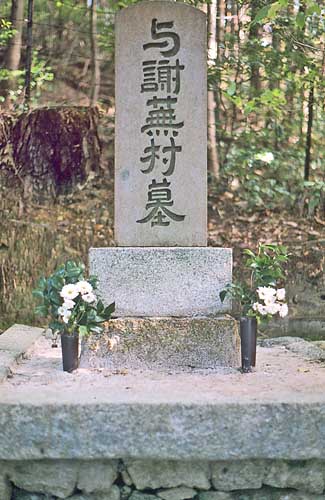
File:YosaBusonGrave.jpg · Wikimedia Commons · See Wikimedia Commons
haiku
Sign in to savethumb|right|250px|Haiku by Matsuo Bashō reading "Quietly, quietly, / yellow mountain roses fall – / sound of the rapids" is a type of short form poetry that originated in Japan. Traditional Japanese haiku consist of three phrases composed of 17 morae (called on in Japanese) in a 5, 7, 5 pattern; that include a kireji, or "cutting word"; and a kigo, or seasonal reference. However, haiku by classical Japanese poets, such as Matsuo Bashō, also deviate from the 17-on pattern and sometimes do not contain a kireji. Similar poems that do not adhere to these rules are generally classified as senryū.
Haiku is a short form of poetry that originated in Japan, traditionally consisting of three phrases with 17 syllables arranged in a 5-7-5 pattern, often including a seasonal reference and a "cutting word" that creates a pause or shift in meaning. While classical Japanese poets like Matsuo Bashō sometimes departed from these strict rules, haiku remains a distinctive and influential poetic form that captures moments of observation and reflection in minimal language.
AI-generated from the Wikipedia summary — may contain errors.
Wikidata facts
Show 6 more facts
- Commons category
- Haiku (poetry)
- topic's main category
- Category:Haiku
- different from
- Haiku
- on focus list of Wikimedia project
- Wikipedia:Vital articles/Level/4
- native label
- 俳句
- significant person
- Masaoka Shiki
via Wikidata · CC0
~25 min read
Encyclopedic overview
32 sectionsContents
- Traditional elements
- ''Kiru'' and ''kireji''
- ''On''
- ''Kigo''
- Examples
- Origin and development
- From hokku to haiku
- Bashō
- Buson
- Issa
- Shiki
- Exposure to the West
- Blyth
- Shimoi
- Yasuda
- Henderson
- Haiku in other languages
- English-language haiku
- Italian-language haiku
- Spanish-language haiku
- Southeastern Europe
- Related forms
- Haibun
- Haiga
- Kuhi
- Famous writers
- Pre-Shiki period
- Shiki and later
- See also
- Notes
- References
- External links
thumb|right|250px|Haiku by Matsuo Bashō reading "Quietly, quietly, / yellow mountain roses fall – / sound of the rapids" is a type of short form poetry that originated in Japan. Traditional Japanese haiku consist of three phrases composed of 17 morae (called on in Japanese) in a 5, 7, 5 pattern; that include a kireji, or "cutting word"; and a kigo, or seasonal reference. However, haiku by classical Japanese poets, such as Matsuo Bashō, also deviate from the 17-on pattern and sometimes do not contain a kireji. Similar poems that do not adhere to these rules are generally classified as senryū.
Haiku originated as an opening part of a larger Japanese genre of poetry called renga. These haiku written as an opening stanza were known as hokku and over time they began to be written as stand-alone poems. Haiku was given its current name by the Japanese writer Masaoka Shiki at the end of the 19th century.
Excerpted from Wikipedia’s “haiku” article, available under the CC BY-SA 4.0 licence.
Gallery (6)
Available in 113 languages
- Español
- Français
- Deutsch
- 中文
- 日本語
- Русский
- Português
- Italiano
- العربية
- हिन्दी
- Afrikaans
- Albanian
- Albanian
- Armenian
- Assamese
- Asturian
- Awadhi
- Azerbaijani
Show 94 more
- Bahasa Indonesia
- Bangla
- Bashkir
- Basque
- Bavarian
- be_x_old
- Belarusian
- Bislama
- Breton
- Bulgarian
- Burmese
- Catalan
- cbk_zam
- Central Kurdish
- Church Slavic
- Croatian
- Czech
- Danish
- Esperanto
- Estonian
- Filipino
- Finnish
- fiu_vro
- Galician
- Gan Chinese
- Georgian
- Greek
- Guarani
- Gujarati
- Hebrew
- Hungarian
- Icelandic
- Ido
- Interlingua
- Interlingue
- Irish
- Jamaican Creole English
- Kurdish
- Kyrgyz
- Latin
- Latvian
- Limburgish
- Lingala
- Lingua Franca Nova
- Lithuanian
- Luxembourgish
- Macedonian
- Malay
- Malayalam
- Mongolian
- nds_nl
- Nederlands
- Nepali
- Norwegian
- Norwegian Nynorsk
- nrm
- Odia
- Pampanga
- Papiamento
- Pashto
- Picard
- Piedmontese
- Polski
- Punjabi
- Romanian
- Scots
- Serbian
- Serbian (Latin)
- simple
- Sindhi
- Slovak
- Slovenian
- Sundanese
- Svenska
- Swahili
- Tajik
- Tamil
- Tatar
- Telugu
- Tibetan
- Tiếng Việt
- Türkçe
- Ukrainian
- Urdu
- Walloon
- Welsh
- Western Frisian
- Western Panjabi
- Wu Chinese
- zh_classical
- zh_yue
- فارسی
- ไทย
- 한국어
via Wikidata sitelinks · CC0