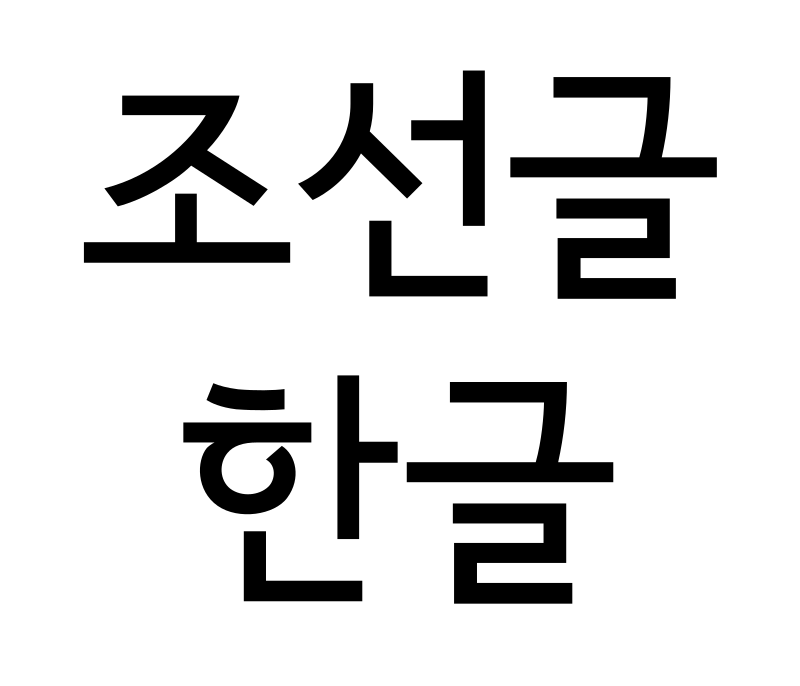
File:Hangul_chosongul_fontembed.svg · Wikimedia Commons · See Wikimedia Commons
Hangul
Sign in to saveAlso known as Chosongul, Hangeul, Chosŏn'gŭl, Hangŭl, Hang, Hunminjeong'eum
The Korean alphabet is the modern writing system for the Korean language. It has gone by a variety of names, such as ' in North Korea, Hangul internationally, and ' in South Korea. The script's original name was ''''''.
Hangul is the modern alphabet used to write the Korean language, and it's known by different names in different regions—called Hangul internationally and in South Korea, while North Korea uses an alternative name. The script has become the standard writing system for Korean speakers worldwide.
AI-generated from the Wikipedia summary — may contain errors.
Key facts
- Writing system.name
- Korean alphabet
- Writing system.type
- Alphabet
- Writing system.sample
- Hangul chosongul fontembed.svg
- Writing system.caption
- Hangul text. Top is the North Korean name, , and bottom is the international and South Korean name, or
- Writing system.time
- 1443 or 1444 to present
- Writing system.iso15924
- Hang
- Writing system.iso15924 note
- (for the jamo subset)
- Writing system.direction
- Left-to-right Top-to-bottom, columns right-to-left
- Korean name/auto.child
- yes
- Korean name/auto.title
- North Korean name
- Korean name/auto.hangul
- ^조선글
- Korean name/auto.hanja
- 朝鮮글
- Korean name/auto.othername1
- South Korean name
- Korean name/auto.hangul1
- ^한글
via Wikipedia infobox
Wikidata facts
- Instance of
- unicase alphabet
- Has part
- ㅋ
- Country of origin
- Korea
- Creator
- Sejong the Great
- Image
- Hangul chosongul fontembed.svg
- Has use
- Jejuan
Show 9 more facts
- inception
- 1443-00-00
- Commons category
- Hangul
- topic's main category
- Category:Hangul
- on focus list of Wikimedia project
- Wikipedia:Vital articles/Level/4
- language of work or name
- Jejuan
- described at URL
- cheonilguk.ru/Koreyskiy-yazyk-hangeul
- Unicode range
- U+D7B0-D7FF
- name
- hangeul
- native label
- 반절
Sources (7)
via Wikidata · CC0
~45 min read
Encyclopedic overview
51 sectionsContents
- Names
- Classifications
- Featural script
- History
- Background
- Origin
- Spread
- Enlightenment and Korean Empire periods
- Colonial period
- Liberation and division
- Distribution outside Korea
- Letters
- Letter counts
- Consonant letters
- Vowel letters
- Letter names
- Design
- Alphabetic order
- North Korean order
- South Korean order
- Obsolete letters
- Orthography
- Syllable blocks
- Spelling
- North–South differences
- Punctuation
- South Korean punctuation
- North Korean punctuation
- Writing direction
- Style
- Stroke order
- Hangul and computers
- Encoding methods
- Hangul keyboards
- Derivatives and uses for other languages
- Use for Jeju
- Uses for non-Koreanic languages
- Cia-Cia language
- Chitembo language
- Evaluations and legacy
- Notes
- References
- Sources
- In English
- Books
- Academic articles
- In Korean
- Books
- Academic articles
- Primary sources
- External links
The Korean alphabet is the modern writing system for the Korean language. It has gone by a variety of names, such as ' in North Korea, Hangul internationally, and ' in South Korea. The script's original name was ''''''.
Before Hangul's creation, Korea had been using Hanja (Chinese characters) since antiquity. As Hanja was poorly suited for representing the Korean language, and because its difficulty contributed to high illiteracy, Joseon king Sejong the Great () moved to create Hangul. The script was announced around late 1443 to early 1444 and officially published in 1446 via the text Hunminjeongeum and its companion commentary Hunminjeongeum Haerye. While Hangul saw gradual adoption among both the elite and commoners, it was looked down upon by the elite for centuries. It only began to receive societal acceptance in the late 19th century. It is now the predominant script for Korean in both Koreas and among the Korean diaspora. It is also used to write the Jeju language, and to a limited degree, the Cia-Cia language of Indonesia.
Excerpted from Wikipedia’s “Hangul” article, available under the CC BY-SA 4.0 licence.
Gallery (21)
Available in 138 languages
- Español
- Français
- Deutsch
- 中文
- 日本語
- Русский
- Português
- Italiano
- العربية
- हिन्दी
- abstract
- Afrikaans
- Albanian
- Albanian
- Amharic
- Aragonese
- Armenian
- Assamese
Show 119 more
- Asturian
- azb
- Azerbaijani
- Bahasa Indonesia
- Balinese
- Bangla
- Banjar
- Bashkir
- Basque
- bat_smg
- be_x_old
- Belarusian
- Bikol
- Bosnian
- Breton
- btm
- Bulgarian
- Buriat
- Burmese
- Catalan
- cdo
- Central Kurdish
- Chechen
- Corsican
- Crimean Tatar
- Croatian
- Czech
- Danish
- Egyptian Arabic
- Esperanto
- Estonian
- Faroese
- Filipino
- Finnish
- Galician
- Gan Chinese
- Georgian
- Greek
- Hebrew
- Hungarian
- Iban
- Icelandic
- Ido
- Iloko
- Irish
- Javanese
- Kanuri
- Kara-Kalpak
- Karachay-Balkar
- Kashmiri
- Kashubian
- Kazakh
- kge
- Khmer
- Latin
- Latvian
- Lingua Franca Nova
- Lithuanian
- Lombard
- Lower Sorbian
- Macedonian
- Madurese
- Malagasy
- Malay
- Malayalam
- Manx
- Marathi
- Mingrelian
- Mongolian
- Nederlands
- Northern Frisian
- Norwegian
- Norwegian Nynorsk
- Occitan
- Ossetic
- Pampanga
- Pashto
- Piedmontese
- Polski
- Punjabi
- pwn
- Romanian
- Rusyn
- Scots
- Serbian
- Serbian (Latin)
- Shona
- Sicilian
- simple
- Sinhala
- Slovak
- Slovenian
- Somali
- Sundanese
- Svenska
- Swahili
- Tajik
- Tamil
- Tatar
- Tiếng Việt
- Tok Pisin
- Toki Pona
- Türkçe
- Tuvinian
- Ukrainian
- Urdu
- Uzbek
- Waray
- Welsh
- Western Panjabi
- wikifunctions
- Wu Chinese
- Yakut
- Yiddish
- zh_min_nan
- zh_yue
- فارسی
- ไทย
- 한국어
via Wikidata sitelinks · CC0