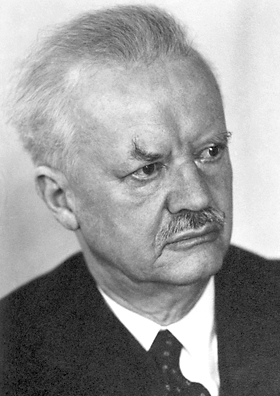
File:Hans_Spemann_nobel.jpg · Wikimedia Commons · See Wikimedia Commons
Hans Spemann
Sign in to saveGerman embryologist (1869–1941)
OverviewAI-generated
Hans Spemann (1869–1941) was a German zoologist, university teacher, and physician. Born in Stuttgart and educated at Heidelberg University, he worked at the University of Freiburg, Humboldt-Universität zu Berlin, and the University of Rostock. His professional locations included Würzburg and Freiburg im Breisgau, where he died. Spemann’s field of work focused on embryology and zoology.
He received the Nobel Prize in Physiology or Medicine, the Cothenius Medal, and the Croonian Medal and Lecture. Spemann was a member of the German Academy of Sciences Leopoldina, the Heidelberg Academy of Sciences and Humanities, the American Academy of Arts and Sciences, and the Royal Prussian Academy of Sciences. He supervised doctoral students Viktor Hamburger and Hilde Mangold. His notable works include *Embryonic development and induction* and *Forschung und Leben*.
Synthesized by Vinony from 32 facts across 4 sources: Wikidata, Open Library, Nobel Prize, Vinony collections. Generated from structured data (not the Wikipedia text) and checked against those facts — may still contain errors.
Person · Open Library
- Born
- 1869
- Died
- 1941
- Works
- 6
Top works
- Die zoologische Station zu Neapel
- Ueber die erste Entwicklung der Tuba Eustachii und des Kopfskelets von Rana temporaria
- Zur Entwicklung des Strongylus Paradoxus
- Embryonic development and induction
- Forschung und Leben
via Open Library + Wikidata
Nobel Prize
- The Nobel Prize in Physiology or Medicine1935
“for his discovery of the organizer effect in embryonic development”
Wikidata facts
- Instance of
- human
- Given name
- Hans
- Gender
- male
- Citizenship
- Germany
- Place of birth
- Stuttgart
- Place of death
- Freiburg im Breisgau
- Father
- Wilhelm Spemann
- Occupation
- physician
- Employer
- University of Rostock
- Languages spoken
- German
- Doctoral student
- Hilde Mangold
- Field of work
- zoology
- Image
- Hans Spemann nobel.jpg
- Work location
- Würzburg
Show 9 more facts
- date of birth
- 1869-06-27
- date of death
- 1941-09-12
- member of
- Accademia Nazionale dei Lincei
- Commons category
- Hans Spemann
- nominated for
- Nobel Prize in Physiology or Medicine
- name in native language
- Hans Spemann
- P8168
- Bobby Lewis
- interested in
- embryology
via Wikidata · CC0
~8 min read
Encyclopedic overview
Hans Spemann ( German: [ˈhans ˈʃpeːˌman] ; 27 June 1869 – 9 September 1941) was a German embryologist who was awarded a Nobel Prize in Physiology or Medicine in 1935 for his student Hilde Mangold's discovery of the effect now known as embryonic induction, an influence, exercised by various parts of the embryo, that directs the development of groups of cells into particular tissues and organs, one of the first steps towards cloning. Spemann added his name as an author to Hilde Mangold's dissertation (although she objected) and won a Nobel Prize for her work.
Biography
Excerpted from Wikipedia’s “Hans Spemann” article, available under the CC BY-SA 4.0 licence.