Encyclopedia of Life · EOL (see source)
Hardhead
Sign in to saveAlso known as Aythya australis, Australian white-eyed duck
The hardhead (Aythya australis), also known as the white-eyed duck, is the only true diving duck found in Australia. The common name "hardhead" has nothing to do with the density of the bird's skull, instead referring to the difficulty encountered by early taxidermists in processing the head. Hardheads are found in wetter, coastal regions of Australia, particularly in the south-east, but are known to disperse as far afield as New Guinea, New Zealand, and the Pacific Islands.
OverviewAI-generated
The hardhead, scientifically named *Aythya australis*, is a species of bird within the family Anatidae. It belongs to the order Anseriformes, class Aves, and phylum Chordata. The taxon was described by Eyton in 1838 and holds an accepted status in biological classification.
This freshwater inhabitant has a recorded mass of 870 and a wingspan of 67.5. Its litter size is listed as 10.8. The species is referenced by 71 other encyclopedia articles.
Synthesized by Vinony from 16 facts across 3 sources: Wikidata, WoRMS, Vinony graph. Generated from structured data (not the Wikipedia text) and checked against those facts — may still contain errors.
Species
hardhead
Species
- PhylumChordata
- ClassAves
- OrderAnseriformes
- FamilyAnatidae
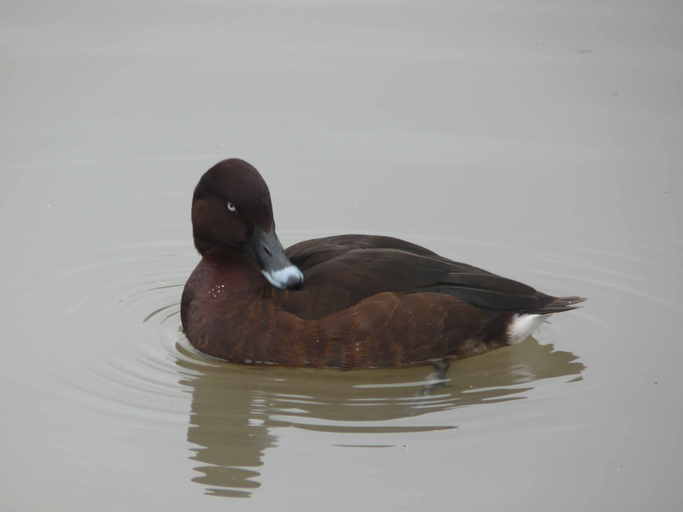
Weibchen der Moorente mit braunen Augen Männchen mit deutlich erkennbaren hellen Augen und auffälliger Schnabelbinde Die Australische Moorente (Aythya australis) ist die einzige Tauchente Australiens. Sie kommt auf dem gesamten australischen Kontinent vor. Auf Tasmanien ist sie jedoch nur selten zu beobachten. In ihrer Gefiederfärbung erinnert sie an die europäische Moorente. Sie ist allerdings etwas größer und das Gefieder ist weniger einheitlich braun. Die IUCN stuft die Australische Moorente als nicht gefährdet (least concern) ein. Der Bestand wird auf 100.000 bis 1 Million geschlechtsreifer Individuen geschätzt. In Australien zählt diese Art zum Federwild.
via
Wikidata facts
Show 10 more facts
- taxon rank
- species
- IUCN conservation status
- Least Concern
- taxon name
- Aythya australis
- Commons category
- Aythya australis
- Commons gallery
- Aythya australis
- taxon common name
- australska patka
- endemic to
- Australia
- wingspan
- 67.5
- litter size
- 10.8
- short name
- A. australis
via Wikidata · CC0
~3 min read
Encyclopedic overview
6 sectionsContents
- Description
- Distribution and habitat
- Behaviour
- Gallery
- References
- External links
The hardhead (Aythya australis), also known as the white-eyed duck, is the only true diving duck found in Australia. The common name "hardhead" has nothing to do with the density of the bird's skull, instead referring to the difficulty encountered by early taxidermists in processing the head. Hardheads are found in wetter, coastal regions of Australia, particularly in the south-east, but are known to disperse as far afield as New Guinea, New Zealand, and the Pacific Islands.
== Description == Hardheads are smaller than most ducks, with body length typically between . Both sexes are similar in size, ranging with wingspans of . Both male and female are a fairly uniform chocolate-brown above, with rufous flanks and white undersides (which are often not visible if the duck is in the water). The trailing edges and almost the entire underside of the wings are white. In the male, the eyes are a striking white, in the female, brown.
Excerpted from Wikipedia’s “Hardhead” article, available under the CC BY-SA 4.0 licence.