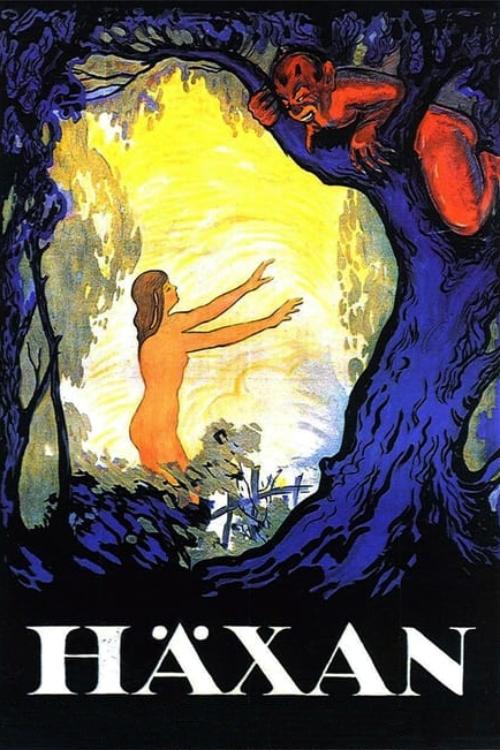
Poster from TMDB
Häxan
Sign in to saveAlso known as Witchcraft Through the Ages
Häxan (, The Witch; Heksen , The Witch; English: The Witches; released in the US in 1968 as Witchcraft Through the Ages) is a 1922 Swedish-Danish silent horror essay film written and directed by Benjamin Christensen. Consisting partly of documentary-style storytelling as well as dramatized narrative sequences, the film purports to chart the historical roots and superstitions surrounding witchcraft, beginning in the Middle Ages through the 20th century. Based partly on Christensen's own study of the Malleus Maleficarum, a 15th-century German guide for inquisitors, Häxan proposes that such witch
Film · TMDB
7.6Grave robbing, torture, possessed nuns, and a satanic Sabbath: Benjamin Christensen's legendary film uses a series of dramatic vignettes to explore the scientific hypothesis that the witches of the Middle Ages suffered the same hysteria as turn-of-the-century psychiatric patients. But the film itself is far from serious-- instead it's a witches' brew of the scary, gross, and darkly humorous.
Cast
- Benjamin Christensen as Devil
- Ella La Cour as Karna / Sorceress
- Emmy Schønfeld as Karna's Assistant
- Kate Fabian as Old Maid
- Oscar Stribolt as Fat Monk
- Wilhelmine Henriksen as Apelone / A Poor Old Woman
Themes
- witch
- superstition
- insanity
- mystic
- sorcery
- hysteria
- satan
- black and white
- torture
- devil
This product uses the TMDB API but is not endorsed or certified by TMDB.
Key facts
- Film.name
- Häxan
- Film.image
- Haxan sv poster.jpg
- Film.caption
- Swedish theatrical release poster
- Film.director
- Benjamin Christensen
- Film.screenplay
- Benjamin Christensen
- Film.cinematography
- Johan Ankerstjerne
- Film.editing
- Edla Hansen
- Film.studio
- Svensk Filmindustri
- Film.distributor
- Skandias Filmbyrå (Sweden)
- Film.language
- Silent film with Swedish intertitles
- Film.budget
- SEK 2 million
via Wikipedia infobox
Wikidata facts
- Instance of
- film
- Genre
- documentary film
- Country of origin
- Denmark
- Main subject
- witchcraft
- Director
- Benjamin Christensen
- Screenwriter
- Benjamin Christensen
- Composer
- Launy Grøndahl
- Production company
- SF Studios
- Cinematographer
- Johan Ankerstjerne
- Duration
- 107
- FilmAffinity ID
- 252111
- Distribution format
- video on demand
- Image
- Heksen (2).tif
Show 10 more facts
- publication date
- 1929-05-27
- title
- Häxan
- color
- black-and-white
- aspect ratio (W:H)
- 4:3
- copyright status
- public domain
- distributed by
- Fandango at Home
- set in period
- 1920s
- review score
- 93%
- capital cost
- 2000000
- Commons category
- Häxan (1922 film)
via Wikidata · CC0
~19 min read
Encyclopedic overview
23 sectionsContents
- Plot
- Part 1
- Part 2
- Parts 3–5
- Parts 6–7
- Cast
- Themes and interpretations
- Cinematic realism
- Depiction of witchcraft and feminist readings
- Sexual repression and freudian themes
- Production
- Special effects
- Music
- Releases
- Reception
- Contemporary response
- Retrospective assessments
- Restorations and home media
- See also
- Notes
- References
- Bibliography
- External links
Häxan (, The Witch; Heksen , The Witch; English: The Witches; released in the US in 1968 as Witchcraft Through the Ages) is a 1922 Swedish-Danish silent horror essay film written and directed by Benjamin Christensen. Consisting partly of documentary-style storytelling as well as dramatized narrative sequences, the film purports to chart the historical roots and superstitions surrounding witchcraft, beginning in the Middle Ages through the 20th century. Based partly on Christensen's own study of the Malleus Maleficarum, a 15th-century German guide for inquisitors, Häxan proposes that such witch-hunts may have stemmed from misunderstandings of mental or neurological disorders, triggering mass hysteria.
The movie was produced by Swedish AB Svensk Filmindustri but shot in Denmark in 1920–1921. With Christensen's meticulous recreation of medieval scenes and its lengthy production period, the film was the most expensive Scandinavian silent film ever made at the time, costing nearly two million Swedish kronor. Although it received some positive reception in Denmark and Sweden, censors in countries such as Germany, France, and the United States objected to what were considered at that time graphic depictions of torture, nudity, and sexual perversion, as well as anti-clericalism.
Excerpted from Wikipedia’s “Häxan” article, available under the CC BY-SA 4.0 licence.