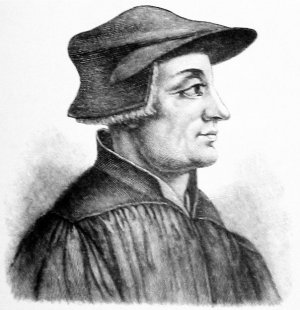
Huldrych Zwingli
Also known as Ulricus Zurlinglius
Protestant Reformation leader in Switzerland, Swiss Reformed Church founder (1484-1531)
AI overview
Huldrych Zwingli was a Swiss religious leader in the 1500s who founded the Swiss Reformed Church as part of the Protestant Reformation, a movement that challenged the Catholic Church's teachings and practices. His work matters because he shaped Protestant Christianity in Switzerland and influenced how millions of people practiced their faith, making him a significant figure in European religious history.
AI-generated from the Wikipedia summary — may contain errors.
Person · Open Library
- Born
- 1484
- Died
- 11 October 1531
- Works
- 326
Top works
- Briefe und Acten zu der Geschichte des Religionsgespräches zu Marburg 1529 und des Reichstages zu Augsburg 1530
- Zeitgemässe Auswahl aus Huldreich Zwingli's praktischen Schriften
- Huldrych Zwinglis Briefe
- Von erkiesen vnd fryheit der spysen
- Wje man die jugendt in gůten sitten vnd
via Open Library + Wikidata
Listeners · Last.fm
- Listeners
- 14
- Total plays
- 226
<a href="https://www.last.fm/music/Huldrych+Zwingli">Read more on Last.fm</a>
Article
Huldrych Zwingli (born Ulrich Zwingli; 1 January 1484 – 11 October 1531) was a Swiss Christian theologian, musician, and leader of the Reformation in Switzerland. Born during a time of emerging Swiss patriotism and increasing criticism of the Swiss mercenary system, he attended the University of Vienna and the University of Basel, a scholarly center of Renaissance humanism. He continued his studies while he served as a pastor in Glarus and later in Einsiedeln, where he was influenced by the writings of Erasmus. During his tenures at Basel and Einsiedeln, Zwingli began to familiarize himself with many criticisms Christian institutions were facing regarding their reform guidance and garnered scripture which aimed to address such criticisms.
In 1519, Zwingli became the Leutpriester (people's priest) of the Grossmünster in Zurich where he began to preach ideas on reform of the Catholic Church. In his first public controversy in 1522, he attacked the custom of fasting during Lent. In his publications, he noted corruption in the ecclesiastical hierarchy, promoted clerical marriage, and attacked the use of images in places of worship. Among his most notable contributions to the Reformation was his expository preaching, starting in 1519, through the Gospel of Matthew, before eventually using Biblical exegesis to go through the entire New Testament, a radical departure from the Catholic mass. In 1525, he introduced a new communion liturgy to replace the Mass. He also clashed with the Anabaptists, which resulted in their persecution. Historians have debated whether or not he turned Zurich into a theocracy.
Gallery (12)
Connections
Categories
1484 births1531 deaths16th-century Calvinist and Reformed theologians16th-century Swiss Roman Catholic priests16th-century Swiss writersCalvinist and Reformed writersChristian humanistsClergy from ZurichCritics of the Catholic ChurchHistory of ZurichHuldrych ZwingliPeople excommunicated by the Catholic Church