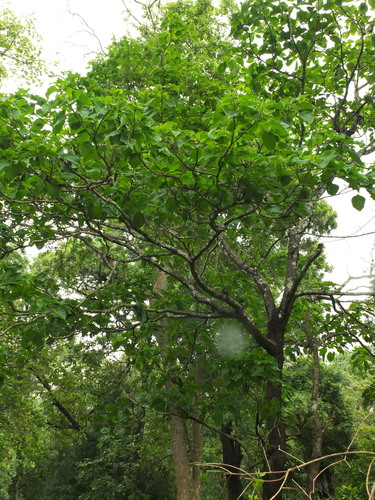
(c) Siddarth Machado, some rights reserved (CC BY), uploaded by Siddarth Machado · cc-by
Hymenodictyon
Sign in to saveHymenodictyon is a genus of flowering plants in the family Rubiaceae. It has about 30 species. All are native to the Old World. The wood of Hymenodictyon orixense is soft and has limited use, mostly for boxes. The type species for Hymenodictyon is Hymenodictyon orixense (synonym: Hymenodictyon excelsum).
In the Vinony graph
Within Vinony's link graph, Hymenodictyon is referenced by 9 other articles, and connects out to Madagascar, plant and Greek.
It sits within the topics Hymenodictyeae, Paleotropical flora and Rubiaceae genera.
Its subject is documented across 10 Wikipedia language editions.
Species
GENUS
- KingdomPlantae
- PhylumTracheophyta
- ClassMagnoliopsida
- OrderGentianales
- FamilyRubiaceae
土连翘属(学名:Hymenodictyon)是茜草科下的一个属,为乔木或灌木植物。该属共有约20种,分布于热带亚洲和非洲。[1] 参考文献 ^ 中国种子植物科属词典. 中国数字植物标本馆. (原始内容存档于2012-04-11). 外部链接 維基物種中有關土连翘属的數據 这是一篇與植物相關的小作品。你可以通过编辑或修订扩充其内容。 查 论 编 取自“https://zh.wikipedia.org/w/index.php?title=土连翘属&oldid=44923788” 分类: 茜草科 土连翘属 隐藏分类: 本地相关图片与维基数据相同 WikispeciesLatinName 全部小作品 植物小作品
via GBIF · Kew POWO
Museum specimens
- Specimen records
- 317
- With media
- 169
- Family
- Rubiaceae
- Collections
- CAS, GH, MO, NY
- Recorded in
- Madagascar, Tanzania, Cambodia, Malawi, Cameroon, Mozambique, Vietnam, Ivory Coast
Wikidata facts
Show 6 more facts
- taxon name
- Hymenodictyon
- taxon rank
- genus
- topic's main category
- Category:Hymenodictyon
- Commons category
- Hymenodictyon
- taxon common name
- 土连翘属
Sources (2)
via Wikidata · CC0
~3 min read
Encyclopedic overview
3 sectionsContents
- Species
- References
- External links
Hymenodictyon is a genus of flowering plants in the family Rubiaceae. It has about 30 species. All are native to the Old World. The wood of Hymenodictyon orixense is soft and has limited use, mostly for boxes. The type species for Hymenodictyon is Hymenodictyon orixense (synonym: Hymenodictyon excelsum).
Hymenodictyon was named by Nathaniel Wallich in 1824 in an addendum to William Roxburgh's Flora Indica, in an edition published by Carey and Wallich after Roxburgh's death. The generic name is derived from two Greek words, hymen, "membrane", and diktyon, "net". It refers to the wing that surrounds each seed.
Excerpted from Wikipedia’s “Hymenodictyon” article, available under the CC BY-SA 4.0 licence.