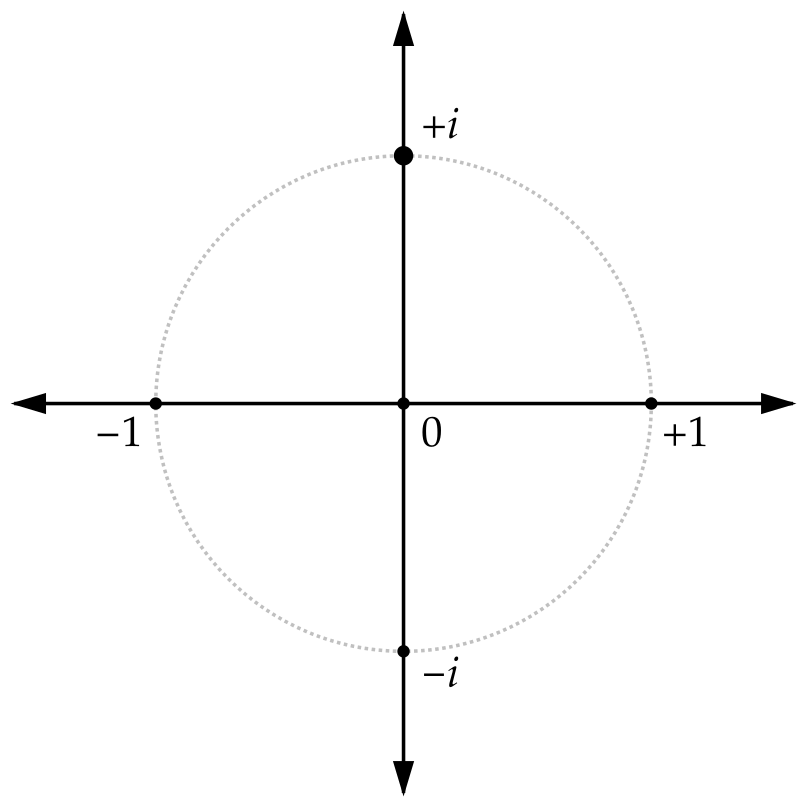
File:ImaginaryUnit5.svg · Wikimedia Commons · See Wikimedia Commons
unité imaginaire
Sign in to saveAlso known as i, ι, unit imaginary number, j
nombre complexe dont le carré et le carré de son opposé valent -1
The imaginary unit is a mathematical tool defined as the square root of negative one, which ordinarily has no solution in everyday numbers. It's used to create complex numbers, a broader number system that extends mathematics beyond what regular numbers alone can express.
AI-generated from the Wikipedia summary — may contain errors.
Wikidata facts
Show 2 more facts
- numeric value
- 1
- maintained by WikiProject
- WikiProject Mathematics
Sources (1)
via Wikidata · CC0
Article · Français
En mathématiques, l’unité imaginaire est un nombre complexe, noté i (parfois j en physique afin de ne pas le confondre avec la notation de l'intensité électrique), dont le carré vaut –1. Ses multiples par des nombres réels constituent les nombres imaginaires purs. L'appellation d'« imaginaire » est due à René Descartes et celle d'« unité imaginaire » à Carl Friedrich Gauss. Sans avoir disparu, elle n'est pas d'un usage très généralisé chez les mathématiciens, qui se contentent souvent de parler du nombre i.
Abstract from DBpedia / Wikipedia · CC BY-SA
Gallery (3)
Available in 65 languages
- Español
- Français
- Deutsch
- 中文
- 日本語
- Русский
- Português
- Italiano
- العربية
- हिन्दी
- Albanian
- Armenian
- Azerbaijani
- Bahasa Indonesia
- Basque
- be_x_old
- Belarusian
- Bosnian
Show 46 more
- Bulgarian
- Catalan
- Central Kurdish
- Chuvash
- Croatian
- Czech
- Danish
- Esperanto
- Estonian
- Finnish
- Galician
- Greek
- Hebrew
- Hungarian
- Ido
- Interlingua
- Latvian
- Limburgish
- Lithuanian
- Lojban
- Lombard
- Macedonian
- Malay
- Nederlands
- Norwegian
- Polski
- Romanian
- Serbian
- Serbian (Latin)
- simple
- Sinhala
- Slovenian
- Svenska
- Tajik
- Tamil
- Tatar
- Tiếng Việt
- Türkçe
- Ukrainian
- Urdu
- Wu Chinese
- Yoruba
- zh_yue
- فارسی
- ไทย
- 한국어
via Wikidata sitelinks · CC0