File:InulaHelenium.jpg · Wikimedia Commons · See Wikimedia Commons
Inula helenium
Sign in to saveAlso known as Elecampane, large scabious, horse-heal, elfdock
Elecampane (Inula helenium), pronounced and also called horse-heal or elfdock, is a widespread plant species in the sunflower family Asteraceae. It is native to Eurasia from Spain to Xinjiang province in western China, and naturalized in parts of North America.
OverviewAI-generated
*Inula helenium*, commonly known as elecampane, is a species of plant in the family Asteraceae. It belongs to the genus *Inula* and is classified within the order Asterales, class Magnoliopsida, and phylum Tracheophyta. The species was described by L. and produces fruit of the achene type. It is utilized as a medicinal plant.
The taxon range for *Inula helenium* includes China and Xinjiang. Its conservation status is listed as Least Concern by the IUCN Red List, with a 2013 assessment. The species name is accepted by WoRMS. Records of the plant exist in institutions such as the University of Alberta Museums, OSU, MICH, MSC, and ANSP, with occurrences documented in Canada and the United States.
Synthesized by Vinony from 42 facts across 8 sources: Wikidata, GBIF, Gbif Occ, Plants of the World, IUCN Red List, WoRMS, iDigBio, Vinony graph. Generated from structured data (not the Wikipedia text) and checked against those facts — may still contain errors.
Species
Least ConcernElecampane
SPECIES
- KingdomPlantae
- PhylumTracheophyta
- ClassMagnoliopsida
- OrderAsterales
- FamilyAsteraceae
Echter Alant (Inula helenium),[1] meist kurz Alant genannt, ist eine Pflanzenart aus der Gattung Alante (Inula) innerhalb Familie der Korbblütler (Asteraceae). Sie wird bereits seit der Antike als Heil- und Gewürzpflanze verwendet. Inhaltsverzeichnis 1 Namen 2 Beschreibung und Inhaltsstoffe 2.1 Vegetative Merkmale 2.2 Generative Merkmale 3 Herkunft und Standortanforderungen 4 Systematik 5 Abbildungen 6 Nutzung 6.1 Gewürz 6.2 Geruch 6.3 Färbepflanze 7 Alant im Volksglauben 8 Geschichte 8.1 Quellen 8.2 Historische Abbildungen 9 Literatur 10 Einzelnachweise 11 Weblinks Namen Diese Pflanzenart trägt je nach Region sehr unterschiedliche deutschsprachige Trivialnamen. Dazu zählt Altkraut, Brustalant, Darmkraut, Darmwurz, Edelwurz, Glockenwurz, Helenenalant, Helenenkraut, Odinskopf und Schlangenkraut.[2] Mittelhochdeutsch sind alan, aland und alant belegt.[3] Der griechische Name von Alant ist Ἑλένιον, der lateinische Helenium (früher auch Elenium geschrieben). Der Echte Alant wurde auch als Enula und Enula campana bezeichnet.[4][5]). Das botanische Artepitheton helenium spielt auf zwei Legenden der Antike an. Nach der einen soll Helena, bevor sie von Paris von Griechenland nach Troja ent
via GBIF · IUCN · Kew POWO
Museum specimens
- Specimen records
- 2,301
- With media
- 1,867
- Family
- Asteraceae
- Collections
- UNIVERSITY OF ALBERTA MUSEUMS, OSU, MICH, MSC, ANSP, UNIVERSITY OF VERMONT
- Recorded in
- Canada, United States
Wikidata facts
- Instance of
- taxon
- Parent taxon
- Inula
- Image
- Inula helenium Prague 2011 1.jpg
- Has use
- medicinal plant
Show 10 more facts
via Wikidata · CC0
~3 min read
Encyclopedic overview
6 sectionsContents
- Description
- Folklore
- Uses
- Chemical constituents
- References
- External links
Elecampane (Inula helenium), pronounced and also called horse-heal or elfdock, is a widespread plant species in the sunflower family Asteraceae. It is native to Eurasia from Spain to Xinjiang province in western China, and naturalized in parts of North America.
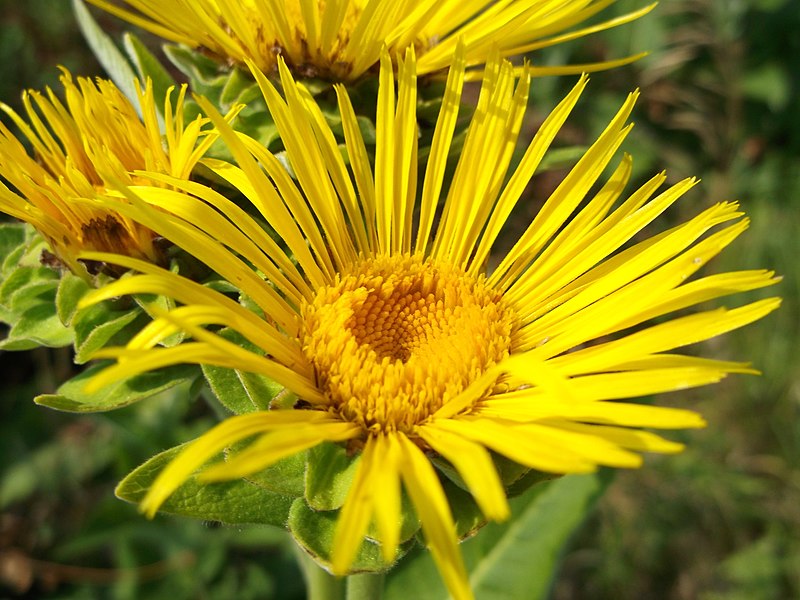
==Description== Elecampane is a rather rigid herb, the stem of which attains a height of about . The leaves are large and toothed, the lower ones stalked, the rest embracing the stem; blades egg-shaped, elliptical, or lance-shaped, as big as long and wide. Leaves are green on the upper side with light, scattered hairs, but whitish on the underside because of a thick layer of wool. The flower heads up to 5 cm (2 inches) broad, each head containing 50-100 yellow ray flowers and 100-250 yellow disc flowers. The root is thick, branching and mucilaginous, and has a bitter taste and a camphoraceous odour with sweet floral (similar to violet) undertones.
Excerpted from Wikipedia’s “Inula helenium” article, available under the CC BY-SA 4.0 licence.