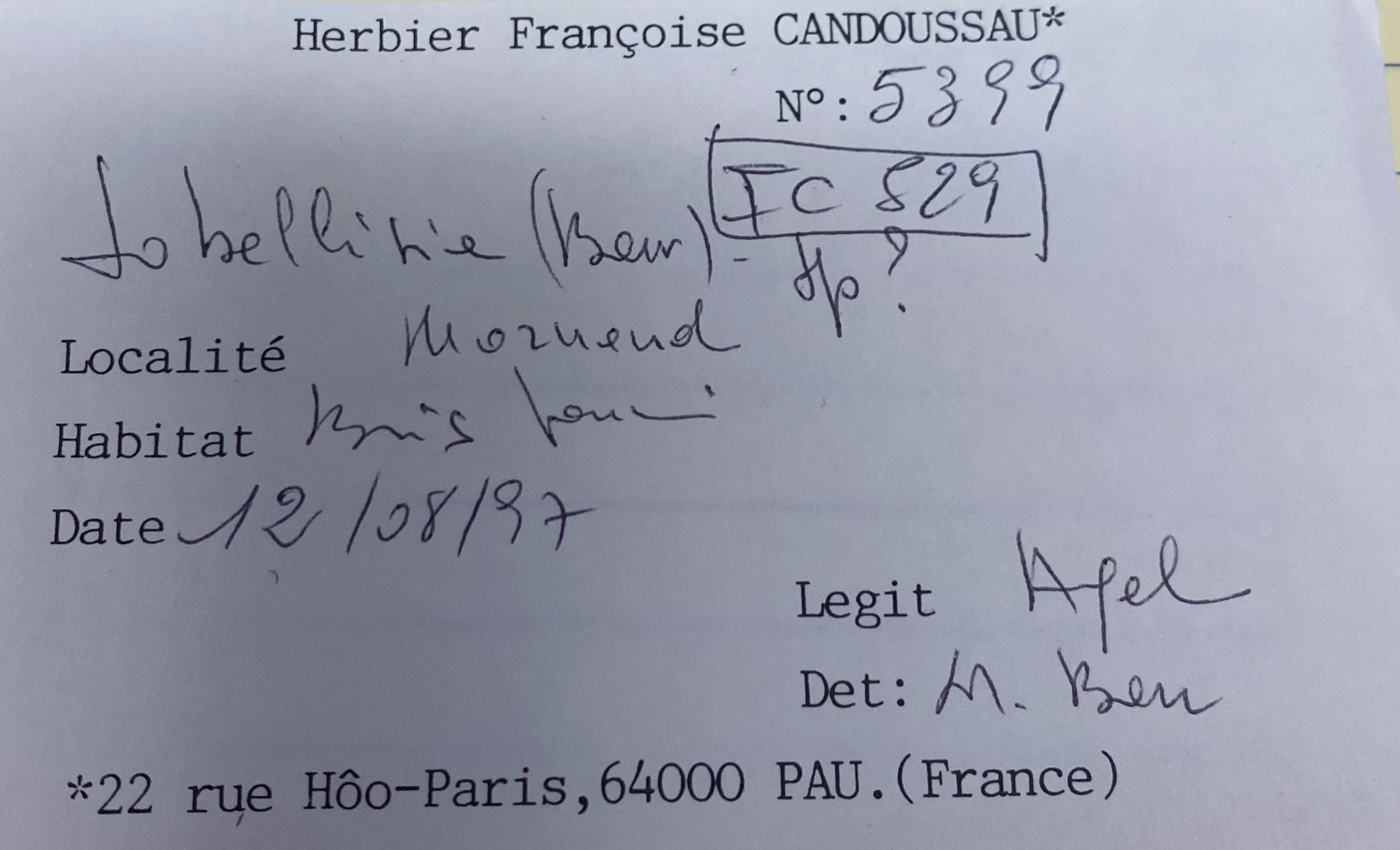
Specimen image via iDigBio · BY-NC-SA
Jobellisia
Sign in to saveJobellisia is a genus of fungi within the monotypic family Jobellisiaceae and the monotypic order Jobellisiales and also the subclass Hypocreomycetidae, and class Sordariomycetes. The genus was circumscribed by Margaret Elizabeth Barr-Bigelow in 1993 with Jobellisia luteola as the type species. It contains species that grow on dead wood and bark in tropical and temperate regions of the Northern Hemisphere.
Species
GENUS
- KingdomFungi
- PhylumAscomycota
- ClassSordariomycetes
- OrderJobellisiales
- FamilyJobellisiaceae
via GBIF
Museum specimens
- Specimen records
- 3
- With media
- 2
- Family
- Pleosporaceae
- Collections
- BPI, CUP
- Recorded in
- Venezuela, France
Wikidata facts
- Instance of
- taxon
- Image
- Jobellisia luteola.jpg
Show 5 more facts
- taxon name
- Jobellisia
- taxon rank
- genus
- taxonomic type
- Jobellisia luteola
- Commons category
- Jobellisia
- taxon author citation
- M.E. Barr
Sources (1)
via Wikidata · CC0
~3 min read
Encyclopedic overview
5 sectionsContents
- History
- Description
- Distribution and habitats
- Species
- References
Jobellisia is a genus of fungi within the monotypic family Jobellisiaceae and the monotypic order Jobellisiales and also the subclass Hypocreomycetidae, and class Sordariomycetes. The genus was circumscribed by Margaret Elizabeth Barr-Bigelow in 1993 with Jobellisia luteola as the type species. It contains species that grow on dead wood and bark in tropical and temperate regions of the Northern Hemisphere.
==History== Barr originally classified Jobellisia in the family Clypeosphaeriaceae of the order Xylariales, with two new species Jobellisia luteola (the type species) and Jobellisia nicaraguensis. Later phylogenetic work showed that Jobellisia luteola and Jobellisia fraterna formed a clade that is sister to the order Diaporthales. In 2008, Martina Réblová erected a new genus, Bellojisia (an anagram of Jobellisia), to contain what was then called Jobellisia rhynchostoma, and created the family Jobiellaceae for the remaining Jobellisia species. Based on LSU sequence data, she demonstrated that Jobiellaceae occupies a basal position in a clade containing the Calosphaeriales and Diaporthales, in the Sordariomycetes incertae sedis.
Excerpted from Wikipedia’s “Jobellisia” article, available under the CC BY-SA 4.0 licence.