
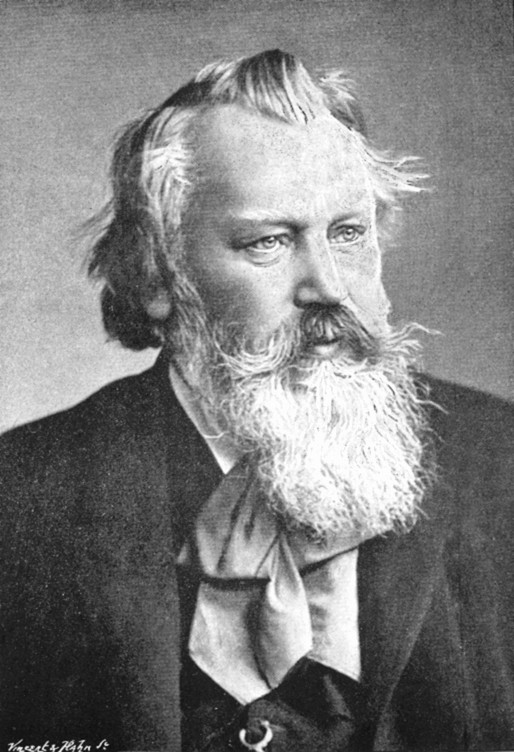
File:JohannesBrahms_(cropped).jpg · Wikimedia Commons · See Wikimedia Commons
Johannes Brahms
Sign in to saveAlso known as Brahms, J. Brahms, Marks, G. W.
German composer (1833–1897)
OverviewAI-generated
Johannes Brahms was a German male composer, conductor, and pianist associated with the Romantic music movement. He studied under Eduard Marxsen and was influenced by Wolfgang Amadeus Mozart and Ludwig van Beethoven. His notable works include Symphony No. 1, Symphony No. 4, the Academic Festival Overture, and the Tragic Overture. He also composed in genres such as art song, classical, concerto, and European styles.
Brahms played the piano, cello, and horn. He was employed by the University of Music and Performing Arts Vienna, the Wiener Singakademie, and the Gesellschaft der Musikfreunde. He resided in Vienna and was buried at the Vienna Central Cemetery after dying of liver cancer on April 3, 1897. He received the Bavarian Maximilian Order for Science and Art, the Order of Leopold, and the Austrian Decoration for Science and Art. He was an agnostic who spoke German and used the pseudonym G.W. Marks.
Synthesized by Vinony from 46 facts across 7 sources: Wikidata, MusicBrainz, Last.fm, TMDb, Firecrawl, VIAF, Europeana Sparql. Generated from structured data (not the Wikipedia text) and checked against those facts — may still contain errors.
Film & TV
Hamburg, Germany
Johannes Brahms was a German composer, pianist, and conductor of the Romantic period. Born in Hamburg into a Lutheran family, Brahms spent much of his professional life in Vienna, Austria. Brahms composed for symphony orchestra, chamber ensembles, piano, organ, and voice and chorus. Many of his works have become staples of the modern concert repertoire. Brahms has been considered, by his…
via TMDB
Listeners · Last.fm
- Listeners
- 1,604,843
- Total plays
- 21,253,805
Tags
Similar artists
Johannes Brahms (7 May 1833 – 3 April 1897) was a German composer, virtuoso pianist, and conductor of the mid-Romantic period. His music is recognised for its rhythmic vitality and flexible use of dissonance, often combined with carefully crafted yet expressive contrapuntal textures. Brahms adapted traditional forms and techniques from a broad range of earlier composers. His body of work includes four symphonies, four concertos, a Requiem, extensive chamber music <a href="https://www.last.fm/music/Johannes+Brahms">Read more on Last.fm</a>
Authority record · VIAF
- Lifespan
- 1833–1897
- Nationality
- DE, AT, IT, DEU, AUT
- Role / Field
- Composers, Compositeurs, Composer, 피아니스트pianist, Pianists, Composition music
- Language
- ger, deu
- Gender
- Male
Recorded by 44 libraries
via VIAF · OCLC
Described at
Johannes Brahms
johannesbrahms.org →Link to a page describing this subject · 977 chars · not written by Vinony
Wikidata facts
- Instance of
- human
- Given name
- Johannes
- Gender
- male
- Citizenship
- Germany
- Place of birth
- Hamburg
- Place of death
- Vienna
- Occupation
- pianist
- Employer
- Gesellschaft der Musikfreunde
- Languages spoken
- German
- Religion
- agnosticism
- Notable work
- Clarinet Sonatas
- Academic degree
- Doctor of Music
- Student of
- Eduard Marxsen
- Field of work
- art music
- Movement
- Romantic music
- Instrument
- horn
- Official website
- www.brahms-institut.de/index.php/de/allgemeines
- Image
- JohannesBrahms.jpg
- Work location
- Vienna
- Residence
- Vienna
Show 22 more facts
- place of burial
- Vienna Central Cemetery
- Commons category
- Johannes Brahms
- date of birth
- 1834-05-07
- date of death
- 1897-04-03
- cause of death
- liver cancer
- Commons Creator page
- Johannes Brahms
- topic's main category
- Category:Johannes Brahms
- manner of death
- natural causes
- Commons gallery
- Johannes Brahms
- pseudonym
- G.W. Marks
- date of baptism
- 1833-05-26
- influenced by
- Ludwig van Beethoven
- described at URL
- www.johannesbrahms.org
- writing language
- German
- start of work period
- 1843-00-00
- name in native language
- Johannes Brahms
- list of works
- list of compositions by Johannes Brahms
- has works in the collection
- Memoria Chilena
- related category
- Category:Compositions by Johannes Brahms
- P12674
- Nadia Gray
- P12749
- Paeonia
Sources (9)
via Wikidata · CC0
Works in European collections
36 objects attributed to Johannes Brahms, held across European museums, libraries & archives · via Europeana
Canto d'amore [Música notada] :]op. 71, n. 5
Domenica [Música notada] :]op. 47, N. 3 ; y Ode Saffica : [op. 94, N. 4] / Joh. Brahms. Heimlichkeit / C. Loewe
Rapsodia, op. 27 [i.e. op. 79], n.2 [Música notada]
Sextett G-dur für zwei Violinen, zwei Violen und zwei Violoncelli, op. 36 [Música notada]
Ungarische Tänze für pianoforte [Música notada]
Quintett, F moll für Pianoforte, 2 Violinen, Viola und Violoncell [Música notada]
Ungarische Tänze.. Band II, (Heft III-IV)
Hamlet [Música notada] : grand opéra de Ambroise Thomas
Walzer für das Pianoforte zu vier Händen, op. 39 [Música notada]
Quintett H-moll für Clarinette, zwei Violinen, viola und Violoncell, op. 115 [Música notada]
Quintett F-dur für zwei Violinen, zwei Violen und Violoncell, op. 88 [Música notada]
Quartett C-moll für zwei Violinen, Viola und Violoncell, op. 51, n. 1 [Música notada]
Quartett B-dur für zwei Violinen, Viola und Violoncel, op. 67 [Música notada]
Quartett C-moll für Pianoforte, Violine, Viola und Violoncell, op. 60 [Música notada]
Trio H-dur für Pianoforte, Violine und Violoncelle, op. 8 [Música notada]
Trio C-dur für Pianoforte, Violine und Violoncelle, op. 87 [Música notada]
Trio C-moll für Pianoforte, Violine und Violoncelle, op. 101 [Música notada]
Trio A-moll für Pianoforte, Clarinette (oder Viola) und Violoncell, op. 114 [Música notada]
Sextett B-dur für zwei Violinen, zwei Violen und zwei Violoncelli, op. 28 [Música notada]
Trio Es-dur für Pianoforte, Violine und Waldhorn (oder Violoncell oder Viola), op. 40 [Música notada]
Quartett A-dur für Pianoforte, Violine, Viola und Violoncell, op. 26 [Música notada]

Whenever the march is blowing: Song

Lullaby (“Good evening, good 'night”); Op. 49 No. 4/(Joh. Brahms)

Field loneliness (In summer fields)/(Brahms)

Hungarian Dance No. 1 G-moll/(Brahms)

Mariae Wiegenlied: op. 76, No 52/(Reger)

Sapphische Ode/(music: Joh. Brahms. Text: Hans Schmidt)

Down in the valley/(J. Brahms)

In silent night/(Brahms)

Wiegenlied, Op. 49, No. 4/von Brahms

I turned to see: Op. 121, No. 2/(J. Brahms)

My slumber is getting quieter (Op. 105, No.2)/(Hermann Lingg-Brahms)

Lullaby: Op. 49, No. 4/(Brahms)

Walde talk

Lullaby/(Brahms)

The Wanderer/(Brahms)
~40 min read
Encyclopedic overview
Johannes Brahms (/brɑːmz/; German: [joˈhanəs ˈbʁaːms] ; 7 May 1833 – 3 April 1897) was a German composer, virtuoso pianist, and conductor of the mid-Romantic period. His music features expressive counterpoint, freer dissonance, rhythmic vitality, and traditional forms. His works include four symphonies, four concertos, a Requiem, much chamber music, and hundreds of folk-song arrangements and Lieder (German art songs).
Born in Hamburg to a musical family, Brahms composed and performed locally in his youth before touring Central Europe as a pianist, premiering his own works and meeting Franz Liszt in Weimar. He worked with Ede Reményi and, through Joseph Joachim, gained Robert and Clara Schumann's support and guidance. He lived with Clara in Düsseldorf, becoming devoted to her amid Robert's voluntary commitment. After Robert's death, they remained close friends. Brahms never married, focusing on his work as a composer prone to self-criticism.
Excerpted from Wikipedia’s “Johannes Brahms” article, available under the CC BY-SA 4.0 licence.
Gallery (12)
Available in 137 languages
- Español
- Français
- Deutsch
- 中文
- 日本語
- Русский
- Português
- Italiano
- العربية
- Afrikaans
- Albanian
- Albanian
- Amharic
- Aragonese
- Armenian
- Assamese
- Asturian
- Aymara
Show 118 more
- azb
- Azerbaijani
- Bahasa Indonesia
- Bangla
- Bashkir
- Basque
- bat_smg
- Bavarian
- be_x_old
- Belarusian
- Bislama
- Bosnian
- Breton
- btm
- Bulgarian
- Buriat
- Burmese
- Catalan
- cdo
- Cebuano
- Central Kurdish
- Chamorro
- Chechen
- Cornish
- Corsican
- Crimean Tatar
- Croatian
- Czech
- Danish
- Egyptian Arabic
- Esperanto
- Estonian
- Faroese
- Fiji Hindi
- Filipino
- Finnish
- Galician
- Georgian
- Greek
- Guarani
- Haitian Creole
- Hakka Chinese
- Hebrew
- Hungarian
- Icelandic
- Ido
- Iloko
- Interlingua
- Irish
- Jju
- Kabardian
- Kanuri
- Kara-Kalpak
- Kazakh
- kbp
- Latin
- Latvian
- Ligurian
- Lithuanian
- Lombard
- Low German
- Luxembourgish
- Macedonian
- Madurese
- Malagasy
- Malay
- Malayalam
- Manx
- Marathi
- Mingrelian
- Mongolian
- Nederlands
- Newari
- Northern Frisian
- Norwegian
- Norwegian Nynorsk
- Novial
- Occitan
- olo
- Picard
- Piedmontese
- Polski
- Punjabi
- Quechua
- roa_rup
- Romanian
- Rusyn
- Serbian
- Serbian (Latin)
- Sicilian
- simple
- Sindhi
- Slovak
- Slovenian
- Svenska
- Swahili
- Tajik
- Tamil
- Tatar
- Tiếng Việt
- Türkçe
- Ukrainian
- Urdu
- Uzbek
- Veps
- Volapük
- Waray
- Welsh
- Western Panjabi
- Wu Chinese
- Yakut
- Yiddish
- Zaza
- zh_min_nan
- zh_yue
- فارسی
- ไทย
- 한국어
via Wikidata sitelinks · CC0