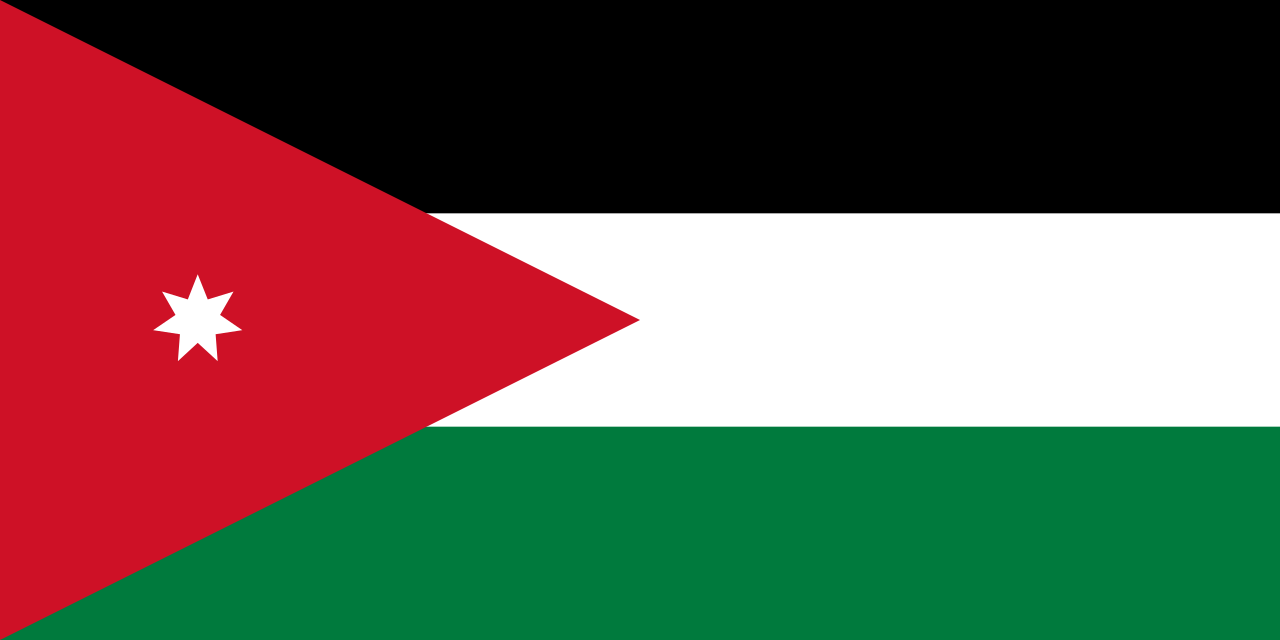
Giordania
Sign in to saveAlso known as Hashemite Kingdom of Jordan, Kingdom of Jordan, Yarden, ISO 3166-1:JO, HKJ, State of Jordan
stato del Medio Oriente
OverviewAI-generated
Jordan, officially the Hashemite Kingdom of Jordan, is a country in Western Asia. Its capital is Amman. The nation gained independence in 1946, replacing Mandatory Palestine. It shares diplomatic relations with Germany, Israel, Australia, and Syria. The official language is Arabic, and the currency is the Jordanian dinar. The legislative body is the Parliament of Jordan, with the head of state holding the office of King of Jordan and the head of government serving as Prime Minister of Jordan.
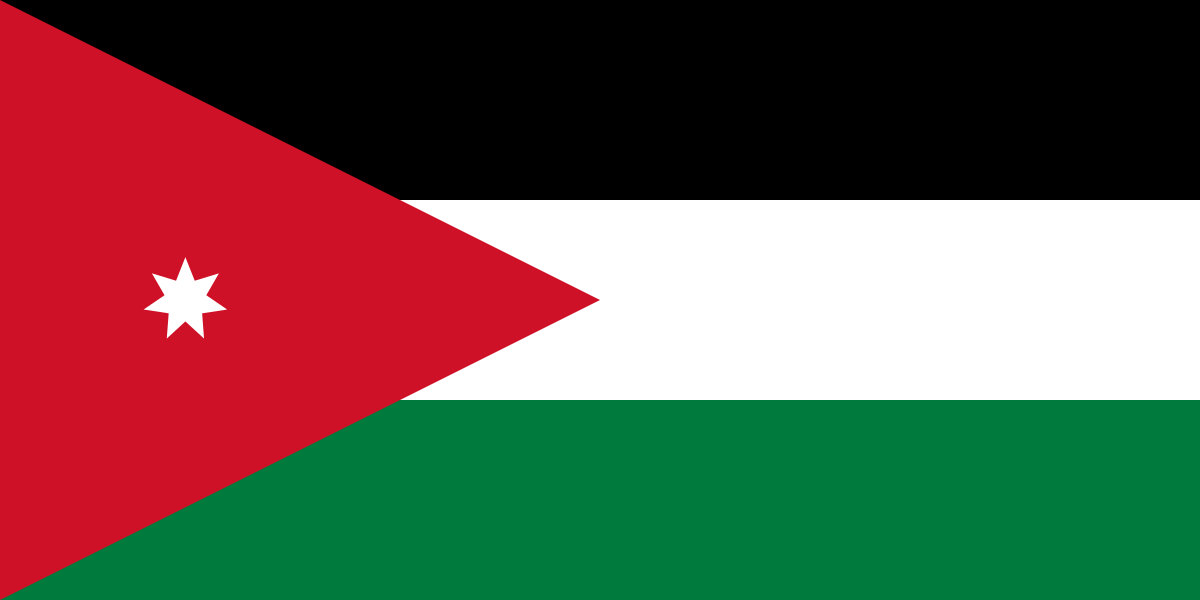
The country has a population of 11,734,000, with 92.95% living in urban areas. The area covers 89,342 square kilometers. The top-level domain is .jo. The emergency phone number is 911. Electrical outlets support Europlug, Schuko, BS 1363, and SN 441011 standards. The license plate code is HKJ. The time zone is UTC+03:00. The flag is represented by the Unicode character 🇯🇴.
Synthesized by Vinony from 67 facts across 9 sources: Wikidata, REST Countries, Open Meteo, Openweathermap, World Bank, OpenStreetMap, PubMed, Vinony graph, Geo. Generated from structured data (not the Wikipedia text) and checked against those facts — may still contain errors.
Weather now
cached 9h ago7-day forecast
via Open-Meteo
Country

- Capital
- Amman
- Population
- 11,734,000
- Region
- Asia · Western Asia
- Demonym
- Jordanian
- Currencies
- JOD (د.ا)
- Languages
- Arabic
- Calling code
- +962
- Drives on
- Right
- Gini
- 33.7 (2010)
- FIFA code
- JOR
- TLD
- .jo, الاردن.
- Timezones
- UTC+03:00
- Borders
- IRQ, ISR, PSE, SAU, SYR
via REST Countries
Indicators · World Bank
- GDP
- $53.4B(2024)
- Population
- 11,552,876(2024)
- Life expectancy
- 78 yrs(2024)
- Unemployment
- 16.5 %(2025)
- Urban population
- 93 %(2024)
- Internet users
- 95.6 %(2024)
- Forest area
- 1.1 %(2023)
- Renewable energy
- 11.5 %(2021)
via World Bank Open Data · CC BY 4.0
Wikipedia views (30d)
132,357 totalvia Wikimedia Pageviews API
Key facts
- Country.utc_offset
- +03:00
- Country.conventional_long_name
- Hashemite Kingdom of Jordan
- Country.common_name
- Jordan
- Country.image_flag
- Flag of Jordan.svg
- Country.image_coat
- Coat of arms of Jordan.svg
- Country.coa_size
- 75
- Country.national_motto
- "God, Country, King"
- Country.national_anthem
- "Peace to the King of Jordan"
- Country.capital
- Amman
- Country.largest_city
- capital
- Country.religion
- 1% others
- Country.official_languages
- Arabic
- Country.demonym
- Jordanian
- Country.government_type
- Unitary parliamentary constitutional monarchy
- Country.leader_title1
- Monarch
- Country.leader_name1
- Abdullah II
- Country.leader_title2
- Prime Minister
- Country.leader_name2
- Jafar Hassan
via Wikipedia infobox
Research
67,872 papers- The status of cryptosporidiosis in Jordan: a review.ReviewEastern Mediterranean health journal = La revue de sante de la Mediterranee orientale = al-Majallah al-sihhiyah li-sharq al-mutawassit · 2020Zueter ADOI: 10.26719/emhj.20.065
- Breast Cancer Care in Jordan.ReviewJCO global oncology · 2020Abdel-Razeq H, Mansour A, Jaddan DDOI: 10.1200/JGO.19.00279
- Cancer care in Jordan.ReviewHematology/oncology and stem cell therapy · 2015Abdel-Razeq H, Attiga F, Mansour ADOI: 10.1016/j.hemonc.2015.02.001
- Tobacco control in Jordan.ReviewThe Lancet. Respiratory medicine · 2019Burki TKDOI: 10.1016/S2213-2600(19)30077-3
- History of Neurosurgery in Jordan.ReviewWorld neurosurgery · 2016Sbeih IA, Asad MYDOI: 10.1016/j.wneu.2015.09.107
- Cancer Care in Resource-Limited Countries: Jordan as an Example.ReviewJCO global oncology · 2024Abdel-Razeq H, Al-Ibraheem A, Al-Rabi K et al.DOI: 10.1200/GO.24.00237
- Jordan.Department of State publication. Background notes series · 1988United States. Department of State. Bureau of Public Affairs
- Jordan palliative care initiative: a WHO Demonstration Project.ReviewJournal of pain and symptom management · 2007Stjernswärd J, Ferris FD, Khleif SN et al.DOI: 10.1016/j.jpainsymman.2007.02.032
via PubMed
Wikidata facts
- Instance of
- country
- Part of
- Arab world
- Named after
- Jordan River
- Official name
- المملكة الأردنية الهاشمية
- Demonym
- Jordanka
- Participant in
- War of Attrition
- Country
- Jordan
- Contains
- Ma'an Governorate
- Continent
- Asia
- Capital
- Amman
- Official language
- Arabic
- Currency
- Jordanian dinar
- Population
- 9531712
- Area
- 89341
- Time zone
- UTC+02:00
- Head of government
- Jafar Hassan
- Head of state
- Abdullah II of Jordan
- Legislature
- Parliament of Jordan
- Shares border with
- Palestine
- Highest point
- Jabal Umm ad Dami
- Official website
- jordan.gov.jo/wps/portal/%5c?lang=en#
- Image
- 17 Dead Sea (13) (13252089754).jpg
- Life expectancy
- 74
Show 65 more facts
- Nominal GDP
- 47451499859
- Unemployment rate
- 11
- Calling code
- +962
- Licence plate code
- HKJ
- Electrical plug type
- SN 441011
- Mains voltage
- 230
- Motto
- Duw, Gwlad, Y Frenhiniaeth
- Flag
- flag of Jordan
- Coat of arms
- coat of arms of Jordan
- topic's main Wikimedia portal
- Portal:Jordan
- Unicode character
- 🇯🇴
- category of associated people
- Category:Jordanian people
- emergency phone number
- 911
- geography of topic
- Geography of Jordan
- office held by head of government
- Prime Minister of Jordan
- number of out-of-school children
- 261842
- diplomatic relation
- Hungary
- office held by head of state
- King of Jordan
- Commons gallery
- الأردن
- inception
- 1946-01-01
- trunk prefix
- 0
- history of topic
- history of Jordan
- replaces
- Mandatory Palestine
- topic has template
- Template:Jordan topics
- mobile country code
- 416
- total fertility rate
- 3.422
- maritime identification digits
- 438
- marriageable age
- 18
- topic's main category
- Category:Jordan
- category for films shot at this location
- Category:Films shot in Jordan
- category for people born here
- Category:Births in Jordan
- category for people who died here
- Category:Deaths in Jordan
- Commons category
- Jordan
- top-level Internet domain
- .الاردن
- official symbol
- Iris nigricans
- driving side
- right
- lowest point
- Dead Sea
- central bank
- Central Bank of Jordan
- language used
- Malay
- GS1 country code
- 625
- culture
- culture of Jordan
- VAT rate
- 16
- BTI Status Index
- 4.98
- BTI Governance Index
- 4.86
- economy of topic
- economy of Jordan
- demographics of topic
- demographics of Jordan
- Democracy Index
- 3.49
- Human Development Index
- 0.720
- P11012
- Bob Dylan
- hashtag
- Jordan
- on focus list of Wikimedia project
- Wikipedia:Vital articles/Level/4
- Happy Planet Index score
- 43.9
- Gini coefficient
- 33.7
- Inequality-adjusted Human Development Index
- 0.617
- suicide rate
- 2.0
- social media followers
- 69832
- native label
- االْمَمْلَكَةُ الْأُرْدُنِيَةُ الْهَاشِمِيَة
- birth rate
- 21.616
- male population
- 5846915
- death rate
- 3.957
- rural population
- 922394
- female population
- 5438953
- urban population
- 10363475
Sources (15)
via Wikidata · CC0
Travel guide
Get in
thumb|450px|Visa policy of Jordan
Do
Go diving or snorkelling in the Red Sea by Aqaba. The Red Sea has some of the world's most famous coral reefs and is a popular place for diving and snorkelling. Turtles, squids, clownfish and a sunken tank are a few of the underwater sights. Equipment can be rented at diving centres, and if you contact them they are happy to come pick you up by car and take you to a good beach spot and back. Floating and "swimming" in the Dead Sea is one of the highlights. Explore the country's desert landscapes, experienced through guided Bedouin tours.
Eat
Jordanian cuisine is quite similar to fare served elsewhere in the region. The daily staple being khobez, a large, flat bread sold in bakeries across the country for a few hundred fils. Delicious when freshly baked.
For breakfast, the traditional breakfast is usually fried eggs, labaneh, cheese, zaatar and olive oil along with bread and a cup of tea. Falafel and hummus are eaten on the weekends by some and more often by others. There's no convention for when you should or should not eat any type of food. It's up to you. This is the most popular breakfast. Manousheh and pastries come in as the second most popular breakfast item. All of the hotels offer American breakfast. thumb|Making mansaf The national dish of Jordan is the mansaf, prepared with jameed, a sun-dried yogurt. Grumpygourmet.com describes the mansaf as "an enormous platter layered with crêpe-like traditional "shraak" bread, mounds of glistening rice and chunks of lamb that have been cooked in a unique sauce made from reconstituted jameed and spices, sprinkled with golden pine nuts." In actuality more people use fried almonds instead of pine nuts because of the cheaper price tag. The best mansaf can be found in Kerak.
While mansaf is the national dish, most people in urban areas eat it on special occasions and not every day. Other popular dishes include Maklouba, stuffed vegetables, freekeh.
Levantine-style mezza are served in "Lebanese-style" - which is typical to Jordanian style - restaurants around the count…
Drink
Although Jordan is an Islamic state, the locally brewed Amstel beer is available in the better restaurants. Guinness, Becks and Heineken are served in bars catering for westerners. Jordanian wine, mostly from Mount Nebo, is also quite good. A few shops, especially in the tourism centres also sell harder alcohol. Liquor stores are generally identifiable by the Amstel logo. In touristy areas it is easy to find them, and only during Ramadan they might be closed. One exception is Wadi Rum, because there are no shops here, just camps, but the more luxurious ones will cater for such needs.
For more details on alcohol in Jordan, also see the Amman article.
Sleep
Amman has an abundance of 5- and 4-star hotels. In addition there is a good number of 3-star hotels and there are plenty of 2-star and 1-star hotels in downtown Amman which are very cheap, and there are plenty of tourists, especially those that are passing by stay in these hotels.
There are two scales of rating the hotels in Jordan. There are the standard, Western-style 5-star hotels such as the Sheraton, Crowne Plaza, etc., and then there are the local 5-star establishments. The local establishments that are considered '5-star' in Jordan would be more like 3-star hotels in the West. A traveller will pay top dollar for a Western brand-name 5-star hotel in Amman or Petra and less for the local 5-star hotel.
Furthermore, for longer stays it is possible to get furnished apartments for 200-600 JD a month.
Seems like it is illegal to camp next to the Dead sea, locals warn that police will take you if they see your tent next to the shore during evening or night, but camping right next to some building or shop is fine for police.
Stay safe
right|thumb|Tourist police kiosk at Petra Jordan is a relatively safe country, however there are some precautions you need to take, to ensure your safety.
Stay healthy
Hospitals in Jordan, especially Amman, are abundant, Jordan's health care system is advanced and the country takes great pride in being a hub for medical tourism.
The biggest risk to your health in Jordan is being involved in a road traffic accident.
Take caution with buying food from vendors; the vendors usually have no bad intentions, but the food might be unclean.
Aggressive dogs can be a problem in remote areas of Jordan, although they are far less numerous than in many other parts of Asia. If they get too close to you, (pretend to) pick up a stone. They will remember this gesture from the last painful experience. Carrying a large stick might also help.
Rabies is endemic in Jordan, and promptly seeking post-exposure prophylaxis after an animal bite is recommended. Receiving a vaccine booster before travel isn't completely necessary, but it's recommended if engaging in activities with a high risk of animal contact, such as caving. In other words, you can be protected before, and you have a very limited amount of time to get treated after a bite. If you start showing symptoms of rabies, death is 100% certain. It's better to err on the side of assuming the animal was rabid.
Tap water is said to be potable, at least in some areas, but most people drink bottled water, which is the safest choice for visitors.
Respect
Jordan is a majority-Muslim country with a large Christian minority. It is one of the most liberal nations in the region and very hospitable to tourists, and locals will be happy to help you if asked.
Women may wear regular clothing without harassment in any part of Jordan. Western fashions are popular among young Jordanian women. However, modest clothing should be worn in religious and old historical sites.
Connect
WiFi is commonly available in restaurants, cafés, hostels and hotels.
Most of Jordan has mobile coverage. There are three mobile operators: Zain - the largest mobile provider Orange Umniah
Card-based temporary numbers can be purchased at the airport or any mobile shop for 5 JD. These numbers can be subsequently recharged with a prepaid card starting at only 1 JD. Temporary "throw away" phones can be bought at many mobile phone shops across the country for around 20-30 JD, but a Jordanian must buy the phone before possession can be transferred to you.
When buying prepaid cards in Jordan, foreign travelers may be required to provide a passport, even for prepaid cards. This is in contrast to the practice in Europe.
Due to geographical features near the Dead Sea, there is a possibility that Jordanian SIM cards might attempt to connect to cell networks in The Palestinian Territories. To avoid unintended roaming, which is usually disabled on prepaid cards by default, it is advisable to explicitly select the network of the operator from which the SIM card was purchased, instead of relying on the "Automatically select network" option in your phone settings.
In 2024, there were many reports that GPS was not working reliably in the Gulf of Aqaba and the general area near the city of Aqaba due to the ongoing conflict in Israel/Palestine. Although the city is safe, be prepared for your GPS device to show an incorrect location or no location at all.
Go next
There are border crossings to Israel, the West Bank, Saudi Arabia, Iraq and Syria, but most travellers will want to keep well clear of the latter two for reasons of safety. There are also ferries from Aqaba to several locations in Egypt's Sinai Peninsula; see Aqaba#Egypt for additional information.
Travel guide from Wikivoyage (CC BY-SA 4.0)
Article · Italiano
La Giordania (in arabo: الأردن, Al-ʾUrdunn), ufficialmente Regno hascemita di Giordania, è un paese dell'Asia occidentale. Si trova all'incrocio tra Asia, Africa ed Europa, nella regione del Levante, sulla sponda orientale del fiume Giordano. La Giordania confina con l'Arabia Saudita a sud e ad est, l'Iraq a nord-est, la Siria a nord e la Cisgiordania palestinese, Israele e il Mar Morto a ovest. Ha una costa di 26 km sul Golfo di Aqaba nel Mar Rosso a sud-ovest. Il Golfo di Aqaba separa la Giordania dall'Egitto. Amman è la capitale e la città più grande della Giordania, nonché il suo centro economico, politico e culturale. La Giordania moderna è stata abitata dall'uomo sin dal Paleolitico. Alla fine dell'età del bronzo emersero tre regni stabili: Ammon, Moab ed Edom. I governanti successivi includono l'impero assiro, l'impero babilonese, il regno nabateo, l'impero persiano, l'impero romano, i califfati Rashidun, omayyade e abbaside e l'impero ottomano. Dopo la grande rivolta araba contro gli ottomani nel 1916 durante la prima guerra mondiale, l'impero ottomano fu diviso tra Gran Bretagna e Francia. L'emirato di Transgiordania è stato fondato nel 1921 dall'hascemita, poi emiro, Abdullah I, e l'emirato è diventato un protettorato britannico. Nel 1946, la Giordania divenne uno stato indipendente ufficialmente noto come Regno hascemita di Transgiordania, ma fu ribattezzato nel 1949 Regno hascemita di Giordania dopo che il paese conquistò la Cisgiordania durante la guerra arabo-israeliana del 1948 e lo annesse fino a quando non fu perso a Israele nel 1967. La Giordania ha rinunciato alla sua pretesa sul territorio nel 1988 ed è diventata il secondo stato arabo a firmare un trattato di pace con Israele nel 1994. La Giordania è un membro fondatore della Lega Araba e dell'Organizzazione per la Cooperazione Islamica. Lo stato sovrano è una monarchia costituzionale, ma il re detiene ampi poteri esecutivi e legislativi. La Giordania è un paese semi-arido, che copre un'area di 89.342 km², con una popolazione di 10 milioni, rendendolo l'undicesimo paese arabo più popoloso. La maggioranza dominante, ovvero circa il 95% della popolazione del paese, è musulmana sunnita, con una minoranza prevalentemente araba cristiana. La Giordania è stata più volte definita "oasi di stabilità" nella turbolenta regione del Medio Oriente. È rimasto per lo più illeso dalle violenze che hanno colpito la regione dopo la Primavera araba nel 2010. Fin dal 1948, la Giordania ha accolto rifugiati provenienti da più paesi vicini in conflitto. Secondo un censimento del 2015, in Giordania sono presenti circa 2,1 milioni di palestinesi e 1,4 milioni di siriani. Il regno è anche un rifugio per migliaia di cristiani iracheni in fuga dalle persecuzioni dello Stato Islamico. Mentre la Giordania continua ad accettare rifugiati, il recente grande afflusso dalla Siria ha messo a dura prova le risorse e le infrastrutture nazionali. La Giordania ha un alto indice di sviluppo umano, classificandosi al 102º posto, ed è considerata un'economia a reddito medio-alto. L'economia giordana, una delle economie più piccole della regione, attrae gli investitori stranieri grazie a una forza lavoro qualificata. Il paese è una delle principali destinazioni turistiche, attirando anche il turismo medico grazie al suo settore sanitario ben sviluppato. Tuttavia, la mancanza di risorse naturali, l'ampio flusso di rifugiati e le turbolenze regionali hanno ostacolato la crescita economica.
Abstract from DBpedia / Wikipedia · CC BY-SA
Gallery (39)
On the map
4 mapped locations
Available in 257 languages
- Español
- Français
- Deutsch
- 中文
- 日本語
- Русский
- Português
- Italiano
- العربية
- हिन्दी
- Abkhazian
- Achinese
- Adyghe
- Afrikaans
- Albanian
- Albanian
- Amharic
- ami
Show 238 more
- Angika
- Aragonese
- Aramaic
- Armenian
- Arpitan
- Assamese
- Asturian
- Avaric
- Awadhi
- azb
- Azerbaijani
- Bahasa Indonesia
- Balinese
- Bambara
- Bangla
- Banjar
- Bashkir
- Basque
- bat_smg
- Bavarian
- be_x_old
- Belarusian
- Betawi
- Bhojpuri
- Bikol
- Bishnupriya
- Bislama
- Bosnian
- Breton
- Buginese
- Bulgarian
- Buriat
- Burmese
- Catalan
- cbk_zam
- cdo
- Cebuano
- Central Dusun
- Central Kurdish
- Chechen
- Chuvash
- Cornish
- Crimean Tatar
- Croatian
- Czech
- dag
- Danish
- Divehi
- dty
- Egyptian Arabic
- Esperanto
- Estonian
- Extremaduran
- Faroese
- Fiji Hindi
- Filipino
- Finnish
- fiu_vro
- Fula
- Gagauz
- Galician
- gcr
- Georgian
- Gilaki
- Goan Konkani
- Gorontalo
- Greek
- Guarani
- Gujarati
- Haitian Creole
- Hakka Chinese
- Hausa
- Hawaiian
- Hebrew
- Hungarian
- hyw
- Iban
- Icelandic
- Ido
- Igbo
- Iloko
- Inari Sami
- Interlingua
- Interlingue
- Irish
- Jamaican Creole English
- Javanese
- Kabardian
- Kabyle
- Kannada
- Kara-Kalpak
- Karachay-Balkar
- Kashmiri
- Kashubian
- Kazakh
- kbp
- kge
- Khmer
- Kikuyu
- Kinyarwanda
- Komi
- Kongo
- Kurdish
- Kyrgyz
- Ladino
- Latin
- Latvian
- Lezghian
- Ligurian
- Limburgish
- Lingala
- Lingua Franca Nova
- Lithuanian
- lld
- Lojban
- Lombard
- Low German
- Lower Sorbian
- Luxembourgish
- Macedonian
- Madurese
- Maithili
- Malagasy
- Malay
- Malayalam
- Maltese
- Manipuri
- Manx
- Māori
- Marathi
- Mazanderani
- Minangkabau
- Mingrelian
- Mirandese
- Moksha
- Mongolian
- Moroccan Arabic
- Navajo
- Neapolitan
- Nederlands
- Nepali
- Newari
- Northern Frisian
- Northern Sami
- Norwegian
- Norwegian Nynorsk
- Novial
- Obolo
- Occitan
- Odia
- Old English
- olo
- Oromo
- Ossetic
- Pampanga
- Papiamento
- Pashto
- Picard
- Piedmontese
- Polski
- Punjabi
- Quechua
- rki
- Romanian
- Rusyn
- Sanskrit
- Santali
- Sardinian
- Saterland Frisian
- Scots
- Scottish Gaelic
- Serbian
- Serbian (Latin)
- Shan
- Shona
- Sicilian
- Silesian
- simple
- Sindhi
- Sinhala
- skr
- Slovak
- Slovenian
- Somali
- Sranan Tongo
- Standard Moroccan Tamazight
- Sundanese
- Svenska
- Swahili
- Swati
- syl
- szy
- Tachelhit
- Tajik
- Talysh
- Tamil
- Taroko
- Tatar
- tay
- Telugu
- Tetum
- Tibetan
- Tiếng Việt
- Tok Pisin
- Toki Pona
- Tongan
- Tumbuka
- Türkçe
- Turkmen
- Tyap
- Udmurt
- Ukrainian
- Upper Sorbian
- Urdu
- Uyghur
- Uzbek
- Venetian
- Veps
- Volapük
- Waray
- Welsh
- West Flemish
- Western Frisian
- Western Panjabi
- Wolof
- Wu Chinese
- Yakut
- Yiddish
- Yoruba
- Zaza
- Zeelandic
- zh_classical
- zh_min_nan
- zh_yue
- Zhuang
- فارسی
- ไทย
- 한국어
via Wikidata sitelinks · CC0