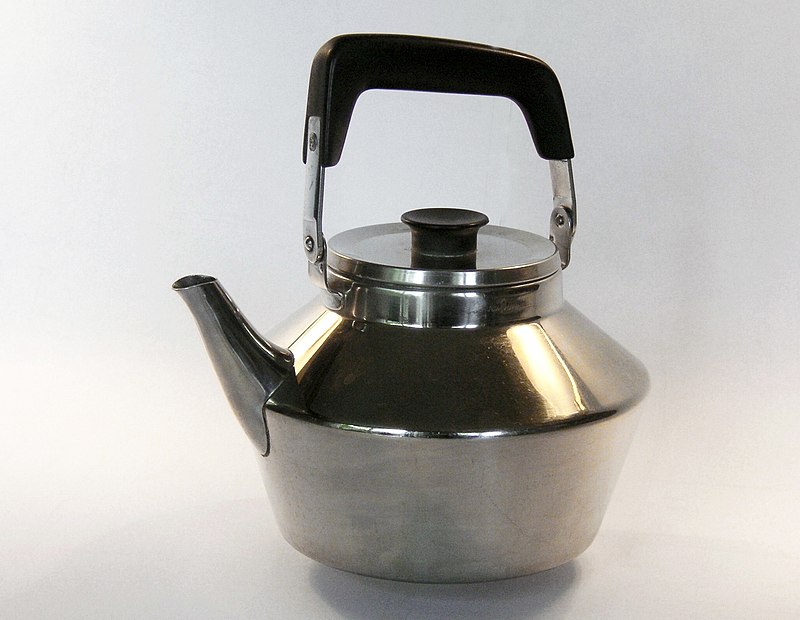
File:Bernadotte_Wasserkessel.jpg · Wikimedia Commons · See Wikimedia Commons
kettle
Sign in to saveAlso known as tea kettle, teakettle
thumb|A traditional stainless steel kettle with a handle upright|thumb|An electric kettle, with boiling water visible in its transparent water chamber A kettle, sometimes called a tea kettle or teakettle, is a device specialized for boiling water, commonly with a lid, spout, and handle. Strictly, this refers to a stovetop kettle, which uses heat from a cooktop. An electric water boiler, which is a small kitchen appliance with an internal heating element, may also be referred to as an electric kettle.
A kettle is a device designed for boiling water, typically featuring a lid, spout, and handle, and can be either a stovetop version heated by a cooktop or an electric appliance with a built-in heating element. Kettles matter because they provide a quick and practical way to heat water for tea, coffee, cooking, and other everyday household needs.
AI-generated from the Wikipedia summary — may contain errors.
Wikidata facts
- Subclass of
- cooking pot
- Image
- Aeg peter-behrens03.jpg
- Has use
- boiling
Show 2 more facts
- Commons category
- Kettles
- MCN code
- 7013.42.10
Sources (2)
via Wikidata · CC0
~8 min read
Encyclopedic overview
11 sectionsContents
- Etymology
- Stovetop kettles
- Electric kettles
- Development
- Whistling kettles
- Automatic tea kettles
- Kettle gallery
- Similar devices
- See also
- References
- Further reading
thumb|A traditional stainless steel kettle with a handle upright|thumb|An electric kettle, with boiling water visible in its transparent water chamber A kettle, sometimes called a tea kettle or teakettle, is a device specialized for boiling water, commonly with a lid, spout, and handle. Strictly, this refers to a stovetop kettle, which uses heat from a cooktop. An electric water boiler, which is a small kitchen appliance with an internal heating element, may also be referred to as an electric kettle.
== Etymology == The word kettle originates from Old Norse ketill, "cauldron". The Old English spelling was cetel with initial che- [tʃ] like 'cherry', Middle English (and dialectal) was chetel, both come (together with German Kessel "cauldron") ultimately from Germanic *katilaz, that was borrowed from Latin catillus, diminutive form of catinus "deep vessel for serving or cooking food", which in various contexts is translated as "bowl", "deep dish", or "funnel".
Excerpted from Wikipedia’s “kettle” article, available under the CC BY-SA 4.0 licence.
Gallery (24)
Available in 76 languages
- Español
- Français
- Deutsch
- 中文
- 日本語
- Русский
- Português
- Italiano
- العربية
- हिन्दी
- Afrikaans
- Albanian
- Armenian
- Azerbaijani
- Bahasa Indonesia
- Bangla
- bdr
- be_x_old
Show 57 more
- Belarusian
- Bikol
- Breton
- Catalan
- Chuvash
- Czech
- Egyptian Arabic
- Esperanto
- Filipino
- Gujarati
- Hausa
- Hebrew
- hyw
- Iban
- Icelandic
- Irish
- Javanese
- Kazakh
- Kurdish
- Latin
- Latvian
- lbe
- Low German
- Luxembourgish
- Macedonian
- Malay
- Marathi
- Minangkabau
- Mongolian
- Nederlands
- nup
- olo
- Papiamento
- Polski
- Punjabi
- Romanian
- Serbian
- simple
- Slovenian
- Somali
- Svenska
- Tajik
- Tiếng Việt
- Türkçe
- Tyap
- Ukrainian
- Urdu
- Uzbek
- Veps
- Welsh
- West Flemish
- Western Panjabi
- Wu Chinese
- Yiddish
- zh_yue
- فارسی
- 한국어
via Wikidata sitelinks · CC0