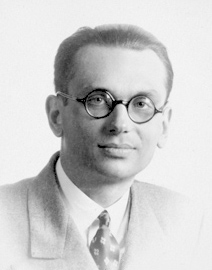
File:Kurt_gödel.jpg · Wikimedia Commons · See Wikimedia Commons
Kurt Gödel
Sign in to saveAlso known as Kurt Friedrich Gödel
Austrian-American logician, mathematician, and philosopher of mathematics (1906-1978)
Kurt Gödel was an Austrian-American logician and mathematician who fundamentally changed our understanding of mathematics and logic through his revolutionary work in the early 20th century. His discoveries about the limits of mathematical proof systems matter because they showed that no consistent set of mathematical rules can prove all true statements within its own framework—a finding that reshaped philosophy, mathematics, and computer science.
AI-generated from the Wikipedia summary — may contain errors.
Wikidata facts
- Instance of
- human
- Given name
- Kurt
- Gender
- male
- Citizenship
- Czechoslovakia
- Place of birth
- Brno
- Place of death
- Princeton
- Occupation
- physicist
- Educated at
- University of Vienna
- Employer
- Institute for Advanced Study
- Languages spoken
- English language
- Native language
- German
- Religion
- Christianity
- Doctoral advisor
- Hans Hahn
- Student of
- Philipp Furtwängler
- Field of work
- philosophy of mathematics
- Image
- 1925 kurt gödel.png
- Work location
- Brno
- Residence
- Austria
Show 16 more facts
- Commons category
- Kurt Gödel
- cause of death
- starvation
- member of
- American Philosophical Society
- date of birth
- 1906-04-28
- date of death
- 1978-01-14
- Erdős number
- 3
- Commons gallery
- Kurt Gödel
- name in native language
- Kurt Friedrich Gödel
- topic's main category
- Category:Kurt Gödel
- ACM Classification Code (2012)
- 10011419
- writing language
- German
- manner of death
- Suicide
- P8168
- Tamar
- birth name
- Kurt Friedrich Gödel
- on focus list of Wikimedia project
- Wikipedia:Vital articles/Level/4
- maintained by WikiProject
- WikiProject Mathematics
Sources (8)
via Wikidata · CC0
~31 min read
Encyclopedic overview
Kurt Friedrich Gödel (/ˈɡɜːrdəl/ GUR-dəl; German: [ˈkʊʁt ˈɡøːdl̩] ; April 28, 1906 – January 14, 1978) was a logician, mathematician, and philosopher. Considered along with Aristotle and Gottlob Frege to be one of the most significant logicians in history, Gödel profoundly influenced scientific and philosophical thinking in the 20th century (at a time when Bertrand Russell, Alfred North Whitehead, and David Hilbert were using logic and set theory to investigate the foundations of mathematics), building on earlier work by Frege, Richard Dedekind, and Georg Cantor.
Gödel's discoveries in the foundations of mathematics led to the proof of his completeness theorem in 1929 as part of his dissertation to earn a doctorate at the University of Vienna, and the publication of Gödel's incompleteness theorems two years later, in 1931. The incompleteness theorems address limitations of formal axiomatic systems. In particular, they imply that a formal axiomatic system satisfying certain technical conditions cannot decide the truth value of all statements about the natural numbers, and cannot prove that it is itself consistent. To prove this, Gödel developed a technique now known as Gödel numbering, which codes formal expressions as natural numbers.
Excerpted from Wikipedia’s “Kurt Gödel” article, available under the CC BY-SA 4.0 licence.
Gallery (5)
Available in 96 languages
- Español
- Français
- Deutsch
- 中文
- 日本語
- Русский
- Português
- Italiano
- العربية
- हिन्दी
- Afrikaans
- Albanian
- Armenian
- Asturian
- azb
- Azerbaijani
- Bahasa Indonesia
- Bangla
Show 77 more
- Basque
- be_x_old
- Belarusian
- Bosnian
- Bulgarian
- Burmese
- Catalan
- Croatian
- Czech
- Danish
- Egyptian Arabic
- Esperanto
- Estonian
- Faroese
- Filipino
- Finnish
- Galician
- Gan Chinese
- Greek
- Haitian Creole
- Hausa
- Hebrew
- Hungarian
- Icelandic
- Ido
- Interlingua
- Jamaican Creole English
- Javanese
- Kannada
- Kyrgyz
- Latin
- Latvian
- Lithuanian
- Lojban
- Macedonian
- Malagasy
- Malayalam
- Marathi
- Mirandese
- Nederlands
- Newari
- Norwegian
- Norwegian Nynorsk
- Novial
- Piedmontese
- Polski
- Punjabi
- rki
- Romanian
- Sanskrit
- Scots
- Serbian
- Serbian (Latin)
- simple
- Slovak
- Slovenian
- Svenska
- Tajik
- Tamil
- Tiếng Việt
- Türkçe
- Ukrainian
- Urdu
- Uzbek
- Waray
- Western Frisian
- Western Panjabi
- Wu Chinese
- Xhosa
- Yoruba
- Zaza
- zh_classical
- zh_min_nan
- zh_yue
- فارسی
- ไทย
- 한국어
via Wikidata sitelinks · CC0