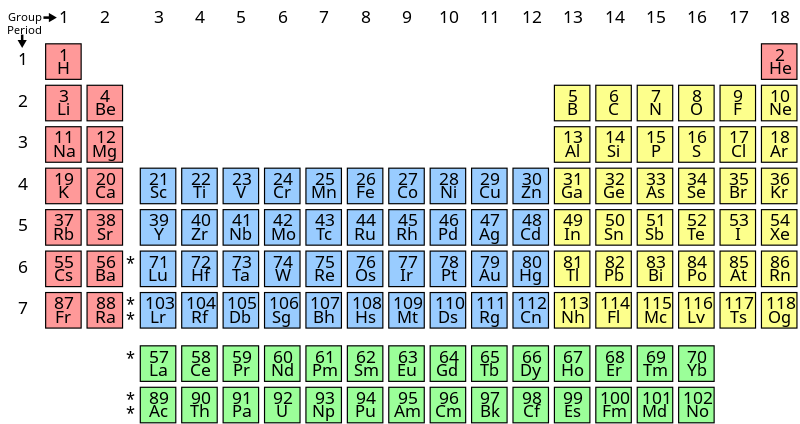
File:Simple_Periodic_Table_Chart-blocks.svg · Wikimedia Commons · See Wikimedia Commons
lanthanide
Sign in to saveAlso known as rare earths, lanthanide series, lanthanoid, lanthanoid series element, lanthanoid series elements
A lanthanide () is any of the 15 metallic chemical elements with atomic numbers 57–71, from lanthanum through lutetium. In the periodic table, the first fourteen (up to ytterbium) fill the 4f orbitals. Lutetium (element 71) is also often considered a lanthanide, despite being a d-block element and a transition metal. The IUPAC lists the 15 elements La, Ce, Pr, Nd, Pm, Sm, Eu, Gd, Tb, Dy, Ho, Er, Tm, Yb, Lu, under the collective name lanthanoid (), which it recommends as chemically more correct for this series.
Lanthanides are 15 metallic elements found on the periodic table (atomic numbers 57–71) that share similar chemical properties because of how their electrons are arranged. These elements are important in modern technology and materials, though they are often grouped together because their chemistry makes them behave in comparable ways.
AI-generated from the Wikipedia summary — may contain errors.
Research
53,350 papersvia PubMed
Wikidata facts
- Subclass of
- lithophile
- Has part
- cerium
- Named after
- lanthanum
- Image
- Cerium2.jpg
Show 5 more facts
- element symbol
- Ln
- Commons category
- Lanthanides
- topic's main category
- Category:Lanthanides
- on focus list of Wikimedia project
- Wikipedia:Vital articles/Level/4
- topic has template
- Template:Periodic table (lanthanides)
Sources (3)
via Wikidata · CC0
~58 min read
Encyclopedic overview
31 sectionsContents
- Etymology
- Physical properties of the elements
- Effect of 4f orbitals
- <span class="anchor" id="Chemistry"></span> Chemistry and compounds
- Lanthanide oxidation states
- Separation of lanthanides
- Coordination chemistry and catalysis
- Ln(III) compounds
- Ln(II) and Ln(IV) compounds
- Hydrides
- Halides
- Oxides and hydroxides
- Chalcogenides (S, Se, Te)
- Pnictides (group 15)
- Carbides
- Borides
- Organometallic compounds
- Physical properties
- Magnetic and spectroscopic
- Occurrence
- Applications
- Industrial
- Radiation Resistance
- Life science
- Possible medical uses
- Biological effects
- See also
- Notes
- References
- Cited sources
- External links
A lanthanide () is any of the 15 metallic chemical elements with atomic numbers 57–71, from lanthanum through lutetium. In the periodic table, the first fourteen (up to ytterbium) fill the 4f orbitals. Lutetium (element 71) is also often considered a lanthanide, despite being a d-block element and a transition metal. The IUPAC lists the 15 elements La, Ce, Pr, Nd, Pm, Sm, Eu, Gd, Tb, Dy, Ho, Er, Tm, Yb, Lu, under the collective name lanthanoid (), which it recommends as chemically more correct for this series.
The informal chemical symbol Ln is used in general discussions of lanthanide chemistry to refer to any lanthanide. All but one of the lanthanides are f-block elements, corresponding to the filling of the 4f electron shell. Lutetium is a d-block element (thus also a transition metal), and on this basis its inclusion has been questioned; however, like its congeners scandium and yttrium in group 3, it behaves similarly to the other 14. The term rare-earth element or rare-earth metal is often used to include the stable group 3 elements Sc, Y, and Lu in addition to the 4f elements. All lanthanide elements form trivalent cations, Ln3+, whose chemistry is largely determined by the ionic radius, which decreases steadily from lanthanum (La) to lutetium (Lu).
Excerpted from Wikipedia’s “lanthanide” article, available under the CC BY-SA 4.0 licence.
Gallery (48)
Available in 103 languages
- Español
- Français
- Deutsch
- 中文
- 日本語
- Русский
- Português
- Italiano
- العربية
- हिन्दी
- Afrikaans
- Albanian
- Amharic
- Aragonese
- Armenian
- Asturian
- Azerbaijani
- Bahasa Indonesia
Show 84 more
- Balinese
- Bangla
- Bashkir
- Basque
- be_x_old
- Belarusian
- Bhojpuri
- Bosnian
- Breton
- Bulgarian
- Catalan
- cdo
- Central Kurdish
- Chuvash
- Croatian
- Czech
- Danish
- Esperanto
- Estonian
- Fiji Hindi
- Filipino
- Finnish
- Galician
- Georgian
- Hakka Chinese
- Hebrew
- Hungarian
- Icelandic
- Interlingua
- Irish
- Javanese
- Kazakh
- Kyrgyz
- Latin
- Latvian
- Limburgish
- Lithuanian
- Lombard
- Low German
- Luxembourgish
- Macedonian
- Malagasy
- Malay
- Malayalam
- Marathi
- Nederlands
- Newari
- Northern Frisian
- Norwegian
- Norwegian Nynorsk
- Occitan
- Polski
- Punjabi
- Quechua
- Romanian
- Scots
- Scottish Gaelic
- Serbian
- Serbian (Latin)
- simple
- Slovak
- Slovenian
- Svenska
- Swahili
- Tajik
- Tamil
- Tatar
- Tibetan
- Tiếng Việt
- Tumbuka
- Türkçe
- Ukrainian
- Uzbek
- Veps
- Waray
- Welsh
- Wu Chinese
- Yakut
- zh_classical
- zh_min_nan
- zh_yue
- فارسی
- ไทย
- 한국어
via Wikidata sitelinks · CC0