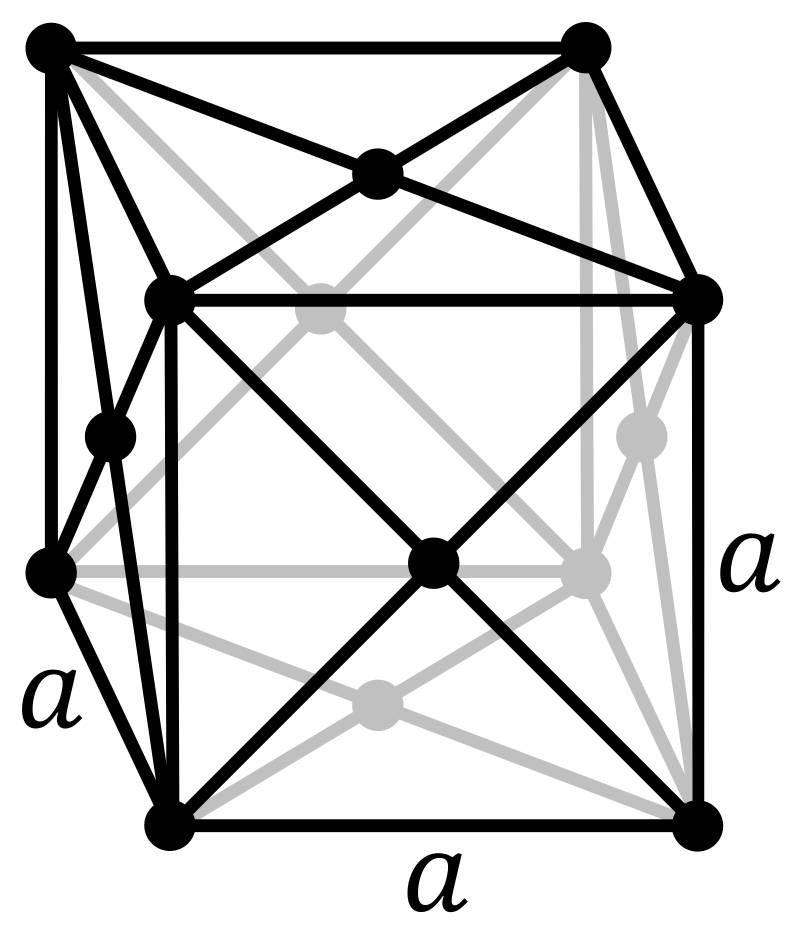
File:Cubic-face-centered.svg · Wikimedia Commons · See Wikimedia Commons
mendelevium
Sign in to saveAlso known as Md, element 101, Unu, unnilunium, 101Md, Mv
Mendelevium is a synthetic chemical element; it has symbol Md (formerly Mv) and atomic number 101. A metallic radioactive transuranium element in the actinide series, it is the first element by atomic number that currently cannot be produced in macroscopic quantities by neutron bombardment of lighter elements. It is the thirteenth actinide, the ninth transuranic element, and the first transfermium; it is named after Dmitri Mendeleev, the father of the periodic table.
OverviewAI-generated
Mendelevium is a chemical element with the symbol Md and atomic number 101. It was discovered in 1955. The element has an electronegativity of 1.3. Its chemical formula is Md.
The atomic weight of mendelevium is 258.09843. It is classified under the IUPAC name mendelevium. The substance has a topological polar surface area of 0 and contains no hydrogen bond donors or acceptors. It carries a charge of 0.
References to mendelevium appear in 951 other encyclopedia articles. Scientific literature includes 5 entries related to the element.
Synthesized by Vinony from 21 facts across 4 sources: Wikidata, PubChem, PubMed, Vinony graph. Generated from structured data (not the Wikipedia text) and checked against those facts — may still contain errors.
Chemical data
- Formula
- Md
- Molecular weight
- 258.09843 g/mol
- IUPAC name
- mendelevium
- SMILES
- [Md]
- InChIKey
- MQVSLOYRCXQRPM-UHFFFAOYSA-N
- Polar surface area
- 0 Ų
- H-bond donors
- 0
- H-bond acceptors
- 0
- Formal charge
- 0
via PubChem
Research
5 papers- Mendelevium 101.Nature chemistry · 2019Pichon ADOI: 10.1038/s41557-019-0227-8
- Mendelevium: divalency and other chemical properties.Science (New York, N.Y.) · 1967Hulet EK, Lougheed RW, Brady JD et al.DOI: 10.1126/science.158.3800.486
- Investigation of the solvent extraction of californium, fermium and mendelevium.Talanta · 1966Gavrilov KA, Gvuzdz E, Starý J et al.DOI: 10.1016/0039-9140(66)80065-6
- Measurement of the Md3+/Md2+ reduction potential studied with flow electrolytic chromatography.Inorganic chemistry · 2013Toyoshima A, Li Z, Asai M et al.DOI: 10.1021/ic401571h
- First Ionization Potentials of Fm, Md, No, and Lr: Verification of Filling-Up of 5f Electrons and Confirmation of the Actinide Series.Journal of the American Chemical Society · 2018Sato TK, Asai M, Borschevsky A et al.DOI: 10.1021/jacs.8b09068
via PubMed
Wikidata facts
- Instance of
- synthetic element
- Part of
- actinide
- Named after
- Dmitri Mendeleev
- Image
- Mendelevium.svg
Show 14 more facts
- element symbol
- Unu
- Commons category
- Mendelevium
- time of discovery or invention
- 1955-01-01
- topic's main category
- Category:Mendelevium
- atomic number
- 101
- Commons gallery
- Mendelevium
- described by source
- Armenian Soviet Encyclopedia
- canonical SMILES
- [Md]
- chemical formula
- Md
- discoverer or inventor
- Glenn T. Seaborg
- Unicode character
- 鍆
- electronegativity
- 1.3
- on focus list of Wikimedia project
- Wikipedia:Vital articles/Level/4
- topic has template
- Template:Infobox mendelevium
Sources (6)
via Wikidata · CC0
~21 min read
Encyclopedic overview
13 sectionsContents
- Discovery
- Characteristics
- Physical
- Chemical
- Atomic
- Isotopes
- Production and isolation
- Toxicity
- Notes
- References
- Bibliography
- Further reading
- External links
Mendelevium is a synthetic chemical element; it has symbol Md (formerly Mv) and atomic number 101. A metallic radioactive transuranium element in the actinide series, it is the first element by atomic number that currently cannot be produced in macroscopic quantities by neutron bombardment of lighter elements. It is the thirteenth actinide, the ninth transuranic element, and the first transfermium; it is named after Dmitri Mendeleev, the father of the periodic table.
Like all the transfermiums, it can only be produced in particle accelerators by bombarding lighter elements with charged particles. The element was first produced in 1955 by bombarding einsteinium with alpha particles, the method still used today. Using commonly-available microgram quantities of einsteinium-253, over a million mendelevium atoms may be made each hour. The chemistry of mendelevium is typical for the late actinides, with a dominant +3 oxidation state but also a +2 oxidation state accessible in solution. All known isotopes of mendelevium have short half-lives; there are currently no uses for it outside basic scientific research, and only small amounts are produced.
Excerpted from Wikipedia’s “mendelevium” article, available under the CC BY-SA 4.0 licence.
Gallery (14)
Available in 131 languages
- Español
- Français
- Deutsch
- 中文
- 日本語
- Русский
- Português
- Italiano
- العربية
- हिन्दी
- Afrikaans
- Albanian
- Amharic
- Angika
- Armenian
- Asturian
- Azerbaijani
- Bahasa Indonesia
Show 112 more
- Balinese
- Bangla
- Basque
- be_x_old
- Belarusian
- Bhojpuri
- Bosnian
- Breton
- Bulgarian
- Burmese
- Catalan
- cdo
- Cebuano
- Central Kurdish
- Chuvash
- Cornish
- Corsican
- Croatian
- Czech
- Danish
- Egyptian Arabic
- Esperanto
- Estonian
- Fiji Hindi
- Filipino
- Finnish
- Friulian
- Galician
- Georgian
- Greek
- Gujarati
- Hakka Chinese
- Hebrew
- Hungarian
- Icelandic
- Ido
- Interlingua
- Irish
- Javanese
- Kalmyk
- Kannada
- Kazakh
- kbp
- Komi
- Kyrgyz
- Latin
- Latvian
- Ligurian
- Limburgish
- Lithuanian
- Lojban
- Luxembourgish
- Macedonian
- Malay
- Malayalam
- Manipuri
- Manx
- Marathi
- Mongolian
- Moroccan Arabic
- Nederlands
- Newari
- Northern Frisian
- Norwegian
- Norwegian Nynorsk
- Novial
- Occitan
- Odia
- olo
- Pashto
- Piedmontese
- Polski
- Quechua
- roa_rup
- Romanian
- Sanskrit
- Sardinian
- Saterland Frisian
- Scottish Gaelic
- Serbian
- Serbian (Latin)
- Sicilian
- simple
- Slovak
- Slovenian
- Svenska
- Tajik
- Tamil
- Tatar
- Telugu
- Tiếng Việt
- Türkçe
- Ukrainian
- Urdu
- Uyghur
- Uzbek
- Veps
- Volapük
- Waray
- Welsh
- Western Mari
- Western Panjabi
- Wu Chinese
- Yakut
- Yoruba
- zh_classical
- zh_min_nan
- zh_yue
- Zulu
- فارسی
- ไทย
- 한국어
via Wikidata sitelinks · CC0