File:Simple_Periodic_Table_Chart-blocks.svg · Wikimedia Commons · See Wikimedia Commons
period
Sign in to saveAlso known as row, Reihe
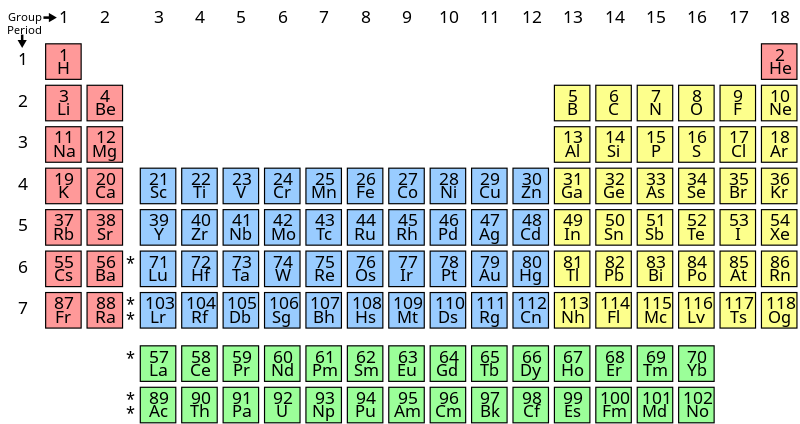
row in the periodic table: repetition of properties in chemical elements when ordered by atomic number:
A period is a horizontal row in the periodic table of elements, where elements are arranged by their atomic number. Periods matter because elements in the same period share similar patterns in their chemical properties and structure, which helps scientists predict how elements will behave and react with one another.
AI-generated from the Wikipedia summary — may contain errors.
Wikidata facts
- Part of
- Periodic table
Show 6 more facts
- topic has template
- Template:Periodic table (micro)
- name in kana
- げんそのしゅうき
- topic's main category
- Category:Periods (periodic table)
- different from
- group
- on focus list of Wikimedia project
- Wikipedia:Vital articles/Level/4
- is metaclass for
- chemical element
Sources (1)
via Wikidata · CC0
~10 min read
Encyclopedic overview
In the periodic table of the elements, each numbered row is a period. A period on the periodic table is a row of chemical elements. All elements in a row have the same number of electron shells. Each next element in a period has one more proton and is less metallic than its predecessor. Arranged this way, elements in the same group (column) have similar chemical and physical properties, reflecting the periodic law. For example, the halogens lie in the second-to-last group (group 17) and share similar properties, such as high reactivity and the tendency to gain one electron to arrive at a noble-gas electronic configuration. As of 2026, a total of 118 elements have been discovered and confirmed.
The Madelung energy ordering rule describes the order in which orbitals are arranged by increasing energy according to the Madelung rule. Each diagonal corresponds to a different value of n + l. Modern quantum mechanics explains these periodic trends in properties in terms of electron shells. As atomic number increases, shells fill with electrons in approximately the order shown in the ordering rule diagram. The filling of each shell corresponds to a row in the table.
Excerpted from Wikipedia’s “period” article, available under the CC BY-SA 4.0 licence.
Gallery (3)
Available in 84 languages
- Español
- Français
- Deutsch
- 中文
- 日本語
- Русский
- Português
- Italiano
- العربية
- हिन्दी
- Afrikaans
- Angika
- Aragonese
- Armenian
- Asturian
- Azerbaijani
- Bahasa Indonesia
- Balinese
Show 65 more
- Bangla
- Basque
- Belarusian
- Bosnian
- Breton
- Bulgarian
- Catalan
- Chuvash
- Croatian
- Czech
- Danish
- Esperanto
- Estonian
- Finnish
- Galician
- Georgian
- Greek
- Haitian Creole
- Hebrew
- Hungarian
- Icelandic
- Inari Sami
- Interlingua
- Javanese
- Latin
- Latvian
- Lombard
- Low German
- Luxembourgish
- Macedonian
- Malay
- Malayalam
- Mongolian
- Nederlands
- Norwegian
- Norwegian Nynorsk
- Odia
- Polski
- Punjabi
- Romanian
- Serbian
- Serbian (Latin)
- simple
- Slovak
- Slovenian
- Somali
- Sundanese
- Svenska
- Tajik
- Tamil
- Telugu
- Tiếng Việt
- Türkçe
- Ukrainian
- Urdu
- Waray
- Welsh
- West Flemish
- Western Frisian
- Wu Chinese
- zh_min_nan
- zh_yue
- فارسی
- ไทย
- 한국어
via Wikidata sitelinks · CC0