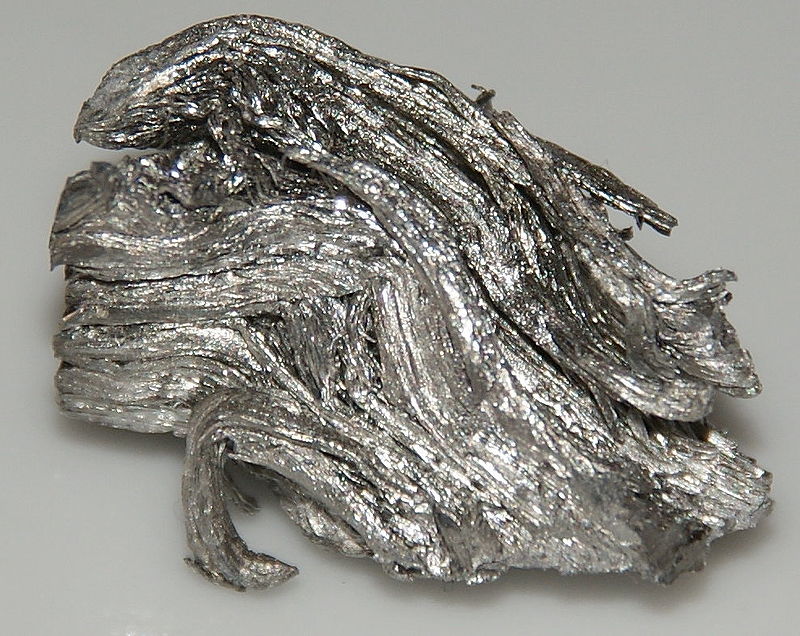
File:Holmium2.jpg · Wikimedia Commons · See Wikimedia Commons
holmium
Sign in to saveAlso known as element 67, Ho
Holmium is a chemical element; it has symbol Ho and atomic number 67. It is a rare-earth element and the eleventh member of the lanthanide series of elements. It is a relatively soft, silvery, fairly corrosion-resistant and malleable metal. Like many other lanthanides, holmium is too reactive to be found in native form, as pure holmium slowly forms a yellowish oxide coating when exposed to air. When isolated, holmium is relatively stable in dry air at room temperature. However, it reacts with water and corrodes readily, and also burns in air when heated.
OverviewAI-generated
Holmium is a chemical element with the symbol Ho and atomic number 67. It has an atomic mass of 164.930329 and typically exhibits an oxidation state of 3. The element has an electronegativity of 1.23. Its chemical formula is Ho, and it is represented by the canonical SMILES string [Ho].
Holmium was discovered in 1878. It has a melting point of 1734 and a boiling point of 2873. The substance has a topological polar surface area of 0, with zero hydrogen bond donors and acceptors, and a charge of 0. It is classified under the 2022 Harmonized System Code 280530.
Synthesized by Vinony from 26 facts across 4 sources: Wikidata, PubChem, PubMed, Vinony graph. Generated from structured data (not the Wikipedia text) and checked against those facts — may still contain errors.
Chemical data
- Formula
- Ho
- Molecular weight
- 164.93033 g/mol
- IUPAC name
- holmium
- SMILES
- [Ho]
- InChIKey
- KJZYNXUDTRRSPN-UHFFFAOYSA-N
- Polar surface area
- 0 Ų
- H-bond donors
- 0
- H-bond acceptors
- 0
- Formal charge
- 0
via PubChem
Research
5,442 papers- Holmium-166 Microsphere Radioembolization of Hepatic Malignancies.ReviewSeminars in nuclear medicine · 2019Reinders MTM, Smits MLJ, van Roekel C et al.DOI: 10.1053/j.semnuclmed.2019.01.008
- Holmium-166 Radioembolization: Current Status and Future Prospective.ReviewCardiovascular and interventional radiology · 2022Stella M, Braat AJAT, van Rooij R et al.DOI: 10.1007/s00270-022-03187-y
- Holmium:yttrium-aluminum-garnet laser prostatectomy.ReviewMayo Clinic proceedings · 1998Kabalin JN, Gilling PJ, Fraundorfer MRDOI: 10.4065/73.8.792
- Holmium laser prostatectomy.ReviewCurrent urology reports · 2001Paterson RF, Lingeman JEDOI: 10.1007/s11934-001-0063-3
- Holmium laser enucleation versus bipolar transurethral enucleation for treating benign prostatic hyperplasia, which one is better?ReviewThe aging male : the official journal of the International Society for the Study of the Aging Male · 2021Li J, Cao D, Huang Y et al.DOI: 10.1080/13685538.2021.2014807
- Holmium laser applications of the prostate.ReviewThe Urologic clinics of North America · 2009Lerner LB, Tyson MDDOI: 10.1016/j.ucl.2009.07.005
- Holmium laser resection of the prostate.ReviewEuropean urology · 1999Le Duc A, Gilling PJDOI: 10.1159/000019836
- Incidental prostate cancer after holmium laser enucleation of the prostate-A narrative review.ReviewAndrologia · 2022Yilmaz M, Toprak T, Suarez-Ibarrola R et al.DOI: 10.1111/and.14332
via PubMed
Wikidata facts
- Instance of
- chemical element
- Part of
- period 6
- Named after
- Stockholm
- Mass
- 164.930329
- Image
- Holmium.jpg
- Has use
- nuclear poison
Show 18 more facts
- Commons category
- Holmium
- element symbol
- Ho
- discoverer or inventor
- Jacques-Louis Soret
- topic's main category
- Category:Holmium
- location of discovery
- Uppsala
- time of discovery or invention
- 1878-01-01
- atomic number
- 67
- oxidation state
- 3
- electronegativity
- 1.23
- Commons gallery
- Holmium
- Unicode character
- 鈥
- chemical formula
- Ho
- canonical SMILES
- [Ho]
- different from
- Ho
- on focus list of Wikimedia project
- Wikipedia:Vital articles/Level/4
- boiling point
- 2873
- melting point
- 1734
- 2022 Harmonized System Code
- 280530
Sources (6)
via Wikidata · CC0
~14 min read
Encyclopedic overview
18 sectionsContents
- Properties
- Physical properties
- Chemical properties
- Oxidation states
- Isotopes
- Compounds
- Oxides and chalcogenides
- Halides
- Organoholmium compounds
- History
- Occurrence and production
- Applications
- Biological role and precautions
- See also
- References
- Bibliography
- Further reading
- External links
Holmium is a chemical element; it has symbol Ho and atomic number 67. It is a rare-earth element and the eleventh member of the lanthanide series of elements. It is a relatively soft, silvery, fairly corrosion-resistant and malleable metal. Like many other lanthanides, holmium is too reactive to be found in native form, as pure holmium slowly forms a yellowish oxide coating when exposed to air. When isolated, holmium is relatively stable in dry air at room temperature. However, it reacts with water and corrodes readily, and also burns in air when heated.
In nature, holmium occurs together with the other rare-earth metals (like thulium). It is a relatively rare lanthanide, making up 1.4 parts per million of the Earth's crust, an abundance similar to tungsten. Holmium was discovered through isolation by Swedish chemist Per Theodor Cleve. It was also independently discovered by Jacques-Louis Soret and Marc Delafontaine, who together observed it spectroscopically in 1878. Its oxide was first isolated from rare-earth ores by Cleve in 1878. The element's name comes from Holmia, the Latin name for the city of Stockholm.
Excerpted from Wikipedia’s “holmium” article, available under the CC BY-SA 4.0 licence.
Gallery (12)
Available in 130 languages
- Español
- Français
- Deutsch
- 中文
- 日本語
- Русский
- Português
- Italiano
- العربية
- हिन्दी
- Afrikaans
- Albanian
- Amharic
- Angika
- Armenian
- Asturian
- Azerbaijani
- Bahasa Indonesia
Show 111 more
- Balinese
- Bangla
- Basque
- be_x_old
- Belarusian
- Bhojpuri
- Bosnian
- Breton
- Bulgarian
- Burmese
- Catalan
- cdo
- Cebuano
- Central Kurdish
- Chuvash
- Cornish
- Corsican
- Croatian
- Czech
- Danish
- Egyptian Arabic
- Esperanto
- Estonian
- Faroese
- Fiji Hindi
- Finnish
- Friulian
- Galician
- Georgian
- Greek
- Gujarati
- Hakka Chinese
- Hebrew
- Hungarian
- Icelandic
- Ido
- Interlingua
- Irish
- Javanese
- Kalmyk
- Kannada
- Kazakh
- kbp
- Komi
- Kyrgyz
- Latin
- Latvian
- Ligurian
- Limburgish
- Lithuanian
- Lojban
- Luxembourgish
- Macedonian
- Malagasy
- Malay
- Malayalam
- Manx
- Marathi
- Mongolian
- Moroccan Arabic
- Nederlands
- Newari
- Northern Frisian
- Norwegian
- Norwegian Nynorsk
- Novial
- Occitan
- olo
- Pashto
- Piedmontese
- Polski
- Quechua
- roa_rup
- Romanian
- Sanskrit
- Sardinian
- Saterland Frisian
- Scottish Gaelic
- Serbian
- Serbian (Latin)
- Sicilian
- simple
- Slovak
- Slovenian
- Svenska
- Swahili
- Tajik
- Tamil
- Tatar
- Telugu
- Tiếng Việt
- Türkçe
- Ukrainian
- Urdu
- Uyghur
- Uzbek
- Veps
- Waray
- Welsh
- Western Mari
- Western Panjabi
- Wu Chinese
- Yakut
- Yoruba
- zh_classical
- zh_min_nan
- zh_yue
- Zulu
- فارسی
- ไทย
- 한국어
via Wikidata sitelinks · CC0