
Also known as Lao People's Democratic Republic, la, Lao PDR, LAO
東南アジアの国
OverviewAI-generated
Laos, officially the Lao People's Democratic Republic, is a landlocked sovereign state in South-Eastern Asia. Its capital is Vientiane. The country shares borders with Myanmar, Cambodia, China, and Thailand. The highest point within its territory is Phou Bia. The official language is Lao, and the currency is the Lao kip. The national anthem is Pheng Xat Lao.
The population is reported as 7,647,000 and 7,769,819 in different datasets. The head of state and head of government include Thongloun Sisoulith, Phankham Viphavan, and Sonexay Siphandone. Laos is a member of the United Nations and the Association of Southeast Asian Nations. It contains administrative entities such as Attapeu Province, Bokeo Province, Bolikhamsai Province, and Champasak Province. The top-level Internet domain is .la.
Synthesized by Vinony from 71 facts across 10 sources: Wikidata, REST Countries, Open Meteo, Openweathermap, World Bank, OpenStreetMap, Firecrawl, PubMed, Vinony graph, Geo. Generated from structured data (not the Wikipedia text) and checked against those facts — may still contain errors.
Weather now
7-day forecast
via Open-Meteo
Country

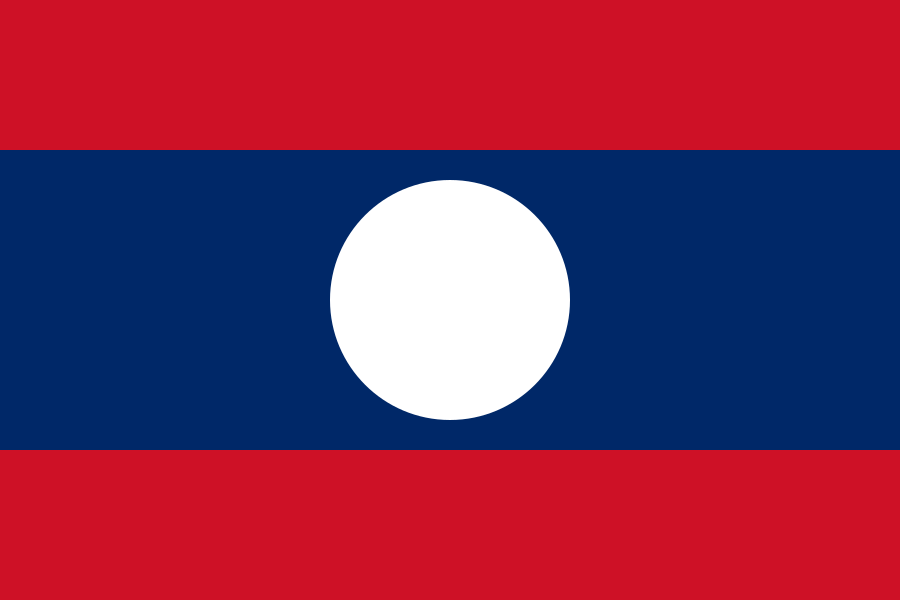
- Capital
- Vientiane
- Population
- 7,647,000
- Region
- Asia · South-Eastern Asia
- Demonym
- Laotian
- Currencies
- LAK (₭)
- Languages
- Lao
- Calling code
- +856
- Drives on
- Right
- Gini
- 38.8 (2018)
- FIFA code
- LAO
- TLD
- .la
- Timezones
- UTC+07:00
- Borders
- MMR, KHM, CHN, THA, VNM
via REST Countries
Indicators · World Bank
- GDP
- $16.5B(2024)
- Population
- 7,769,819(2024)
- Life expectancy
- 69.2 yrs(2024)
- Unemployment
- 1.2 %(2025)
- Urban population
- 39.6 %(2024)
- Internet users
- 65.6 %(2024)
- Forest area
- 71.5 %(2023)
- Renewable energy
- 49.2 %(2022)
via World Bank Open Data · CC BY 4.0
Place details
- Locality
- Phonkeo
- Region
- ບໍລິຄຳໄຊ
- Country
- ປະເທດລາວ
- Population
- 7,061,507
- Timezone
- Asia/Vientiane
via OpenStreetMap · GeoNames
Wikipedia views (30d)
117,345 totalvia Wikimedia Pageviews API
Key facts
- Country.conventional_long_name
- Lao People's Democratic Republic
- Country.common_name
- Laos
- Country.image_flag
- Flag of Laos.svg
- Country.image_coat
- Emblem of Laos.png
- Country.coa_size
- 90
- Country.symbol_type
- Emblem
- Country.national_motto
- "Peace, Independence, Democracy, Unity and Prosperity"
- Country.national_anthem
- "Lao National Anthem"
- Country.capital
- Vientiane
- Country.largest_city
- capital
- Country.official_languages
- Lao
- Country.languages_type
- Spoken languages
- Country.ethnic_groups_year
- 2015
- Country.demonym
- Laotian
- Country.government_type
- Unitary communist state
- Country.leader_title1
- General Secretary, and President
- Country.leader_name1
- Thongloun Sisoulith
- Country.leader_title2
- Prime Minister
via Wikipedia infobox
Research
5,111 papers- Laos.Department of State publication. Background notes series · 1986United States. Department of State. Bureau of Public Affairs
- Laos eliminates lymphatic filariasis.The Lancet. Infectious diseases · 2024Bagcchi SDOI: 10.1016/S1473-3099(23)00770-3
- Type 1 diabetes in Laos, 2016-2021.Pediatric diabetes · 2022Lek N, Manivong A, Rassavong K et al.DOI: 10.1111/pedi.13366
- Typhoid in Laos: An 18-Year Perspective.The American journal of tropical medicine and hygiene · 2020Roberts T, Rattanavong S, Phommasone K et al.DOI: 10.4269/ajtmh.19-0637
- Zika virus in Vietnam, Laos, and Cambodia: are there health risks for travelers?ReviewEuropean journal of clinical microbiology & infectious diseases : official publication of the European Society of Clinical Microbiology · 2019Dinh TC, Bac ND, Minh LB et al.DOI: 10.1007/s10096-019-03563-6
- Detection of Batborne Hantaviruses, Laos, 2023-2024.Emerging infectious diseases · 2025Vanhnollat C, Somlor S, Dimitrova K et al.DOI: 10.3201/eid3104.241720
- The Genus Haemaphysalis (Acari: Ixodidae) in Laos: An Update of Species Records and a Review of Taxonomic Challenges.ReviewJournal of medical entomology · 2022Vongphayloth K, Apanaskevich DA, Lakeomany K et al.DOI: 10.1093/jme/tjac075
- Laos is Affected by HIV CRF01_AE and the Newly Identified CRF97_01B.Virologica Sinica · 2020Chen X, Ye M, Wang Y et al.DOI: 10.1007/s12250-020-00215-4
via PubMed

Wikidata facts
- Instance of
- sovereign state
- Official name
- ສາທາລະນະລັດ ປະຊາທິປະໄຕ ປະຊາຊົນລາວ
- Demonym
- Laosach
- Country
- Laos
- Contains
- Xaisomboun
- Continent
- Asia
- Capital
- Vientiane
- Official language
- Lao
- Currency
- Lao kip
- Population
- 6858160
- Area
- 236800
- Head of government
- Sonexay Siphandone
- Head of state
- Thongloun Sisoulith
- Legislature
- National Assembly
- Anthem
- Pheng Xat Lao
- Shares border with
- Vietnam
- Highest point
- Phou Bia
- Official website
- www.tourismlaos.org
- Image
- Karst peaks and green paddy fields under a stormy sky, South view from Mount Nam Xay, Vang Vieng, Laos.jpg
- Life expectancy
- 69
- Nominal GDP
- 15724383783
- Calling code
- +856
- Licence plate code
- LAO
- Electrical plug type
- Schuko
Show 62 more facts
- Mains voltage
- 230
- Motto
- Мир, независимост, демокрация, единство и просперитет
- Flag
- flag of Laos
- Coat of arms
- Emblem of Laos
- top-level Internet domain
- .la
- Commons category
- Laos
- topic's main category
- Category:Laos
- category for people born here
- Category:Births in Laos
- topic's main Wikimedia portal
- Portal:Laos
- category for people who died here
- Category:Deaths in Laos
- category of associated people
- Category:Laotian people
- diplomatic relation
- North Korea
- IPA transcription
- ˈlɑːus
- Commons gallery
- ປະເທດລາວ
- lowest point
- Mekong River
- mobile country code
- 457
- driving side
- right
- geography of topic
- Geography of Laos
- age of majority
- 18
- trunk prefix
- 0
- marriageable age
- 18
- office held by head of state
- President of Laos
- office held by head of government
- Prime Minister of Laos
- number of out-of-school children
- 533089
- total fertility rate
- 2.57
- maritime identification digits
- 531
- inception
- 1949-01-01
- history of topic
- history of Laos
- native label
- ສາທາລະນະລັດ ປະຊາທິປະໄຕ ປະຊາຊົນລາວ
- Unicode character
- 🇱🇦
- central bank
- Bank of the Lao P.D.R.
- language used
- Pacoh
- culture
- culture of Laos
- VAT rate
- 10
- BTI Status Index
- 3.73
- BTI Governance Index
- 4.23
- economy of topic
- economy of Laos
- demographics of topic
- demographics of Laos
- different from
- Popular Orthodox Rally
- Democracy Index
- 1.77
- Human Development Index
- 0.607
- P11012
- Wulingyuan
- hashtag
- Laos
- on focus list of Wikimedia project
- Wikipedia:Vital articles/Level/4
- Happy Planet Index score
- 42.8
- Gini coefficient
- 38.8
- Inequality-adjusted Human Development Index
- 0.459
- female population
- 3260000
- male population
- 3254000
- literacy rate
- 84.7
- P12749
- Hubert Salentin
- birth rate
- 21.46
- death rate
- 6.195
- rural population
- 4698995
- urban population
- 2830480
- P8168
- Chakal
- most populous urban area
- Vientiane
- general secretary
- Thongloun Sisoulith
- position held by head of the organization
- General Secretary of the Lao People's Revolutionary Party
- party chief representative
- Thongloun Sisoulith
- located in/on physical feature
- Southeast Asia
Sources (15)
via Wikidata · CC0
Travel guide
Understand
The Lao People's Democratic Republic (ສາທາລະນະລັດ ປະຊາທິປະໄຕ ປະຊາຊົນລາວ) (Lao PDR) is the only landlocked country in Southeast Asia, and the most sparsely populated. Once the center of the powerful kingdom of Lan Xang, Laos was reduced to a vassal state of Siam (modern-day Thailand) by the end of the 18th century. It was freed from Siamese fiefdom in 1893 upon becoming a French protectorate and gained its independence in 1953 amidst the backdrop of the chaotic Indochina Wars. Since the end of the civil war in 1975, Laos is a one-party communist state under a presidential system. Unlike most countries in Asia, the country has not undergone a major industrialisation and modernisation period; as a result, its lifestyle remains mostly rural, with strong Buddhist traditional culture, and the only large city is Vientiane.
An adjective often applied to Laos is "forgotten", but travelers lured by the prospect of visiting an untouched "Shangri-la" are likely to be disappointed. The country now draws five million visitors per year, nearly as many as the Philippines, and Chinese-led investment is rapidly transforming swathes of the country. But while backpackers may crowd a few tourist hubs like Luang Prabang and Vang Vieng, it's not hard to get off the beaten path and enjoy a laid-back lifestyle and the opportunity to knock back a few cold Beerlao while watching the sunsets on the Mekong. Perhaps one of the biggest attractions of Laos is the famous "Lao PDR" - Lao-Please Don't Rush.
Get in
Laos is one of the easiest countries in the world to visit — virtually everyone, save for citizens of a few countries, can enter the country visa-free or obtain a visa on arrival.
Get around
Travel within Laos has historically been slow, often painful and sometimes dangerous, but the 2021 opening of a railway spanning the northern half of the country and the ongoing construction of a parallel expressway is set to shake things up. Nevertheless, if travelling off the beaten track, allow plenty of leeway in your schedule for the near-inevitable delays, cancellations and breakdowns.
See
Unlike neighboring Thailand or Vietnam, Laos never underwent a massive economic development, neither during colonisation nor even after the liberalisation of the communist economy. As result, one key attraction of Laos is that most of the country, with the increasing exception of capital Vientiane, retains a relaxed, laid back feel with minimal presence of modern architecture or international brands and food chains. How much longer this will last is open to much speculation, especially with Chinese investment flooding in the 2020s, but meanwhile, it makes it a truly special and unique country to visit.
Do
Self-guided journeys by road. The most common trips travellers do in Laos, usually on a motorbike, are the Bolaven Loop and the Thakhek Loop, both in Southern Laos. {| class="wikitable" |+Comparing the Bolaven and Thakhek loops ! !Bolaven Loop !Thakhek Loop |- |Attractions |Waterfalls, hiking trails, scenic vistas, and coffee plantations |Caves, cold rivers and pools, scenic drives, and rock climbing opportunities. |- |Duration |Typically 3-8 days (most commonly 4 days) |Typically 4-10 days (most commonly 7 days) |- |Activities |Hiking, exploring scenic spots, visiting coffee plantations. Great for amateur photographers and lovers of coffee. The loop offers a variety of dining options and accommodation, with guesthouses and motels ranging from 100k-150k kip (Jan 2025). The route is relatively easy, although some dirt roads may pose challenges for novice riders on motorbikes or motor scooters. |Picturesque riding, cave exploration, swimming, wild camping opportunities, and passing through friendly local villages. The improved roads facilitate easy access to destinations such as Xe Bang Fai Cave. The region is also renowned for world-class rock climbing. |- |Example route |PDF map link |Google Maps link |} Both loops feature areas that are very much on the tourist trail, particularly in the south-western sections, making them suitable for short-term visitors. Day trips are feasible.
For individuals with only two days available, a three-day visit may be rushed and less enjoyabl…
Eat
thumb|Clockwise from top right: Tam maak hung papaya salad, sticky rice in a tip khao basket and fresh lettuce leaves
Lao food is one of the underappreciated cuisines of the world and can be a real highlight of your trip. It's very similar to the Isaan food of northeastern Thailand: very spicy, more often bitter than sweet, and using lots of fresh herbs and raw vegetables. These cool your mouth when the chilli gets too intense.
Rice is the staple carbohydrate. The standard kind is sticky rice (ເຂົ້າໜຽວ khao niaow), eaten by hand from small baskets called tip khao. Using your right hand, never your left, pinch off a bit, roll into flat disk, dip or wrap and munch away. Sticky rice is so important culturally that it's the standard offering to monks and the Lao even call themselves "children of sticky rice" (luk khao niaow).
The national dish is laap (ລາບ, also larb), a "salad" of minced meat or fish mixed with herbs, spices, lime juice and, more often than not, blistering amounts of chili. Unlike Thai larb, the Lao version can use raw meat (dip) instead of cooked meat (suk), and if prepared with seafood makes a tasty, if spicy, carpaccio.
Another Lao invention is tam maak hung (ຕໍາຫມາກຫຸ່ງ), the spicy green papaya salad known as som tam in Thailand, but which the Lao like to dress with fermented crab (ປູດອງ pudem) and a chunky, intense fish sauce called pa daek (ປາແດກ), resulting in a stronger flavour than the milder, sweeter Thai style. Other popular dishes include ping ka…
Drink
thumb|You can't visit Laos without having a Beerlao The national drink of Laos is the ubiquitous and tasty Beerlao, made with Laotian jasmine rice and one of the few Lao exports. It maintains an almost mythical status among travellers and beer aficionados. The yellow logo with its tiger-head silhouette can be seen everywhere, and a large 640 ml bottle shouldn't cost more than US$1-2 in restaurants. In addition to the original, it's now available in a constellation of flavors: light, dark, white (wheat), even an IPA!
Rice spirit, known as lao-lao, is everywhere and at less than US$0.30 per 750 ml bottle is the cheapest way to get drunk. Beware, as quality and distilling standards vary wildly: in 2024, six backpackers died from methanol poisoning in Vang Vieng. It's best to stick to commercially produced and sealed stuff.
Lao coffee (kaafeh) is recognised to be of very high quality. It's grown on the Bolaven Plateau in the south; the best brand is Lao Mountain Coffee. Unlike Thai coffees, Lao coffee is not flavoured with ground tamarind seed. To make sure you aren't fed overpriced Nescafé instead, be sure to ask for kaafeh thung. By default in lower end establishments, kaafeh lao comes with sugar and condensed milk; black coffee is kaafeh dam, coffee with milk (but often non-dairy creamer) is kaafeh nom.
Fresh coconut juice is delicious, and soymilk at convenience stores is surprisingly tasty, nutritious, and inexpensive.
There is not much nightlife outside of Vientiane and…
Sleep
thumb|Guesthouses on [[Don Det]] Accommodation options outside the Mekong Valley's main tourist spots are limited to basic hotels and guesthouses, but there are many budget and mid-priced hotels and guesthouses and quite a few fancy hotels in Vientiane and Luang Prabang. Pakse has the Champasak Palace. Rooms usually start from 60,000 kip (Jan 2023).
There are very few hotels that can be booked online. This may lead those about the visit for the first time to conclude that there is very little accommodation in Laos, but this is not the case. The vast majority of accommodation simply has no online presence beyond a Google Maps listing, if that. Booking.com and Agoda (in that order) seem to have the most listings for Laos, but these will be on the soulless corporate-owned end of the spectrum, with prices to match. The best way to find accommodation is to do it once you arrive. If you are concerned about not having anywhere to stay, make a booking online for your first night only, and find a nice guesthouse for a nice price once you arrive.
It is worth noting that wild camping (public areas / riverbanks / forests) is not legal in Laos.
Stay safe
thumb|225x225px|Laos traffic police are known to pull over tourists riding scooters and demand cash payments for road rules allegedly broken Laos in general is a safe country, in part because violent crime is punished to a significant extent by the government. This said, petty crime remains a concern.
In accordance with the law, you are required to have an identification document on you at all times, and the police have the legal right to ask you for it. What this means: a copy of your national identity card or your passport. If they ask you for it, just give it to them. Failing to produce an identity document on request will result in a fine.
Stay healthy
Laos is on track to hit its goal of eliminating malaria by 2030, but there are still occasional outbreaks, particularly in the south (Savannakhet and beyond). Anti-malarials are recommended if visiting those areas for an extended period, but check with health professionals: there is also a high incidence of drug-resistant parasites in Laos. Other mosquito-borne diseases, such as dengue, can be life-threatening, so make sure you bring at least 25% DEET insect repellent and ensure that you sleep with mosquito protection like nets or at least a fan. Vientiane seems to be malaria-free but not dengue-free. The mosquitoes that are active during the day carry dengue and those that are active in the evening carry malaria. 25% DEET insect repellents are almost impossible to find in Laos, so bring some from your home country. thumb|A display of Tiger Head water and Beerlao in a shop in Vientiane. Note the similar logos The usual precautions regarding food and water are needed. Tap water is not drinkable anywhere in Laos, but bottled water is cheap and widely available. In Laos, most bottled water is simply treated tap water, but quality can vary between brands. Tiger Head is recommended, which is made by the Laos Brewing Company (of Beerlao fame), and costing 5,000-6,000 kip. Thai-style roadside water kiosks that let you cheaply fill your own bottle with filtered water are not present in Laos. However, the communal water jars in temples, hotels and certain public buildings contain safe…
Travel guide from Wikivoyage (CC BY-SA 4.0)
Article · 日本語
ラオス人民民主共和国(ラオスじんみんみんしゅきょうわこく、ラーオ語: ສາທາລະນະລັດ ປະຊາທິປະໄຕ ປະຊາຊົນລາວ、英語: Lao People's Democratic Republic)、通称ラオスは、東南アジアのインドシナ半島に位置する社会主義共和制国家。首都はヴィエンチャン。24万平方キロメートルに約50の民族からなる約710万人(2019年時点)の国民が暮らす。東南アジア唯一の内陸国で、北は中華人民共和国(中国)、東はベトナム、南はカンボジア、南西はタイ王国、北西でミャンマーと国境を接する。ラオス人民革命党による一党独裁体制が敷かれている。 1353年にラオ人最初の統一国家であるランサン王国が成立。18世紀初めに3王国に分裂。1770年代末に3王国はタイに支配されたが、1893年にフランスがタイにラオスへの宗主権を放棄させて植民地化し、1899年にフランス領インドシナ(仏印)に編入された。この時に現在の領域がほぼ定まった。第二次世界大戦中の日本軍による仏印進駐や第一次インドシナ戦争などを経てインドシナ半島におけるフランス植民地体制が崩壊過程に入る中で1949年にフランス連合内でラオス王国として独立、ついで1953年に完全独立した。その後パテト・ラオなどの左派と王政を支持する右派、中立派に分かれてラオス内戦が発生したが、ベトナム戦争後に右派が没落し、1975年に王政は廃され、社会主義体制のラオス人民民主共和国が成立した。 その政治体制はラオス人民革命党(パテト・ラオの政党)による一党独裁体制である。『エコノミスト』誌傘下の研究所エコノミスト・インテリジェンス・ユニットによる民主主義指数は世界155位と後順位で、「独裁政治体制」に分類されている(2019年度)。また国境なき記者団による世界報道自由度ランキングも172位と後順位であり、最も深刻な国の一つに分類されている(2020年度)。 人権状況についてヒューマン・ライツ・ウォッチは、人民の基本的自由が著しく制約されていること、労働権が不在であること、薬物使用の疑いがある個人を起訴しないまま人権侵害が横行する薬物常用者拘留センターに拘禁していること、活動家を強制失踪させていることなどを問題視している。 経済面では1975年以降、社会主義計画経済のもとにあったが、ソビエト連邦のペレストロイカやベトナムのドイモイの影響を受けて1986年から「新思考」(チンタナカーン・マイ)政策と呼ぶ国営企業の独立採算制、民営企業の復活など市場経済化への経済改革を行っている。しかし経済状態は厳しく、国連が定める世界最貧国の一つである。また、中華人民共和国が主導する経済圏「一帯一路」に参加しており、中国ラオス鉄道に代表されるインフラ建設などが進んでいるが、債務を返済できなくなる「債務のワナ」に陥ることも懸念されている。 外交面では王政時代の1955年に国連に加盟し、1997年に東南アジア諸国連合(ASEAN)に加盟。1975年に社会主義体制になって以降ベトナムとの外交を軸にしてきたが、近年は中華人民共和国との外交を軸としている。 軍事面では徴兵制度が敷かれており、ラオス人民軍の兵力は2.9万人(2020年)ほどであり、軍事費は日本円にて約30億円(2016年)ほどである。正規軍の他にも、地方防衛用の民兵である自衛隊が10万人いると言われる。 人口は、2018年のラオス計画投資省の発表によれば701万人。住民はタイ諸族の一つであるラオ人が半数以上を占め、最も多いが、他にも少数民族が多数暮らしており、ベトナム人や中国人なども住んでいる。 地理としてはASEAN加盟10か国中唯一の内陸国で、面積は日本の約63%に相当し、国土の約70%は高原や山岳地帯である。その間をメコン川とその支流が流れている。国土は南北に細長く、北は中国、東はベトナム、南はカンボジア、南西はタイ、北西はミャンマーと国境を接する。
Abstract from DBpedia / Wikipedia · CC BY-SA
Gallery (60)
On the map
6 mapped locations
Available in 264 languages
- Español
- Français
- Deutsch
- 中文
- 日本語
- Русский
- Português
- Italiano
- العربية
- हिन्दी
- Abkhazian
- abstract
- Achinese
- Adyghe
- Afrikaans
- Akan
- Albanian
- Albanian
Show 245 more
- Amharic
- ami
- Angika
- Aragonese
- Aramaic
- Armenian
- Arpitan
- Assamese
- Asturian
- Avaric
- Awadhi
- azb
- Azerbaijani
- Bahasa Indonesia
- Balinese
- Bangla
- Bashkir
- Basque
- bat_smg
- Bavarian
- be_x_old
- Belarusian
- Betawi
- Bhojpuri
- Bikol
- Bishnupriya
- Bislama
- blk
- Bosnian
- Breton
- Buginese
- Bulgarian
- Buriat
- Burmese
- Catalan
- cbk_zam
- cdo
- Cebuano
- Central Dusun
- Central Kurdish
- Chechen
- Chuvash
- Cornish
- Crimean Tatar
- Croatian
- Czech
- dag
- Danish
- Divehi
- dty
- Egyptian Arabic
- Esperanto
- Estonian
- Ewe
- Extremaduran
- Faroese
- Fiji Hindi
- Fijian
- Filipino
- Finnish
- fiu_vro
- Fula
- Gagauz
- Galician
- Gan Chinese
- gcr
- Georgian
- Gilaki
- Goan Konkani
- Greek
- Guarani
- Gujarati
- Haitian Creole
- Hakka Chinese
- Hausa
- Hawaiian
- Hebrew
- Hungarian
- hyw
- Iban
- Icelandic
- Ido
- Iloko
- Inari Sami
- Interlingua
- Interlingue
- Inuktitut
- Inupiaq
- Irish
- Jamaican Creole English
- Javanese
- Kabardian
- Kannada
- Kara-Kalpak
- Karachay-Balkar
- Kashmiri
- Kashubian
- Kazakh
- kbp
- kge
- Khmer
- Kikuyu
- Kinyarwanda
- Komi
- Kongo
- Kurdish
- Kyrgyz
- Ladino
- Lao
- Latin
- Latvian
- Ligurian
- Limburgish
- Lingala
- Lingua Franca Nova
- Lithuanian
- lld
- Lojban
- Lombard
- Low German
- Lower Sorbian
- Luxembourgish
- Macedonian
- Madurese
- Maithili
- Malagasy
- Malay
- Malayalam
- Maltese
- Manipuri
- Manx
- Māori
- map_bms
- Marathi
- Mari
- Mazanderani
- Minangkabau
- Mingrelian
- Mirandese
- Moksha
- Mongolian
- Moroccan Arabic
- Navajo
- nds_nl
- Neapolitan
- Nederlands
- Nepali
- Newari
- Nias
- Northern Frisian
- Northern Sami
- Norwegian
- Norwegian Nynorsk
- Novial
- Nyanja
- Occitan
- Odia
- Old English
- olo
- Oromo
- Ossetic
- Pampanga
- Pangasinan
- Papiamento
- Pashto
- Picard
- Piedmontese
- Polski
- Punjabi
- Quechua
- rki
- Romanian
- Romansh
- Rusyn
- Samoan
- Sanskrit
- Santali
- Sardinian
- Scots
- Scottish Gaelic
- Serbian
- Serbian (Latin)
- Shan
- Shona
- Sicilian
- Silesian
- simple
- Sindhi
- Sinhala
- skr
- Slovak
- Slovenian
- Somali
- Sundanese
- Svenska
- Swahili
- Swati
- szy
- Tajik
- Talysh
- Tamil
- Taroko
- Tatar
- tay
- tdd
- Telugu
- Tetum
- Tibetan
- Tiếng Việt
- Tok Pisin
- Toki Pona
- Tongan
- Tsonga
- Tswana
- Tumbuka
- Türkçe
- Turkmen
- Udmurt
- Ukrainian
- Upper Sorbian
- Urdu
- Uyghur
- Uzbek
- Venetian
- Veps
- Volapük
- Waray
- Welsh
- West Flemish
- Western Frisian
- Western Panjabi
- Wolof
- Wu Chinese
- Yakut
- Yiddish
- Yoruba
- Zaza
- Zeelandic
- zh_classical
- zh_min_nan
- zh_yue
- Zhuang
- فارسی
- ไทย
- 한국어
via Wikidata sitelinks · CC0