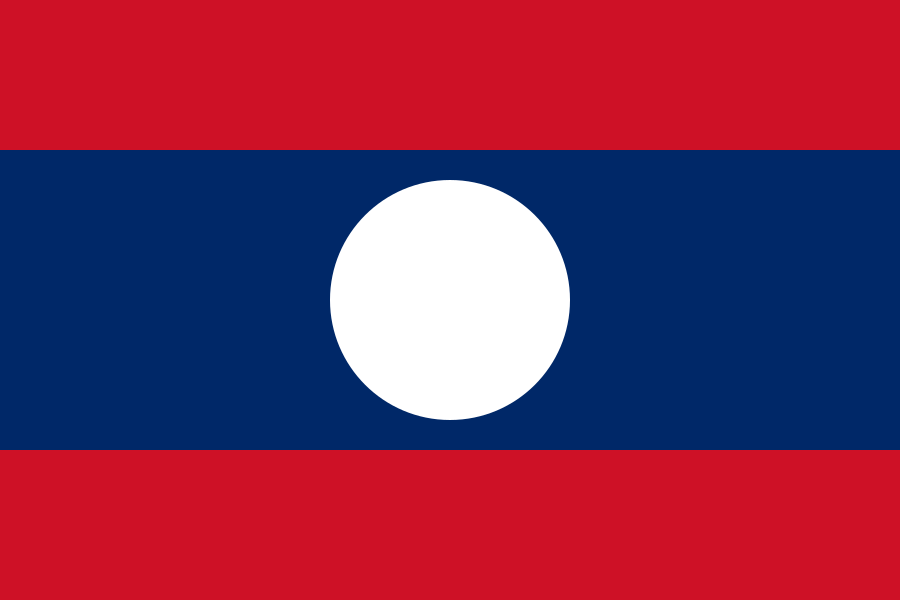
Also known as Lao People's Democratic Republic, la, Lao PDR, LAO
東南亞國家
Laos is a landlocked country in mainland Southeast Asia with a population of over 7 million people, bordered by Myanmar, China, Vietnam, Cambodia, and Thailand, with its capital in Vientiane. The country is notable for its cultural heritage, including three UNESCO World Heritage Sites—Luang Prabang, Vat Phou temple complex, and the Plain of Jars—and recent infrastructure development like the Boten–Vientiane railway.
AI-generated from the Wikipedia summary — may contain errors.
via Open-Meteo
The Lao People's Democratic Republic (ສາທາລະນະລັດ ປະຊາທິປະໄຕ ປະຊາຊົນລາວ) (Lao PDR) is the only landlocked country in Southeast Asia, and the most sparsely populated. Once the center of the powerful kingdom of Lan Xang, Laos was reduced to a vassal state of Siam (modern-day Thailand) by the end of the 18th century. It was freed from Siamese fiefdom in 1893 upon becoming a French protectorate and gained its independence in 1953 amidst the backdrop of the chaotic Indochina Wars. Since the end of the civil war in 1975, Laos is a one-party communist state under a presidential system. Unlike most countries in Asia, the country has not undergone a major industrialisation and modernisation period; as a result, its lifestyle remains mostly rural, with strong Buddhist traditional culture, and the only large city is Vientiane.
An adjective often applied to Laos is "forgotten", but travelers lured by the prospect of visiting an untouched "Shangri-la" are likely to be disappointed. The country now draws five million visitors per year, nearly as many as the Philippines, and Chinese-led investment is rapidly transforming swathes of the country. But while backpackers may crowd a few tourist hubs like Luang Prabang and Vang Vieng, it's not hard to get off the beaten path and enjoy a laid-back lifestyle and the opportunity to knock back a few cold Beerlao while watching the sunsets on the Mekong. Perhaps one of the biggest attractions of Laos is the famous "Lao PDR" - Lao-Please Don't Rush.
Laos is one of the easiest countries in the world to visit — virtually everyone, save for citizens of a few countries, can enter the country visa-free or obtain a visa on arrival.
Travel within Laos has historically been slow, often painful and sometimes dangerous, but the 2021 opening of a railway spanning the northern half of the country and the ongoing construction of a parallel expressway is set to shake things up. Nevertheless, if travelling off the beaten track, allow plenty of leeway in your schedule for the near-inevitable delays, cancellations and breakdowns.
Unlike neighboring Thailand or Vietnam, Laos never underwent a massive economic development, neither during colonisation nor even after the liberalisation of the communist economy. As result, one key attraction of Laos is that most of the country, with the increasing exception of capital Vientiane, retains a relaxed, laid back feel with minimal presence of modern architecture or international brands and food chains. How much longer this will last is open to much speculation, especially with Chinese investment flooding in the 2020s, but meanwhile, it makes it a truly special and unique country to visit.
老挝人民民主共和国(寮語:ສາທາລະນະລັດ ປະຊາທິປະໄຕ ປະຊາຊົນລາວ,简写:ສປປ ລາວ),通稱老挝(寮語:ລາວ),是位于東南亞中南半岛的社会主义国家,首都及最大城市为万象。通行老挝语,面积23.68万平方公里,人口700万人(2018年),老挝是东南亚唯一的内陆国,东邻越南,南接柬埔寨,西连泰国、缅甸,北与中国接壤。 老挝历史上第一个统一国家为法昂在1353年建立的澜沧王国,首都为琅勃拉邦,曾是中南半岛的人口、贸易与文化大国。澜沧王国存在近四个世纪,代表着老挝历史的鼎盛时期。1707年,澜沧王国因王位继承纷争而陷入分裂,又不断遭到邻国暹罗和越南的入侵,沦为两国的属国。1893年,沦为法国殖民地,老挝保护国成立,奠定现代老挝疆界。1953年,老挝宣布独立,建立君主立宪制国家,但很快陷入长期内战。1975年,共产主义组织巴特寮推翻君主制政权,老挝人民民主共和国建立并存续至今。 老挝是以马列主义为官方意识形态的社会主义共和国,唯一政党是老挝人民革命党。老挝是多民族国家,佬族占总人口的55%,在政治和文化领域占主导地位;丘陵和高山地区则分布着众多其他民族;按居住地区分类,又分为低地的老龙、丘陵的老听和高山的老松三大族群。老龙族通用老挝语,而老听族和老松族则使用藏缅语、孟-高棉语和苗语等其他语言。传统上,以上座部佛教为主流的宗教信仰。 老挝的经济以农业为主,工业基础薄弱。老挝工业经济的支柱部门是水力发电,透过输电和铁路运输和邻国建立经贸联系。老挝是高速发展的经济体之一,2013年至2018年的平均GDP增长率为7.25%。2018年,老挝的人均国内生产总值按购买力平价计算,位列东南亚第七位,排在新加坡、汶萊、马来西亚、泰国、印尼、菲律賓之后;人類發展指數位列世界第139位,属中等组别。寮國目前是聯合國、东南亚国家联盟、东亚峰会和法语圈国际组织成员,2013年加入世界贸易组织。
Abstract from DBpedia / Wikipedia · CC BY-SA
6 mapped locations
Discovered by embedding cosine similarity (sentence-transformers MiniLM, 384-dim).
via REST Countries
via World Bank Open Data · CC BY 4.0
via Wikimedia Pageviews API
via Wikipedia infobox
via PubMed
via Wikidata · CC0
Self-guided journeys by road. The most common trips travellers do in Laos, usually on a motorbike, are the Bolaven Loop and the Thakhek Loop, both in Southern Laos. {| class="wikitable" |+Comparing the Bolaven and Thakhek loops ! !Bolaven Loop !Thakhek Loop |- |Attractions |Waterfalls, hiking trails, scenic vistas, and coffee plantations |Caves, cold rivers and pools, scenic drives, and rock climbing opportunities. |- |Duration |Typically 3-8 days (most commonly 4 days) |Typically 4-10 days (most commonly 7 days) |- |Activities |Hiking, exploring scenic spots, visiting coffee plantations. Great for amateur photographers and lovers of coffee. The loop offers a variety of dining options and accommodation, with guesthouses and motels ranging from 100k-150k kip (Jan 2025). The route is relatively easy, although some dirt roads may pose challenges for novice riders on motorbikes or motor scooters. |Picturesque riding, cave exploration, swimming, wild camping opportunities, and passing through friendly local villages. The improved roads facilitate easy access to destinations such as Xe Bang Fai Cave. The region is also renowned for world-class rock climbing. |- |Example route |PDF map link |Google Maps link |} Both loops feature areas that are very much on the tourist trail, particularly in the south-western sections, making them suitable for short-term visitors. Day trips are feasible.
For individuals with only two days available, a three-day visit may be rushed and less enjoyabl…
thumb|Clockwise from top right: Tam maak hung papaya salad, sticky rice in a tip khao basket and fresh lettuce leaves
Lao food is one of the underappreciated cuisines of the world and can be a real highlight of your trip. It's very similar to the Isaan food of northeastern Thailand: very spicy, more often bitter than sweet, and using lots of fresh herbs and raw vegetables. These cool your mouth when the chilli gets too intense.
Rice is the staple carbohydrate. The standard kind is sticky rice (ເຂົ້າໜຽວ khao niaow), eaten by hand from small baskets called tip khao. Using your right hand, never your left, pinch off a bit, roll into flat disk, dip or wrap and munch away. Sticky rice is so important culturally that it's the standard offering to monks and the Lao even call themselves "children of sticky rice" (luk khao niaow).
The national dish is laap (ລາບ, also larb), a "salad" of minced meat or fish mixed with herbs, spices, lime juice and, more often than not, blistering amounts of chili. Unlike Thai larb, the Lao version can use raw meat (dip) instead of cooked meat (suk), and if prepared with seafood makes a tasty, if spicy, carpaccio.
Another Lao invention is tam maak hung (ຕໍາຫມາກຫຸ່ງ), the spicy green papaya salad known as som tam in Thailand, but which the Lao like to dress with fermented crab (ປູດອງ pudem) and a chunky, intense fish sauce called pa daek (ປາແດກ), resulting in a stronger flavour than the milder, sweeter Thai style. Other popular dishes include ping ka…
thumb|You can't visit Laos without having a Beerlao The national drink of Laos is the ubiquitous and tasty Beerlao, made with Laotian jasmine rice and one of the few Lao exports. It maintains an almost mythical status among travellers and beer aficionados. The yellow logo with its tiger-head silhouette can be seen everywhere, and a large 640 ml bottle shouldn't cost more than US$1-2 in restaurants. In addition to the original, it's now available in a constellation of flavors: light, dark, white (wheat), even an IPA!
Rice spirit, known as lao-lao, is everywhere and at less than US$0.30 per 750 ml bottle is the cheapest way to get drunk. Beware, as quality and distilling standards vary wildly: in 2024, six backpackers died from methanol poisoning in Vang Vieng. It's best to stick to commercially produced and sealed stuff.
Lao coffee (kaafeh) is recognised to be of very high quality. It's grown on the Bolaven Plateau in the south; the best brand is Lao Mountain Coffee. Unlike Thai coffees, Lao coffee is not flavoured with ground tamarind seed. To make sure you aren't fed overpriced Nescafé instead, be sure to ask for kaafeh thung. By default in lower end establishments, kaafeh lao comes with sugar and condensed milk; black coffee is kaafeh dam, coffee with milk (but often non-dairy creamer) is kaafeh nom.
Fresh coconut juice is delicious, and soymilk at convenience stores is surprisingly tasty, nutritious, and inexpensive.
There is not much nightlife outside of Vientiane and…
thumb|Guesthouses on [[Don Det]] Accommodation options outside the Mekong Valley's main tourist spots are limited to basic hotels and guesthouses, but there are many budget and mid-priced hotels and guesthouses and quite a few fancy hotels in Vientiane and Luang Prabang. Pakse has the Champasak Palace. Rooms usually start from 60,000 kip (Jan 2023).
There are very few hotels that can be booked online. This may lead those about the visit for the first time to conclude that there is very little accommodation in Laos, but this is not the case. The vast majority of accommodation simply has no online presence beyond a Google Maps listing, if that. Booking.com and Agoda (in that order) seem to have the most listings for Laos, but these will be on the soulless corporate-owned end of the spectrum, with prices to match. The best way to find accommodation is to do it once you arrive. If you are concerned about not having anywhere to stay, make a booking online for your first night only, and find a nice guesthouse for a nice price once you arrive.
It is worth noting that wild camping (public areas / riverbanks / forests) is not legal in Laos.
thumb|225x225px|Laos traffic police are known to pull over tourists riding scooters and demand cash payments for road rules allegedly broken Laos in general is a safe country, in part because violent crime is punished to a significant extent by the government. This said, petty crime remains a concern.
In accordance with the law, you are required to have an identification document on you at all times, and the police have the legal right to ask you for it. What this means: a copy of your national identity card or your passport. If they ask you for it, just give it to them. Failing to produce an identity document on request will result in a fine.
Laos is on track to hit its goal of eliminating malaria by 2030, but there are still occasional outbreaks, particularly in the south (Savannakhet and beyond). Anti-malarials are recommended if visiting those areas for an extended period, but check with health professionals: there is also a high incidence of drug-resistant parasites in Laos. Other mosquito-borne diseases, such as dengue, can be life-threatening, so make sure you bring at least 25% DEET insect repellent and ensure that you sleep with mosquito protection like nets or at least a fan. Vientiane seems to be malaria-free but not dengue-free. The mosquitoes that are active during the day carry dengue and those that are active in the evening carry malaria. 25% DEET insect repellents are almost impossible to find in Laos, so bring some from your home country. thumb|A display of Tiger Head water and Beerlao in a shop in Vientiane. Note the similar logos The usual precautions regarding food and water are needed. Tap water is not drinkable anywhere in Laos, but bottled water is cheap and widely available. In Laos, most bottled water is simply treated tap water, but quality can vary between brands. Tiger Head is recommended, which is made by the Laos Brewing Company (of Beerlao fame), and costing 5,000-6,000 kip. Thai-style roadside water kiosks that let you cheaply fill your own bottle with filtered water are not present in Laos. However, the communal water jars in temples, hotels and certain public buildings contain safe…
Travel guide from Wikivoyage (CC BY-SA 4.0)
via Wikidata sitelinks · CC0