Lissanthe · Kew POWO · Kew Plants of the World Online
Lissanthe
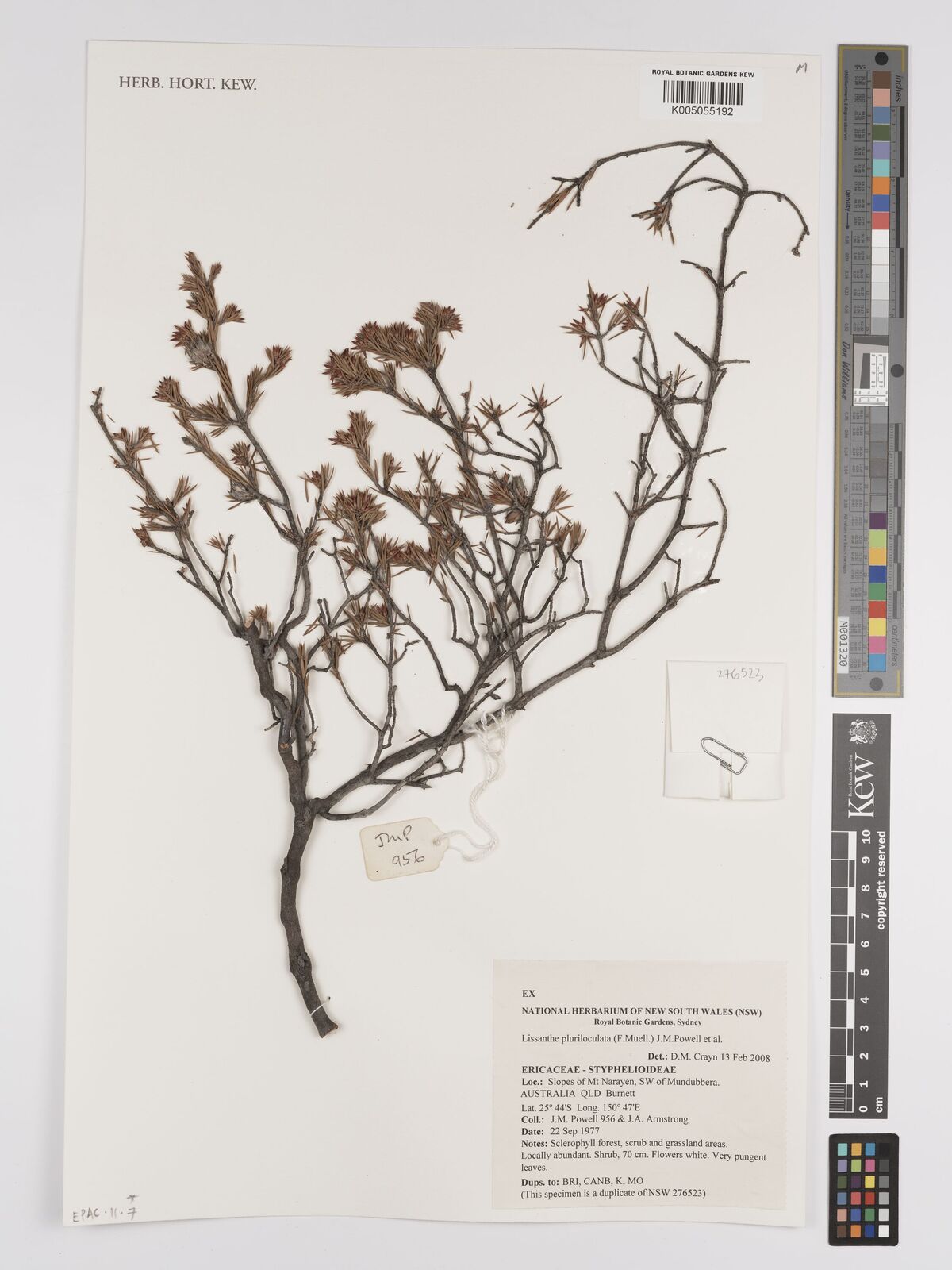
Sign in to saveLissanthe is a genus of about 10 species of flowering plants in the family Ericaceae and is endemic to Australia. Plants in the genus Lissanthe are small, erect to spreading shrubs with egg-shaped to oblong leaves. Up to 17 bisexual flowers are arranged in leaf axils or on the ends of branches, the 5 petals joined at the base to form a cylindrical to urn-shaped tube with triangular lobes.
In the Vinony graph
Within Vinony's link graph, Lissanthe is referenced by 18 other articles, and connects out to Robert Brown, plant and International Standard Book Number.
It sits within the topics Epacridoideae, Ericaceae genera and Ericales of Australia.
Its subject is documented across 8 Wikipedia language editions.
Species
GENUS
- KingdomPlantae
- PhylumTracheophyta
- ClassMagnoliopsida
- OrderEricales
- FamilyEricaceae
via GBIF · Kew POWO
Museum specimens
- Specimen records
- 17
- With media
- 8
- Family
- Ericaceae
- Collections
- MEL, UF, CM, MNHN, VT
- Recorded in
- Australia, Germany
Wikidata facts
Show 5 more facts
- taxon rank
- genus
- taxon name
- Lissanthe
- Commons category
- Lissanthe
- topic's main category
- Category:Lissanthe
Sources (1)
via Wikidata · CC0
~2 min read
Encyclopedic overview
5 sectionsContents
- Description
- Taxonomy
- Species list
- Distribution
- References
Lissanthe is a genus of about 10 species of flowering plants in the family Ericaceae and is endemic to Australia. Plants in the genus Lissanthe are small, erect to spreading shrubs with egg-shaped to oblong leaves. Up to 17 bisexual flowers are arranged in leaf axils or on the ends of branches, the 5 petals joined at the base to form a cylindrical to urn-shaped tube with triangular lobes.
==Description== Plants in the genus Lissanthe are small, erect to spreading shrubs with egg-shaped to oblong, petiolate leaves that are usually a paler shade of green on the lower surface. The leaves have a small point on the tip and a few parallel veins on the lower surface. Up to 17 bisexual flowers are arranged in leaf axils or on the ends of branchlets with a bract and 2 bracteoles at the base of the flowers. The 5 petals are joined at the base to form a cylindrical to urn-shaped tube that is longer than the sepals and has triangular, valvate, glabrous lobes in the bud, and spreading to curved backwards in the open flower. The style is enclosed within the petal tube and the style is lobed. The fruits is drupe with a hard covering.
Excerpted from Wikipedia’s “Lissanthe” article, available under the CC BY-SA 4.0 licence.