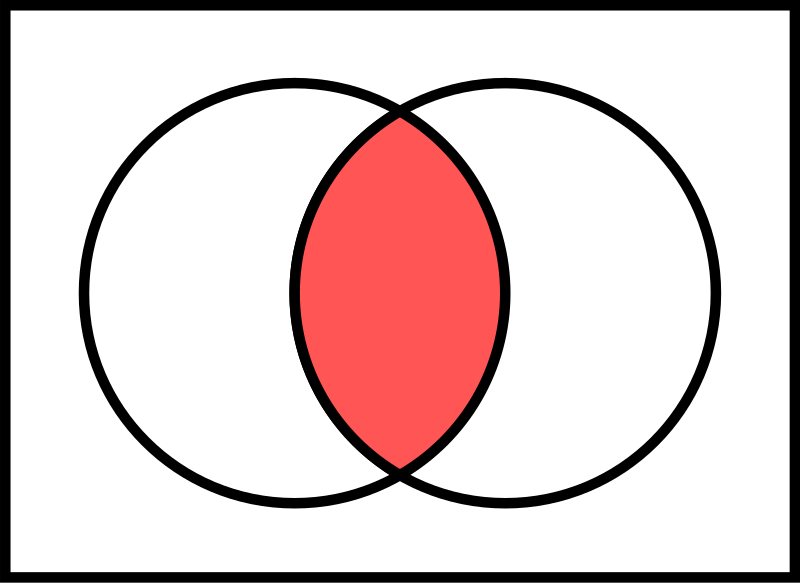
File:Venn0001.svg · Wikimedia Commons · See Wikimedia Commons
Also known as AND, logical AND, conjunction, ∧, conjoint, logical multiplication
logical connective AND
A logical conjunction is when you connect two statements with "AND" to create a new statement that is only true if both parts are true. It matters because it's a fundamental way we reason about situations that require multiple conditions to be satisfied at the same time, like "it's raining AND it's cold" being only true when both weather conditions actually occur.
AI-generated from the Wikipedia summary — may contain errors.
Key facts
- Definition
- x y {\displaystyle xy}
- Truth table
- ( 1000 ) {\displaystyle (1000)}
- Disjunctive
- x y {\displaystyle xy}
- Conjunctive
- x y {\displaystyle xy}
- Zhegalkin polynomial
- x y {\displaystyle xy}
- 0 preserving
- yes
- 1 preserving
- yes
- Monotone
- yes
- Affine
- no
- Self dual
- no
via Wikipedia infobox
Wikidata facts
- Instance of
- logical operator
- Image
- Venn0001.svg
Show 5 more facts
- Unicode character
- ∧
- TeX string
- \land
- different from
- conjunction
- Commons category
- Logical conjunction
- maintained by WikiProject
- WikiProject Mathematics
via Wikidata · CC0
Article · 日本語
数理論理学において論理積(ろんりせき、英: logical conjunction)とは、与えられた複数の命題のいずれもが例外なく真であることを示す論理演算である。合接(ごうせつ)、連言(れんげん、れんごん)とも呼び、ANDとよく表す。 二つの命題 P, Q に対する論理積を P ∧ Q と書き、「P かつ Q」や「P そして Q」などと読む。
Abstract from DBpedia / Wikipedia · CC BY-SA