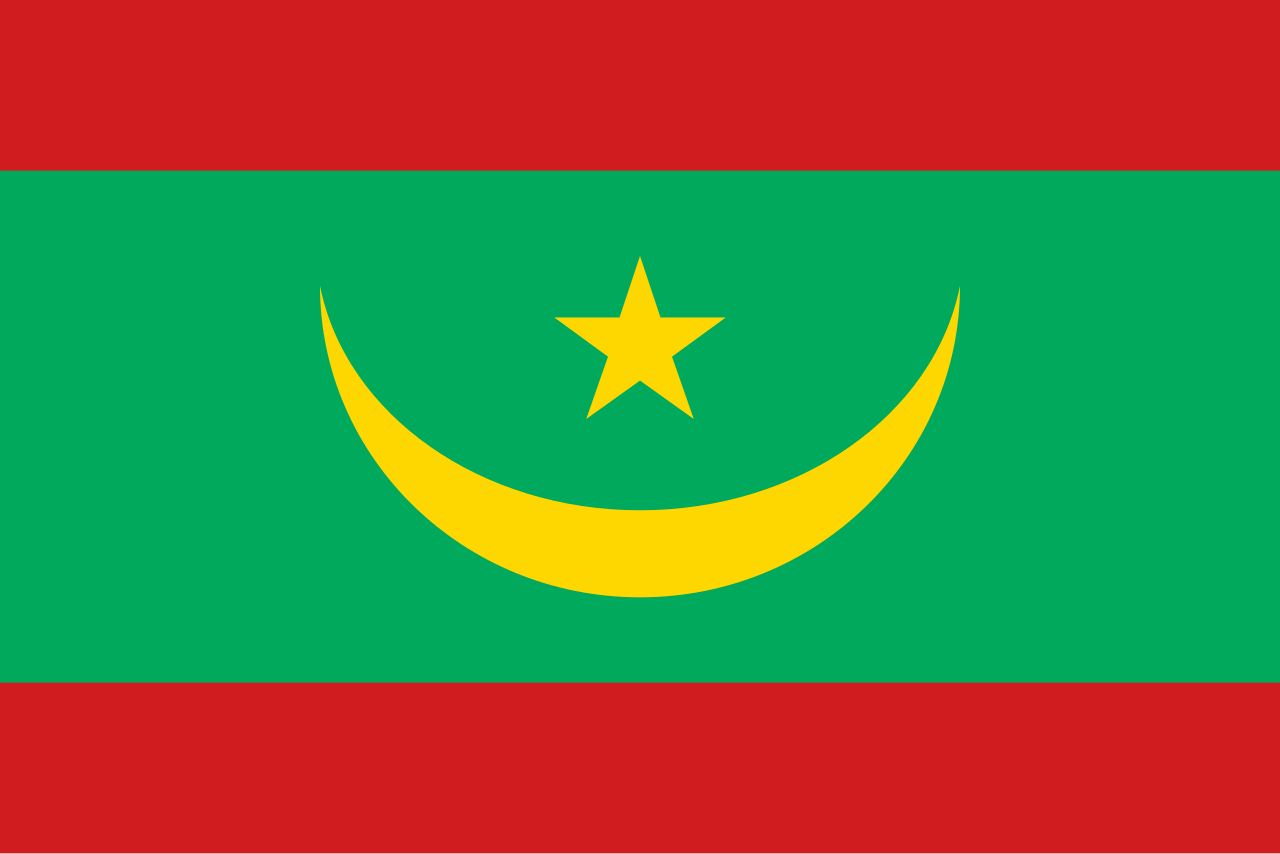
Mauritania
Also known as Islamic Republic of Mauritania, Muritanya, Agawej, Gànnaar, Murutaane, Moritani, mr, Gannaar
país de África
AI overview
Mauritania is a large North African country located on the Atlantic coast, mostly covered by the Sahara desert, with the majority of its roughly 4.3 million people living in the more temperate southern regions and in the capital city of Nouakchott. It matters as a significant African nation by land area and as a strategically positioned country bordered by Western Sahara, Algeria, Mali, Senegal, and the Atlantic Ocean.
AI-generated from the Wikipedia summary — may contain errors.
Weather now
cached 1h ago32°clear sky
28% 3.7 m/s OpenWeatherMap
7-day forecast
via Open-Meteo
Country
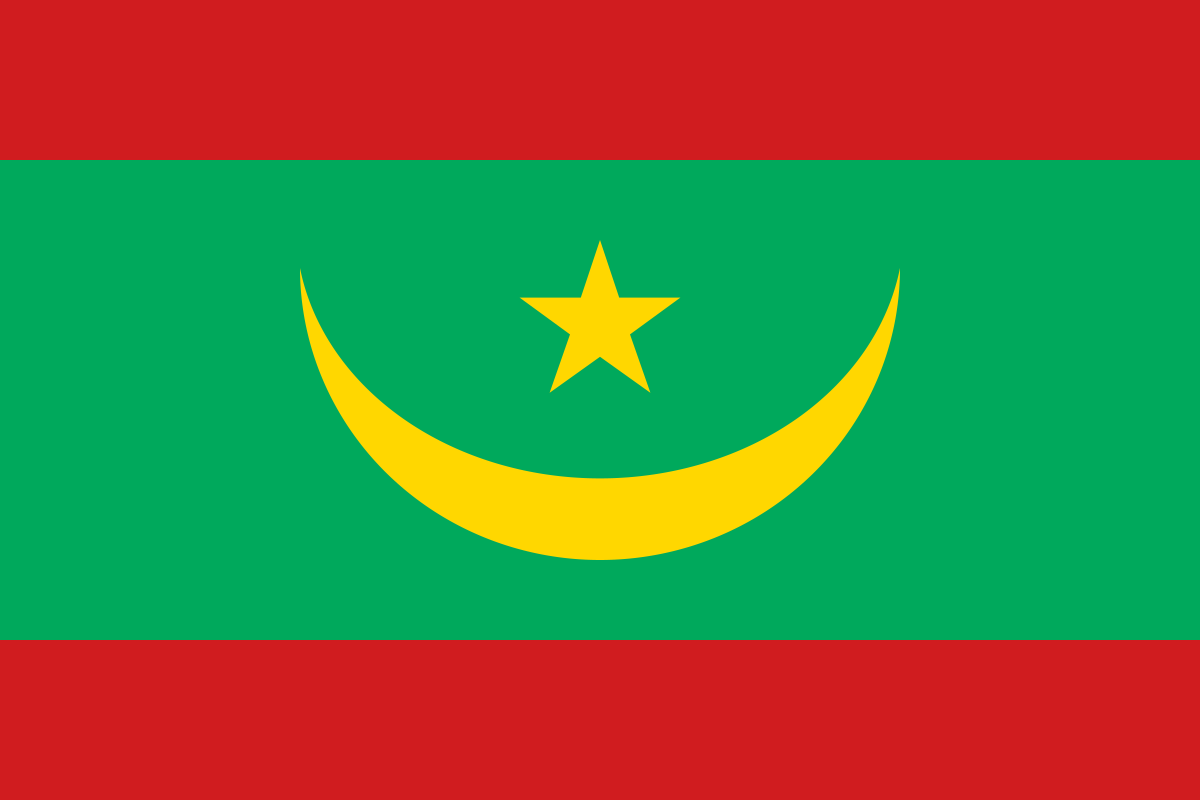
- Capital
- Nouakchott
- Population
- 4,927,532
- Region
Travel guide
Understand
Southwestern Mauritania was once home to the Ghana Empire, one of the earliest urbanised civilisations to emerge in western Africa, with its capital at Koumbi Saleh. Mauritania is an Islamic Republic, and the people in the North have a reputation as being very conservative and quite reserved. The southern part of the country is filled with friendly people, and they are very welcoming, if a little unused to tourists. For people from outside the Maghreb there is a risk of kidnapping, especially in the more remote northern and eastern parts. Travelling to Mauritania is becoming easier, with charter flights from France to Atar through the winter. Guides and tourist agencies are quite easy to find.
Get in
thumb|375px|A map showing the visa requirements of Mauritania, with countries in green having visa-free access.
Get around
thumb|The train snakes through the Mauritanian desert.
Make sure to have plenty of passport copies for travelling between towns. It’s not uncommon to give away up to 5-10 passport copies a day to police at checkpoints.
See
thumb|Great Friday mosque in [[Chinguetti.]] The Adrar massif in the north is full of stunning desert scenery. Take a 4x4 off-piste across rocky terrain and through narrow canyons to explore the lush, hidden oases which have provided water and refuge to traders crossing the Sahara for centuries. The Adrar contains two of the country's magnificent historical cities. Chinguetti was once a trading centre and centre of Islamic scholarship whose architecture remains unchanged in nearly a millennium. Along with Ouadane and a few other small towns, it is a UNESCO World Heritage Site. And do not miss the world's longest train either just for a glimpse or to hop into an iron ore car filled with Mauritanians for the 12-hour journey from the Adrar to the coast. The remains of the Almoravid capital Azoughui, and rock paintings, are draws of the Adrar. thumb|Ancient city of Ouadane Much of the central coastline is part of Parc National du Banc d'Arguin, home to millions of migrating birds each year. At Nouamgar, you can watch the unique spectacle of local tribesmen communicating with dolphins to round up teams of fish into shallow waters for them to be netted.
In the southeast, the oasis city of Oualata was the southern end of most trans-Sahara trading routes in the 13th & 14th centuries. The city has colourful buildings, many of which feature intricate geometric designs. The city is a UNESCO World Heritage Site and also boasts a manuscript museum with examples of ancient scrolls in fine…
Article · Español
Mauritania, oficialmente la República Islámica de Mauritania (en árabe: الجمهورية الإسلامية الموريتانية Al-Ŷumhūrīya al-Islāmīya al-Mawrītānīya, en francés: République Islamique de Mauritanie), es un país ubicado en el noroeste de África. Limita con el océano Atlántico al oeste, con Senegal al suroeste, con Malí al este y al sureste, con Argelia al noreste y con el territorio del Sahara Occidental (en disputa entre la República Árabe Saharaui Democrática y Marruecos) al norte. El 90 por ciento de su territorio está ubicado en el Sahara y la mayor parte de su población de 4,4 millones habita el sur templado del país, con aproximadamente un tercio concentrado en la capital y mayor ciudad, Nuakchot, situada en la costa del océano Atlántico. El nombre del país deriva del antiguo reino bereber de Mauritania, ubicado en los actuales Marruecos y Argelia. Los bereberes ocuparon lo que hoy es Mauritania a partir del siglo III d. C. Los árabes conquistaron la zona en el siglo VIII. A finales del siglo XIX, Mauritania fue colonizada por Francia como parte del África Occidental Francesa. El país consiguió la independencia de Francia el 28 de noviembre de 1960. En 2008, el gobierno civil de Mauritania sufrió un golpe de Estado encabezado por el general Mohamed Uld Abdelaziz. El 16 de abril de 2009, Abdelaziz renunció a su rango militar para competir en las elecciones presidenciales del 19 de julio, siendo elegido presidente. Fue sucedido por Mohamed Ould Ghazouani después de las elecciones de 2019, que fueron consideradas la primera transición de poder pacífica desde la independencia. Mauritania es cultural y políticamente parte del mundo árabe: es miembro de la Liga Árabe y el árabe es el único idioma oficial, aunque el francés se habla ampliamente y sirve como lengua franca. La religión oficial es el islam, y casi todos los habitantes son sunitas. La sociedad mauritana es multiétnica: los beidan, llamados «moros blancos», constituyen el 30 % de la población, mientras que los haratin, llamados «moros negros», comprenden el 40 %. Ambos grupos reflejan el sincretismo árabe-bereber. El otro 30 % de la población está conformado por varios grupos étnicos subsaharianos. En 2008 el 20 % de la población vivía con menos de 1,25 dólares por día. El país sufre varios problemas en materia de derechos humanos. Fue el último país en abolir la esclavitud, en 1981, aunque un informe de Amnistía Internacional publicado en 2018 afirmó que el número de personas esclavizadas en Mauritania podría superar el 1 % de su población.
Abstract from DBpedia / Wikipedia · CC BY-SA
Gallery (39)
On the map
4 mapped locations
Connections
Categories
1960 establishments in MauritaniaCountries and territories where Arabic is an official languageCountries in AfricaCountries in West AfricaIslamic republicsLeast developed countriesMaghrebi countriesMauritaniaMember states of the African UnionMember states of the Arab LeagueMember states of the Organisation internationale de la Francophonie