
File:Maxim_Gorky_LOC_Restored_edit1.jpg · Wikimedia Commons · See Wikimedia Commons
Maxim Gorky
Sign in to saveAlso known as Alexei Maximovich Peshkov, Maksim Gor'ky, Aleksey Maksimovich Peshkov, Aleksey Peshkov, Maksim Gorky, Gorky, Maxim Gorki
Russian and Soviet writer (1868–1936)
OverviewAI-generated
Maxim Gorky, born Aleksey in Nizhny Novgorod in 1868, was a Russian writer and member of the USSR Union of Writers and the Russian Academy of Sciences. He began his work period in 1892 and authored notable works including *Mat’*, *The Lower Depths*, *My Childhood*, and *Twenty-six Men and a Girl*. He was also known by the pseudonym Иегудиил Хламида.
Gorky held citizenship in the Russian Empire and the Soviet Union. He received the Order of Lenin and was nominated for the Nobel Prize in Literature. His residences included Capri, Sorrento, Nizhny Novgorod, and Saint Petersburg. He was detained in the Peter and Paul Fortress and died on June 18, 1936, in Gorki-10, Moscow. He is buried at the Kremlin Wall Necropolis.
Synthesized by Vinony from 30 facts across 4 sources: Wikidata, TMDb, Open Library, Europeana Sparql. Generated from structured data (not the Wikipedia text) and checked against those facts — may still contain errors.
Person · Open Library
- Works
- 109
Top works
- Mother
- Russian Short Stories (Illustrated)
- Foma Gordyeeff
- DOSTOYEVSKY's Notes from the Underground and GORKY's the Confession
- On literature
via Open Library + Wikidata
Film & TV
Nizhny Novgorod, Russian Empire [now Russia]
Alexei Maximovich Peshkov (1868–1936), popularly known as Maxim Gorky (Russian: Максим Горький), was a Russian writer and political activist. He was nominated five times for the Nobel Prize in Literature. Before his success as an author, he travelled widely across the Russian Empire changing jobs frequently, experiences which would later influence his writing. Gorky's most famous works are a…
Known for
- Legends of Cinema — Self (archive footage)2016
- Загадки века с Сергеем Медведевым — Self (archive footage)2016
- The Magic Beam — Self (archive footage)1963
- Maxim Gorky — Self (archive footage)1940
- Soviets on Parade — Self1933
via TMDB
Wikidata facts
- Instance of
- human
- Given name
- Aleksey
- Family name
- Peshkov
- Gender
- male
- Citizenship
- Soviet Union
- Place of birth
- Nizhny Novgorod
- Place of death
- Nizhny Novgorod
- Spouse
- Maria Andreyeva
- Occupation
- publisher
- Position held
- president
- Employer
- Pushkin House
- Political party
- Russian Social Democratic Labour Party
- Languages spoken
- Russian
- Native language
- Russian
- Religion
- atheism
- Notable work
- The Life of Klim Samgin
- Field of work
- belletristic literature
- Movement
- socialist realism
- Image
- Maxim Gorky LOC Restored edit1.jpg
- Residence
- Moscow
- Significant event
- Nazi book burnings
Show 22 more facts
- topic's main category
- Category:Maxim Gorky
- place of burial
- Kremlin Wall Necropolis
- Commons category
- Maxim Gorky
- date of death
- 1936-00-00
- date of birth
- 1868-03-28
- member of
- Russian Academy of Sciences
- Commons gallery
- Maxim Gorky
- nominated for
- Nobel Prize in Literature
- pseudonym
- Иегудиил Хламида
- Commons Creator page
- Maxim Gorky
- start of work period
- 1892-00-00
- archives at
- Library of Congress
- place of detention
- Peter and Paul Fortress
- ethnic group
- Russians
- cause of death
- pneumonia
- end of work period
- 1936-00-00
- name in native language
- Алексей Максимович Пешков
- writing language
- Russian
- different from
- Maxim Gorky
- on focus list of Wikimedia project
- Wikipedia:Vital articles/Level/4
- manner of death
- natural causes
- has works in the collection
- Memoria Chilena
Sources (7)
via Wikidata · CC0
Works in European collections
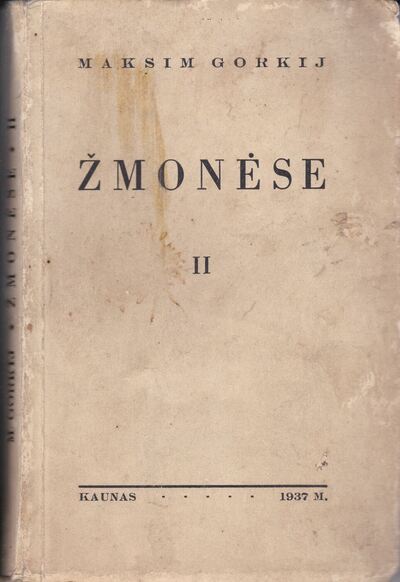
25 objects attributed to Maxim Gorky, held across European museums, libraries & archives · via Europeana
Tomás Gordeieff
Letter from Maksim Gor 'kij to Georgi Ivanov Bakalov

Solnce vschodit i zachodit: russkaja pesnja; s chorom
Letter from Maksim Gor 'kij to Gerhart Hauptmann

Žiznʹ Matveja Kožemjakina

Mother

Mezítlábasok

Huszonhat férfi, egy leány

Ilja gyermekkora

Mesék Itáliáról

Az Artamonovok

Az igazi kultúra

Inasévek
Blaue Funken. Großvater Archipp und Ljonka

Untitled

Untitled

Untitled

Untitled

Untitled
Untitled
Untitled
Untitled
Untitled
Untitled
Untitled
~40 min read
Encyclopedic overview
Alexei Maximovich Peshkov (Russian: Алексей Максимович Пешков; 28 March [O.S. 16 March] 1868 – 18 June 1936), popularly known as Maxim Gorky (/ˈɡɔːrki/; Максим Горький ), was a Russian and Soviet writer, journalist, and proponent of socialism. He was nominated five times for the Nobel Prize in Literature. Before his success as an author, he travelled widely across the Russian Empire, changing jobs frequently; these experiences would later influence his writing. He associated with fellow Russian writers Leo Tolstoy and Anton Chekhov, both mentioned by Gorky in his memoirs.
Gorky was active in the emerging Marxist socialist movement and later supported the Bolsheviks. He publicly opposed the Tsarist regime and for a time closely associated himself with Vladimir Lenin and Alexander Bogdanov's Bolshevik wing of the Russian Social Democratic Labour Party. During World War I, Gorky supported pacifism and internationalism and anti-war protests. For a significant part of his life, he was exiled from Russia and later the Soviet Union, being critical both of Tsarism and of the Bolsheviks during the Russian Civil War and the 1920s, condemning the latter for political repressions. In 1928 he returned to the USSR on Joseph Stalin's personal invitation and lived there from 1932 until his death in June 1936. After his return he was officially declared the "founder of Socialist Realism". Despite this, Gorky's relations with the Soviet regime were rather difficult: while being Stalin's public supporter, he maintained friendships with Lev Kamenev and Nikolai Bukharin, the leaders of the anti-Stalin opposition executed after Gorky's death; he also hoped to ease the Soviet cultural policies and made some efforts to defend the writers who disobeyed them, which resulted in him spending his last days under unannounced house arrest.
Excerpted from Wikipedia’s “Maxim Gorky” article, available under the CC BY-SA 4.0 licence.
Gallery (13)
Available in 115 languages
- Español
- Français
- Deutsch
- 中文
- 日本語
- Русский
- Português
- Italiano
- العربية
- हिन्दी
- Afrikaans
- Albanian
- Amharic
- Aragonese
- Armenian
- Assamese
- Asturian
- Aymara
Show 96 more
- azb
- Azerbaijani
- Bahasa Indonesia
- Bangla
- Bashkir
- Basque
- be_x_old
- Belarusian
- Bosnian
- Breton
- Bulgarian
- Buriat
- Burmese
- Catalan
- cdo
- Central Kurdish
- Chuvash
- Croatian
- Czech
- Danish
- Egyptian Arabic
- Esperanto
- Estonian
- Fiji Hindi
- Filipino
- Finnish
- Galician
- Georgian
- Greek
- Haitian Creole
- Hakka Chinese
- Hebrew
- Hungarian
- hyw
- Icelandic
- Ido
- Interlingue
- Irish
- Javanese
- Kannada
- Kazakh
- Kurdish
- Kyrgyz
- Latin
- Latvian
- Lithuanian
- Macedonian
- Malagasy
- Malay
- Malayalam
- Marathi
- Mari
- Mazanderani
- Mingrelian
- Mongolian
- Nederlands
- Nepali
- Norwegian
- Norwegian Nynorsk
- Occitan
- Polski
- Punjabi
- Quechua
- Romanian
- Rusyn
- Serbian
- Serbian (Latin)
- simple
- Sindhi
- Sinhala
- Slovak
- Slovenian
- Svenska
- Tajik
- Tamil
- Tatar
- Telugu
- Tiếng Việt
- Türkçe
- Ukrainian
- Urdu
- Uzbek
- Volapük
- Waray
- Welsh
- Western Frisian
- Western Mari
- Western Panjabi
- Wu Chinese
- Yakut
- Zaza
- zh_min_nan
- zh_yue
- فارسی
- ไทย
- 한국어
via Wikidata sitelinks · CC0