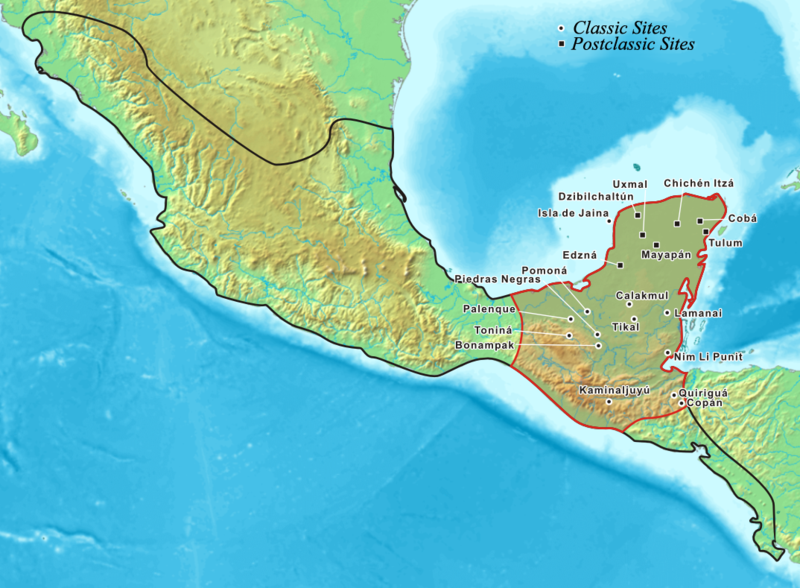
File:Mayamap.png · Wikimedia Commons · See Wikimedia Commons
The Maya civilization was an advanced society that flourished in Mesoamerica (the region spanning parts of modern-day Mexico and Central America) and developed sophisticated achievements in mathematics, astronomy, and writing. It remains historically significant because it demonstrates the complexity and achievements of pre-Columbian American cultures, offering important insights into human civilization independent of Old World influence.
AI-generated from the Wikipedia summary — may contain errors.
Wikidata facts
- Instance of
- civilization
- Continent
- Central America
- Image
- El Castillo, Chichén Itzá.jpg
- Has parts of class
- city-state
Show 10 more facts
- location of formation
- Yucatan Peninsula
- Commons category
- Maya civilization
- topic's main category
- Category:Maya civilization
- on focus list of Wikimedia project
- Wikipedia:Vital articles/Level/4
- OpenStreetMap tag
- historic:civilization=mayan
- has works in the collection
- Musée de l'Homme
- history of topic
- history of the Maya civilization
- inception
- 2000-00-00
- dissolved, abolished or demolished date
- 1521-00-00
- topic has template
- Template:Maya
Sources (1)
via Wikidata · CC0
~40 min read
Encyclopedic overview
The Maya civilization (/ˈmaɪə/) was a Mesoamerican civilization that existed from antiquity to the early modern period. Known by its ancient temples and glyphs (script), the civilization is also noted for its art, architecture, mathematics, calendar, and astronomical system. The Maya script is the most sophisticated and highly developed writing system in the pre-Columbian Americas.
The Maya civilization developed in the Maya Region, an area that today comprises southeastern Mexico, all of Guatemala and Belize, and the western portions of Honduras and El Salvador. It includes the northern lowlands of the Yucatán Peninsula and the Guatemalan Highlands of the Sierra Madre, the Mexican state of Chiapas, southern Guatemala, El Salvador, and the southern lowlands of the Pacific littoral plain. Today, their descendants, known collectively as the Maya, number well over 6 million individuals, speak more than twenty-eight surviving Mayan languages, and reside in nearly the same area as their ancestors.
Excerpted from Wikipedia’s “Maya civilization” article, available under the CC BY-SA 4.0 licence.
Gallery (12)
Available in 130 languages
- Español
- Français
- Deutsch
- 中文
- 日本語
- Русский
- Português
- Italiano
- العربية
- हिन्दी
- Afrikaans
- Albanian
- Albanian
- Aragonese
- Armenian
- Assamese
- Asturian
- azb
Show 111 more
- Azerbaijani
- Bahasa Indonesia
- Bangla
- Bashkir
- Basque
- bat_smg
- Bavarian
- be_x_old
- Belarusian
- Bosnian
- Breton
- Bulgarian
- Buriat
- Burmese
- Catalan
- cdo
- Central Kurdish
- Chechen
- Crimean Tatar
- Croatian
- Czech
- Danish
- Egyptian Arabic
- Esperanto
- Estonian
- Faroese
- Fiji Hindi
- Filipino
- Finnish
- Galician
- Georgian
- Gilaki
- Greek
- Guarani
- Hebrew
- Hungarian
- hyw
- Icelandic
- Ido
- Interlingua
- Irish
- Kannada
- Kazakh
- kbp
- Ladino
- Latin
- Latvian
- Lingua Franca Nova
- Lithuanian
- lld
- Low German
- Macedonian
- Malagasy
- Malay
- Malayalam
- Maltese
- Marathi
- Mazanderani
- Mingrelian
- Mirandese
- Mongolian
- Moroccan Arabic
- nds_nl
- Nederlands
- Newari
- Northern Frisian
- Norwegian
- Occitan
- Odia
- Pashto
- Piedmontese
- Polski
- Punjabi
- Quechua
- Romanian
- Sardinian
- Saterland Frisian
- Scots
- Scottish Gaelic
- Serbian
- Serbian (Latin)
- simple
- Sindhi
- Sinhala
- Slovak
- Slovenian
- Sundanese
- Svenska
- Swahili
- Tamil
- Tatar
- Tibetan
- Tiếng Việt
- Toki Pona
- Türkçe
- Ukrainian
- Urdu
- Uzbek
- Venetian
- Walloon
- Waray
- Welsh
- Western Panjabi
- Wu Chinese
- Yiddish
- zh_classical
- zh_min_nan
- zh_yue
- فارسی
- ไทย
- 한국어
via Wikidata sitelinks · CC0