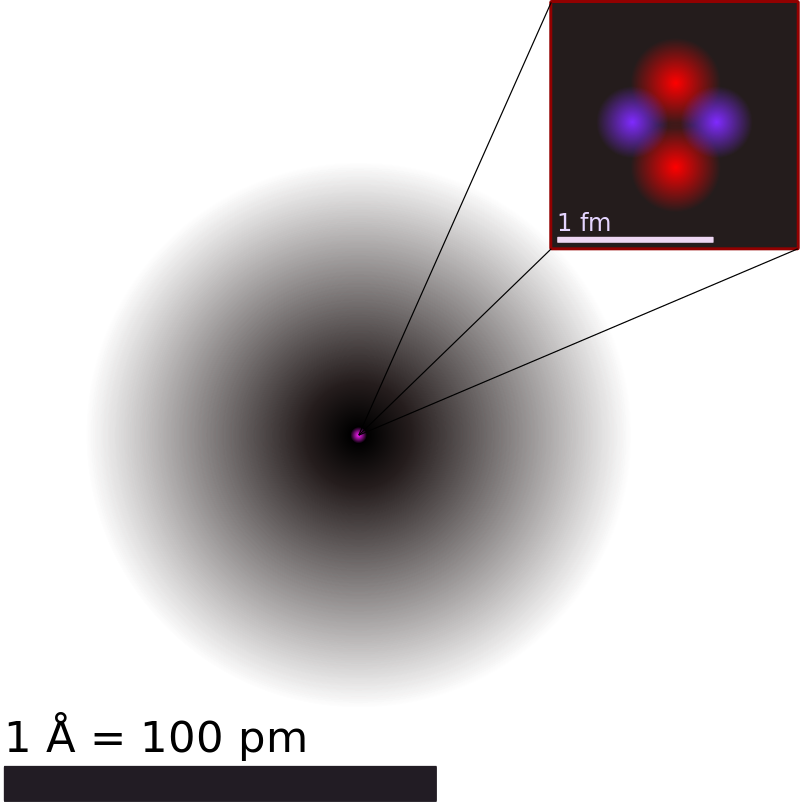
File:Helium_atom_QM.svg · Wikimedia Commons · See Wikimedia Commons
atomic radius
Sign in to saveAlso known as radius of an atom, atom radius
any measure of the size of atoms
Atomic radius is a measurement of how big an atom is, typically measured from its center to its outer edge. It matters because understanding atomic size helps explain how atoms interact with each other, how they bond together, and what properties materials will have.
AI-generated from the Wikipedia summary — may contain errors.
Wikidata facts
- Subclass of
- approximation
- Image
- Atomic size periodic table.svg
Show 1 more fact
- on focus list of Wikimedia project
- Wikipedia:Vital articles/Level/4
Sources (2)
via Wikidata · CC0
~12 min read
Encyclopedic overview
Diagram of a helium atom, showing the electron probability density as shades of gray. The atomic radius of a chemical element is a measure of the size of its atom, usually the mean or typical distance from the center of the nucleus to the outermost isolated electron. Since the boundary is not a well-defined physical entity, there are various non-equivalent definitions of atomic radius. Five widely used definitions of atomic radius are covalent radius, Van der Waals radius, charge radius, ionic radius, and metallic radius. Typically, because of the difficulty to isolate atoms in order to measure their radii separately, the atomic radius is measured in a chemically bonded state; however, theoretical calculations are simpler when considering atoms in isolation. The dependencies on environment, probe, and state lead to a multiplicity of definitions.
Depending on the definition, the term may apply to atoms in condensed matter, covalently bonding in molecules, or in ionized and excited states; and its value may be obtained through experimental measurements, or computed from theoretical models. The value of the radius may depend on the atom's state and context.
Excerpted from Wikipedia’s “atomic radius” article, available under the CC BY-SA 4.0 licence.
Gallery (3)
Available in 72 languages
- Español
- Français
- Deutsch
- 中文
- 日本語
- Русский
- Português
- Italiano
- العربية
- हिन्दी
- Afrikaans
- Aragonese
- Armenian
- Asturian
- Bahasa Indonesia
- Bangla
- Basque
- Belarusian
Show 53 more
- Bosnian
- Bulgarian
- Burmese
- Catalan
- Central Kurdish
- Chuvash
- Croatian
- Czech
- Danish
- Esperanto
- Estonian
- Finnish
- Galician
- Georgian
- Greek
- Hebrew
- Hungarian
- Irish
- Kazakh
- Kyrgyz
- Latvian
- Lithuanian
- Lombard
- Low German
- Macedonian
- Malay
- Malayalam
- Mongolian
- Moroccan Arabic
- Nederlands
- Norwegian
- Norwegian Nynorsk
- Occitan
- Polski
- Romanian
- Serbian
- Serbian (Latin)
- simple
- Sinhala
- Slovak
- Slovenian
- Svenska
- Tamil
- Tiếng Việt
- Türkçe
- Ukrainian
- Urdu
- Uzbek
- Wu Chinese
- zh_yue
- فارسی
- ไทย
- 한국어
via Wikidata sitelinks · CC0