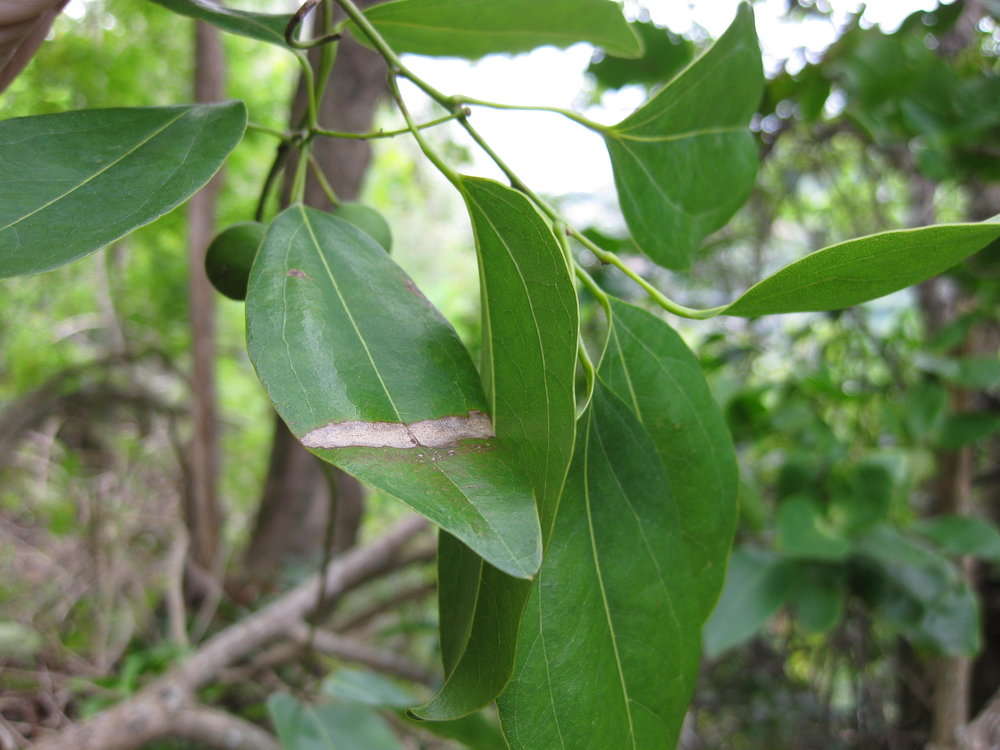
Encyclopedia of Life · EOL (see source)
Menispermaceae
Sign in to saveMenispermaceae (botanical Latin: 'moonseed family' from Greek mene 'crescent moon' and sperma 'seed') is a family of flowering plants. The alkaloid tubocurarine, a neuromuscular blocker and the active ingredient in the 'tube curare' form of the dart poison curare, is derived from the South American liana Chondrodendron tomentosum, which belongs to this family. Several other South American genera belonging to the family have been used to prepare the 'pot' and 'calabash' forms of curare. The family contains 81 genera with some 440 species, which are distributed throughout low-lying tropical area
OverviewAI-generated
Menispermaceae is a family of plants within the order Ranunculales. It belongs to the class Magnoliopsida, phylum Tracheophyta, and kingdom Plantae. The family includes approximately 71 genera and 450 species. Its common names include Kilpikiertokasvit and 防己科. The type genus for this taxon is Menispermum.
The family is primarily distributed in tropical and subtropical regions, with some species found in temperate areas of North America and East Asia. In China, there are 20 genera and about 60 species. Plants in this family produce drupes. Some species have roots used for medicinal purposes, while others have vines used for weaving. The family is a source of tubocurarine.
Records for Menispermaceae exist in various databases, including 219,054 occurrences in GBIF and 2,298 records in iDigBio. iDigBio records include media from institutions such as SDNHM, IIB-UV, YPM, INECOL, and UCMP, covering countries like the United States, Mexico, Philippines, China, and Papua New Guinea. PubMed contains 1,308 entries related to the family.
Synthesized by Vinony from 31 facts across 8 sources: Wikidata, GBIF, PubMed, Gbif Occ, Encyclopedia of Life, Plants of the World, iDigBio, Vinony graph. Generated from structured data (not the Wikipedia text) and checked against those facts — may still contain errors.
Species
FAMILY
- KingdomPlantae
- PhylumTracheophyta
- ClassMagnoliopsida
- OrderRanunculales
- FamilyMenispermaceae
防己科植物共有约71属450种,主要分布于热带和亚热带地区,但是在北美洲和东亚洲的温带地区也有一些种类。中国有20属约60种。本科植物有些种类的根可供药用,有些种类的藤可用于编织。
via GBIF · Kew POWO
Museum specimens
- Specimen records
- 2,298
- With media
- 1,119
- Family
- Menispermaceae
- Collections
- SDNHM, IIB-UV, YPM, INECOL, UCMP, CAS
- Recorded in
- United States, Mexico, Philippines, China, Papua New Guinea
Research
1,308 papers- Alkaloids in genus stephania (Menispermaceae): A comprehensive review of its ethnopharmacology, phytochemistry, pharmacology and toxicology.Journal of ethnopharmacology · 2022
- Network pharmacology, molecular docking, and molecular dynamics simulation to elucidate the mechanism of anti-aging action of Tinospora cordifolia.Molecular diversity · 2024
- The genus Stephania (Menispermaceae): chemical and pharmacological perspectives.Journal of ethnopharmacology · 2010
- Phylogeny and biogeography of Tiliacoreae (Menispermaceae), a tribe restricted to tropical rainforests.Annals of botany · 2023
- From arrow poison to herbal medicine--the ethnobotanical, phytochemical and pharmacological significance of Cissampelos (Menispermaceae).Journal of ethnopharmacology · 2014
via PubMed
Wikidata facts
- Instance of
- taxon
- Parent taxon
- Ranunculales
- Image
- Jateorhiza palmata - Köhler–s Medizinal-Pflanzen-080.jpg
Show 9 more facts
- Commons category
- Menispermaceae
- taxon rank
- family
- taxon name
- Menispermaceae
- topic's main category
- Category:Menispermaceae
- has fruit type
- drupe
- taxon common name
- 防己科
- taxonomic type
- Menispermum
- this taxon is source of
- tubocurarine
Sources (2)
via Wikidata · CC0
~13 min read
Encyclopedic overview
11 sectionsContents
- Description
- Ecology
- Phytochemistry
- Uses
- Fossil record
- Phylogeny and internal classification
- Chasmantheroideae
- Menispermoideae
- Gallery
- References
- External links
Menispermaceae (botanical Latin: 'moonseed family' from Greek mene 'crescent moon' and sperma 'seed') is a family of flowering plants. The alkaloid tubocurarine, a neuromuscular blocker and the active ingredient in the 'tube curare' form of the dart poison curare, is derived from the South American liana Chondrodendron tomentosum, which belongs to this family. Several other South American genera belonging to the family have been used to prepare the 'pot' and 'calabash' forms of curare. The family contains 81 genera with some 440 species, which are distributed throughout low-lying tropical areas with some species present in temperate and arid regions.
==Description== Twining, ever-growing and woody climbing plants, winding anti-clockwise (Stephania winds clockwise) and vines; rarely upright shrubs or small trees. Rarer still herbaceous plants or epiphytes (Stephania cyanantha), perennial or deciduous, with simple to uni-serrate hairs. Alternating, spiral leaves; simple, whole, dentate, lobed to palmatifid (bi- o trifoliate in Burasaia), frequently peltate, petiolated, petiole frequently pulvinate at both extremes, without stipules, sometimes with spines derived from the petioles (Antizoma), venation, parallelodromous, penninerved or frequently palmatinerved, bifacial, rarely isofacial; in Angelisia and Anamirta, with hydathodes derived from trichomes. Domatia present in five genera as pits or hair tufts. Various types of stomata, frequently cyclocytic. Rapidly-growing stems with trilacunar nodes. Phylloclades are present in Cocculus balfourii. Dioecious plants, sometimes perfect flowers in Tiliacora acuminata and Parabaena denudata. Inflorescences in racemiform, paniculate or thyrse with partial inflorescences in a capituliform cyme or pseudo-umbel; multifloral, rarely single or paired flowers; axillary, or on sharp branches or cauliflorous trunks; females frequently less branched. Flowers small, regular to zygomorphic (Antizoma, Cyclea, Cissampelos); cyclic to irregularly spiral; hypogynous, basically trimers. Receptacle sometimes with developed gynophore. Sepals (1-)3-12 or more, usually in (1-)2(-many) whorls of three, rarely six; free to slightly fused; imbricate or valvate, sometimes less numerous in female flowers. Petals numbering 0–6, in two whorls of three, rarely of six; free or fused, frequently holding the opposite stamen; sometimes less numerous in female flowers. Androecium of (1-)3-6(-40) stamens free of the perianth, free or fused together in 2–5, fasciculate or monadelphous, introrse, dehiscence along longitudinal, oblique or transversal slits. Female flowers sometimes with staminodes. Gynoecium apocarpous, superior, of (1-)3-6(-32) carpels, usually oppositipetalous, stigma apical, dry, papillous, ovules 2 per carpel, anatropous, hemianatropous to campilotropous, uni- or bitegmic, crassinucellate, the superior epitropous and fertile, the inferior apotropous and abortive, placentation marginal ventral. Male flowers sometimes with carpelodes. Fruits are compound; each unit in a straight or flattened, asymmetric drupe; more or less stipitate (rarely only one developed); non coalescing; exocarp sub-coriaceous or membranous, mesocarp pulpy, fleshy or fibrous, endocarp woody to petrous, rough, tuberous, echinate or ribbed, often with a recess in the placenta called a condyle. Seeds slightly curved or spiral (Limaciopsis, Spirospermum), with endosperm absent or present, totally or only ventrally ruminate or not ruminate, oleaginous, embryo straight or curved, with two cotyledons flat or cylindrical, leafy or fleshy, divaricate or applied. Pollen tricolpate, without operculum nor ribs, tectum perreticulate columellate, endexine granular; or the pollen can be colporate (Abuta), syncolporate (Tinospora), pororate or hexa-cryptoporate (with 6 apertures). Chromosomal number: x = 11, 13, 19, 25. 2n can be up to 52.
Excerpted from Wikipedia’s “Menispermaceae” article, available under the CC BY-SA 4.0 licence.