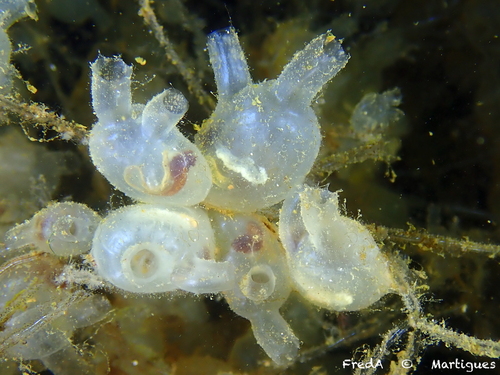
(c) Frédéric ANDRE, some rights reserved (CC BY-NC), uploaded by Frédéric ANDRE · cc-by-nc
Molgula
Sign in to saveMolgula, or sea grapes, are very common, globular, individual marine tunicates roughly the size of grapes. Molgula are a genus of the class ascidians, having many species sized from 20–50 mm and that has a life cycle with a tailed tadpole stage or without a tailed tadpole stage. Molgula are sessile invertebrates that grows on substrates and are always found existing alone. There are over one hundred species of molgulids with a vast majority of them in the Northern and Southern parts of the world with a few along the equator. All species of Molgula are suspension feeders and will have the
Species
フクロボヤ属
GENUS
- KingdomAnimalia
- PhylumChordata
- ClassAscidiacea
- OrderStolidobranchia
- FamilyMolgulidae
via GBIF
Museum specimens
- Specimen records
- 246
- With media
- 14
- Family
- Molgulidae
- Collections
- USNM
- Recorded in
- United States, Russia, Argentina, Vietnam, Antarctica, New Zealand, Canada
Wikidata facts
- Instance of
- taxon
- Parent taxon
- Molgulidae
- Image
- Molgula oculata 001.png
Show 3 more facts
- Commons category
- Molgula
- taxon name
- Molgula
- taxon rank
- genus
Sources (1)
via Wikidata · CC0
~14 min read
Encyclopedic overview
9 sectionsContents
- Morphology and development
- Distribution and habitats
- Evolutionary changes
- Feeding behaviour
- Environmental influences
- Endosymbiotic relationships
- Species
- References
- Further reading
Molgula, or sea grapes, are very common, globular, individual marine tunicates roughly the size of grapes. Molgula are a genus of the class ascidians, having many species sized from 20–50 mm and that has a life cycle with a tailed tadpole stage or without a tailed tadpole stage. Molgula are sessile invertebrates that grows on substrates and are always found existing alone. There are over one hundred species of molgulids with a vast majority of them in the Northern and Southern parts of the world with a few along the equator. All species of Molgula are suspension feeders and will have the highest population in areas with high amounts of small particles to feed on.
== Morphology and development == thumb|334x334px|A green colored Molgula manhattensis thumb|A light yellow colored Molgula manhattensis |249x249px They are translucent with two protruding siphons, oral and atrial consisting of six and four lobes respectively. They are found subtidally, attached to slow-moving submerged objects or organisms. All species of Molgula have a fluid-filled structure called the renal sac. The renal sac contains nitrogenous wastes, solid concretions composed of weddellite and calcite, and an apicomplexan symbiont called Nephromyces. To further expand on the animals structures, they contain a layer of tunic and given the slight variations existing within the species in terms of forms, they have evolved different bodily and structure colorations as well. For instance in the organisms classified as Molgula manhattensis, the majority have adopted shades in between light yellow and green as depicted by the colored images on the right, with a few being a dusty brown color as well. However, when comparing different species, contrast in colors can be observed.
Excerpted from Wikipedia’s “Molgula” article, available under the CC BY-SA 4.0 licence.