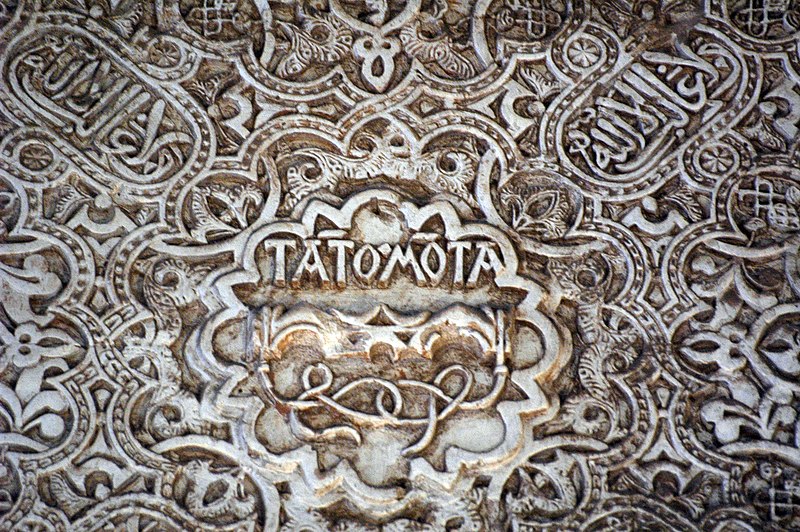
File:Alhambra_Tato_mota.jpg · Wikimedia Commons · See Wikimedia Commons
Ñ or ñ ( ) is a letter of the extended Latin alphabet, formed by placing a tilde (also referred to as a in Spanish, in order to differentiate it from other diacritics, which are also called ) on top of an upper- or lower-case . The origin dates back to medieval Spanish, when the Latin digraph began to be abbreviated using a single with a roughly wavy line above it, and it eventually became part of the Spanish alphabet in the eighteenth century, when it was first formally defined.
The letter Ñ (ñ) is a character in the extended Latin alphabet created by placing a wavy line called a tilde above the letter N, and it originated in medieval Spain as a shorthand way to write certain letter combinations before becoming an official part of the Spanish alphabet in the 1700s. Today it remains an important part of Spanish spelling and is used in words like "niño" (child) and "mañana" (tomorrow).
AI-generated from the Wikipedia summary — may contain errors.
Key facts
- Grapheme.name
- Eñe
- Grapheme.letter
- Ñ ñ
- Grapheme.script
- Latin script
- Grapheme.type
- Alphabet
- Grapheme.typedesc
- ic
- Grapheme.language
- Spanish language
- Grapheme.phonemes
- [] []
- Grapheme.unicode
- U+00D1, U+00F1
- Grapheme.alphanumber
- 15
- Grapheme.fam1
- I10
- Grapheme.fam2
- class=skin-invert-image|20px|Proto-Sinaitic Nun
- Grapheme.fam3
- class=skin-invert-image|20px|Proto-Caanite Nun
- Grapheme.fam4
- class=skin-invert-image|20px|Phoenician Nun
- Grapheme.fam5
- class=skin-invert-image|20px
- Grapheme.fam6
- class=skin-invert-image|20px|Early Greek Ny
- Grapheme.fam7
- Ν ν
- Grapheme.fam8
- 𐌍
- Grapheme.fam9
- N
via Wikipedia infobox
Wikidata facts
- Part of
- Spanish alphabet
- Has part
- tilde
- Image
- Latin Ñ.svg
Show 5 more facts
- different from
- N
- Commons gallery
- Ñ
- Commons category
- Ñ
- Unicode character
- ñ
- code
- --.--
Sources (2)
via Wikidata · CC0