
OverviewAI-generated
Namibia is a sovereign state and republic located in Southern Africa. Its capital is Windhoek. The country shares borders with Angola, Zambia, Botswana, and South Africa. It is named after the Namib. The official language is English. The currency includes the Namibian dollar and the rand. The top-level Internet domain is .na.
The population is approximately 3,022,401 to 3,030,131. The area is 825,615 square kilometers. The highest point is Brandberg. Administrative entities include the Zambezi, Erongo, Hardap, Karas, and Otjozondjupa Regions. Namibia is a member of the United Nations, the Commonwealth of Nations, the African Union, and the World Trade Organization. The telephone country code is +264. The anthem is Namibia, Land of the Brave.
Synthesized by Vinony from 67 facts across 9 sources: Wikidata, REST Countries, Open Meteo, Openweathermap, World Bank, OpenStreetMap, PubMed, Vinony graph, Geo. Generated from structured data (not the Wikipedia text) and checked against those facts — may still contain errors.
Weather now
7-day forecast
via Open-Meteo
Country
- Capital
- Windhoek
- Population
- 3,022,401
- Region
- Africa · Southern Africa
- Demonym
- Namibian
- Currencies
- NAD ($), ZAR (R)
- Languages
- Afrikaans, German, English, Herero, Khoekhoe, Kwangali, Lozi, Ndonga, Tswana
- Calling code
- +264
- Drives on
- Left
- Gini
- 59.1 (2015)
- FIFA code
- NAM
- TLD
- .na
- Timezones
- UTC+01:00
- Borders
- AGO, BWA, ZAF, ZMB
via REST Countries
Indicators · World Bank
- GDP
- $13.4B(2024)
- Population
- 3,030,131(2024)
- Life expectancy
- 67.5 yrs(2024)
- Unemployment
- 19.3 %(2025)
- Urban population
- 50.4 %(2024)
- Internet users
- 64.9 %(2024)
- Forest area
- 7.8 %(2023)
- Renewable energy
- 30 %(2021)
via World Bank Open Data · CC BY 4.0
Wikipedia views (30d)
112,930 totalvia Wikimedia Pageviews API
Key facts
- Country.conventional_long_name
- Republic of Namibia
- Country.common_name
- Namibia
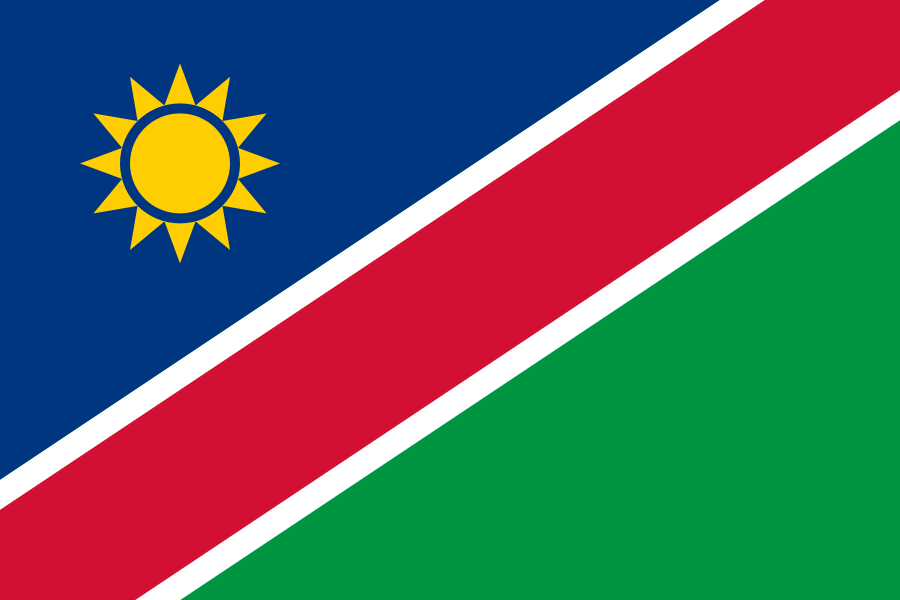
- Country.image_flag
- Flag of Namibia.svg
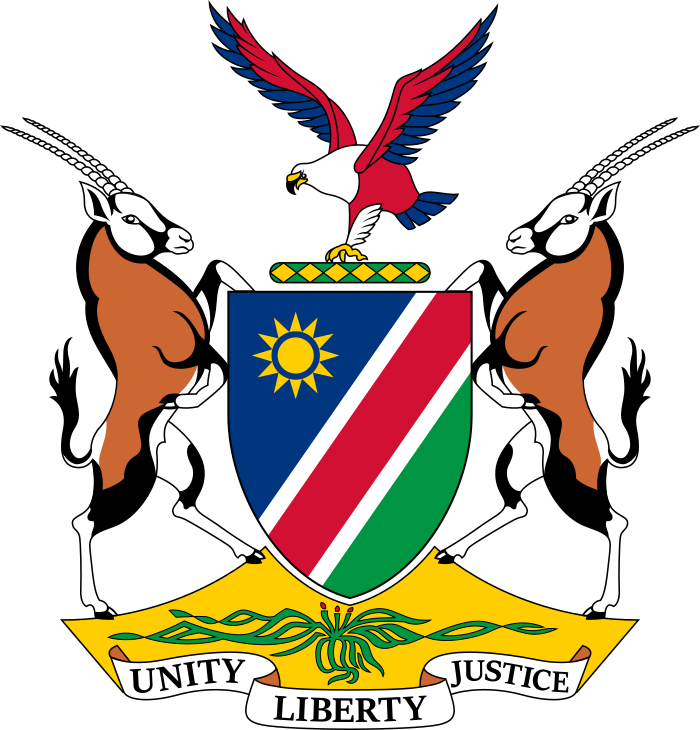
- Country.image_coat
- Coat of arms of Namibia.svg
- Country.national_motto
- "Unity, Liberty, Justice"
- Country.national_anthem
- "Namibia, Land of the Brave"File:Namibia, Land of the Brave.ogg
- Country.capital
- Windhoek
- Country.largest_city
- capital
- Country.official_languages
- English
- Country.ethnic_groups_year
- 2023
- Country.religion_year
- 2023
- Country.demonym
- Namibian
- Country.government_type
- Unitary semi-presidential republic
- Country.leader_title1
- President
- Country.leader_name1
- Netumbo Nandi-Ndaitwah
- Country.leader_title2
- Vice President
- Country.leader_name2
- Lucia Witbooi
- Country.leader_title3
- Prime Minister
via Wikipedia infobox
Research
4,254 papers- Oral hygiene in Namibia: A case of chewing sticks.ReviewJournal of ethnopharmacology · 2021Nyambe MM, Kwembeya EG, Lisao K et al.DOI: 10.1016/j.jep.2021.114203
- Policy framework that addresses malnutrition in Namibia: A retrospective qualitative review.ReviewNutrition and health · 2024Mukisa GW, Shumba TW, Lourens ADOI: 10.1177/02601060231185815
- [Namibia].Jeune Afrique (Paris, France : 1980) · 1996
- Cystic echinococcosis of ruminant livestock in Namibia.Veterinary parasitology, regional studies and reports · 2022Aschenborn J, Schneider C, Addy F et al.DOI: 10.1016/j.vprsr.2022.100727
- Analysis of policies for use of medically important antibiotics in animals in Namibia: implications for antimicrobial stewardship.ReviewExpert review of anti-infective therapy · 2022Kaupitwa CJ, Nowaseb S, Godman B et al.DOI: 10.1080/14787210.2022.2108404
- Factors contributing to the low number of blood donors among employed residents in Oshatumba village, Namibia.ReviewAfrican journal of primary health care & family medicine · 2023Ashipala DO, Joel MHDOI: 10.4102/phcfm.v15i1.3680
- Review on the status of goat production, marketing, challenges and opportunities in Namibia.ReviewTropical animal health and production · 2020Marius LN, Shipandeni MNT, Togarepi CDOI: 10.1007/s11250-020-02468-3
- The role of Namibia Field Epidemiology and Laboratory Training Programme in strengthening the public health workforce in Namibia, 2012-2019.ReviewBMJ global health · 2021Nyarko KM, Miller LA, Baughman AL et al.DOI: 10.1136/bmjgh-2021-005597
via PubMed
Wikidata facts
- Instance of
- country
- Named after
- Namib
- Official name
- République de Namibie
- Demonym
- Namabach
- Country
- Namibia
- Contains
- Kavango West Region
- Continent
- Africa
- Capital
- Windhoek
- Official language
- English language
- Currency
- rand
- Population
- 2533794
- Area
- 825615
- Body of water
- Atlantic Ocean
- Head of government
- Elijah Ngurare
- Head of state
- Netumbo Nandi-Ndaitwah
- Legislature
- Parliament of Namibia
- Shares border with
- Botswana
- Highest point
- Brandberg
- Official website
- gov.na
- Image
- Duna en Sossusvlei, Namibia, 2018-08-06, DD 002.jpg
- Life expectancy
- 64.388
- Nominal GDP
- 12607436976
Show 61 more facts
- Unemployment rate
- 19
- Calling code
- +264
- Licence plate code
- NAM
- Mains voltage
- 220
- Motto
- Endless horizons
- Flag
- flag of Namibia
- Coat of arms
- coat of arms of Namibia
- top-level Internet domain
- .na
- Commons category
- Namibia
- member of
- African Continental Free Trade Area
- topic's main category
- Category:Namibia
- category for people born here
- Category:Births in Namibia
- category for people who died here
- Category:Deaths in Namibia
- category for films shot at this location
- Category:Films shot in Namibia
- category of associated people
- Category:Namibian people
- diplomatic relation
- Kenya
- replaces
- South-West Africa
- Commons gallery
- Namibia
- mobile country code
- 649
- lowest point
- Atlantic Ocean
- inception
- 1990-00-00
- history of topic
- history of Namibia
- driving side
- left
- geography of topic
- Geography of Namibia
- age of majority
- 21
- trunk prefix
- 0
- marriageable age
- 21
- topic's main Wikimedia portal
- Portal:Namibia
- office held by head of government
- Prime Minister of the Republic of Namibia
- retirement age
- 60
- office held by head of state
- President of the Republic of Namibia
- number of out-of-school children
- 94219
- has characteristic
- free country
- located in/on physical feature
- Southern Africa
- total fertility rate
- 3.522
- maritime identification digits
- 659
- Unicode character
- 🇳🇦
- central bank
- Bank of Namibia
- VAT rate
- 15
- BTI Status Index
- 6.49
- BTI Governance Index
- 5.07
- P6413
- Namibia
- economy of topic
- economy of Namibia
- native label
- Republik Namibia
- demographics of topic
- demographics of Namibia
- Democracy Index
- 6.52
- Human Development Index
- 0.615
- P11012
- Nero
- hashtag
- Namibia
- on focus list of Wikimedia project
- Wikipedia:Vital articles/Level/4
- Happy Planet Index score
- 36.8
- Gini coefficient
- 59.1
- Inequality-adjusted Human Development Index
- 0.402
- P12749
- Boutros Boutros-Ghali
- birth rate
- 26.921
- male population
- 1238563
- death rate
- 11.457
- rural population
- 1181955
- female population
- 1328449
- urban population
- 1385057
- Commonwealth Sport country code
- NAM
Sources (15)
via Wikidata · CC0
Travel guide
Get in
thumb|375px|Countries shown in green may visit Namibia visa-free
See
thumb|Sossusvlei landscape
Namibia is a land of astounding natural beauty. To truly appreciate the country, you need to get out in the countryside, either on a tour or by renting a car, and take in the deserts, the mountains, the villages and everything else that Namibia has to offer.
One of its most dominant features, and the one for which the country is named, is the Namib Desert, which stretches for nearly 1000 km along the Atlantic coast. One of the oldest deserts in the world, its sand takes on a distinctive rust colour, with the desert having some of the highest sand dunes in the world. Sossusvlei is the most accessible part of the desert and is a magical place with its towering dunes that shift hues as the sun rises and sets. Further south, near the South African border, is Fish River Canyon, one of the largest canyons in the world. Stretching for 160 km, it is reaches 27 km across at its widest and nearly 550 m down at its deepest. In the north of the country is the empty and mostly inaccessible Skeleton Coast National Park. It is a seemingly barren expanse of stone and sand famous for its fog and the number of shipwrecks along the coast. thumb|300px|The Big Five Namibia still has plenty of African wildlife to see and is one of the countries where all of the Big Five (lion, leopard, rhinoceros, elephant, buffalo) can be seen in the wild. There are also some local subspecies, such as desert lions, desert elephants and the Hartmann's mountain zebra, whi…
Do
When planning your tour, consider that many attractions require a permit but not all of them sell it on-site. Most visitors pass through Windhoek at the start of their tour; Obtain the necessary permits here. The major permit issuers are the Ministry of Environment and Tourism (MET, Dr. Kenneth David Kaunda St, Windhoek), the National Heritage Council (NHC, 52 Robert Mugabe Avenue, Windhoek), and Namibia Wildlife Resorts (NWR, Gathemann Building, Independence Avenue, Windhoek). Go on safari. Explore landscape and wildlife by car. For many of the wild animals you do not need to visit a national park. Just leave the major highways, and you will bump into (not literally, hopefully) giraffe, ostrich, kudu, oryx, springbok, baboon, and much more. Relax. Namibia is not about ticking off boxes on laundry lists of things to see. Instead book a hut or pitch a tent in one of the many breathtakingly beautiful places, occupy a chair outside, and enjoy the landscape, wildlife, sunsets, and the night sky. Go on a 4x4 tour. See our Off-roading in Namibia article. Explore ghost towns of the diamond rush around the coastal town of Lüderitz Fly with a hot-air balloon across the dunes at Sossusvlei Ride a sandboard or a quadbike through the dunes in the coastal area around Walvis Bay and Swakopmund Explore the rich culture by visiting an indigenous community of the San (Tsumkwe), the Ovahimba (Kaokoland), the Ovaherero (Omaheke) or the Damara (Erongo). There are commercial options, called "Li…
Eat
Namibians have a very high intake of meat, and a low intake of vegetables. This has to do with the semi-arid climate; agriculture almost exclusively is cattle, sheep, and goat farming while edible plants only grow when irrigated. As a result, meat is good, cheap, and plentiful, while fruits and vegetables tend to be expensive as a lot of produce is imported from neighbouring states. A very popular way to eat and socialise is the braai, a mixed wood-fired barbecue with lots of alcoholic drinks. Every campsite, every lodge, and every domestic home has pre-installed braai facilities.
thumb|The Fork'n'Nice food lorry on the beach in [[Swakopmund. Try its fish and chips.]] In the coastal towns seafood is fresh and inexpensive. Make sure you try the local specialities kingklip and sole. Hake is also available and cheap. Restaurants will often offer line fish or angel fish which is simply what the fishermen managed to haul out from the sea—do ask what kind of fish it is before ordering. Inland, fish is also served in restaurants but how fresh it is is a matter of luck. Of course it has been frozen during the transport across the Namib Desert; if you don't like that then order something else.
All towns have supermarkets with all standard products, although most fruits and vegetables are imported and therefore rather expensive. Shops in villages will have very little fresh produce. Even if they have cold storage it will mostly be used for drinks. Far away from bigger towns tomatoes,…
Drink
Namibia's nightclubs are always happening and always open late (pretty much until the last person leaves). They are only located in bigger cities. The local version of a bar is the shebeen, a formal or informal structure with a counter for alcohol sale, a TV, a slot machine, and often a pool table. Drinks in shebeens are very cheap, and there are a lot of them, but most are situated in the townships. The flagship beer of Namibia is Windhoek Lager, an easy-drinking filtered beer, brewed by resident German master brewers.
The sale of alcohol for take-away is not allowed between Saturday 13:00 and Monday morning; all holidays count as Sundays. That means in supermarkets, which usually are open every day, the fridges with alcoholic drinks will be padlocked during this period. In informal areas (townships, shebeens, or remote villages) this rule is seldom enforced.
Oshikundu or Ontaku is a traditional Namibian beer-like drink made from fermented millet and sold in markets and at street stalls.
Among travellers various Shandies are popular because they cool you down on a hot summer day. They all contain Angostura, and therefore a trace of alcohol, but not enough to cloud the mind. The original recipe is subject to debate, but often Rock Shandy will be lemonade plus soda water, and Malawi Shandy ginger ale plus soda water, all on a copious amount of ice cubes, and with a dash of Angostura. Make sure you try one when it is hot.
Stay safe
thumb|A Namibian police car Namibia is a peaceful country and is not involved in any wars. Since the end of the Angolan civil war in May 2002, the violence that spilled over into northeastern Namibia is no longer an issue. Namibia is, however, a country with extreme income disparities. A middle manager easily earns twenty times the salary of a cleaner, and a third of the workforce is unemployed. As a tourist you're inevitably seen as stinking rich, and a prime target for thieves.
Namibia has a relatively high crime rate, particularly sexual abuse, general violence after alcohol abuse, and theft. Be careful on or right after pay day, the last day of the month, when there will be more drunk people than usual. Travellers should have no problem visiting the townships, but do not go there on your own, or after dark. In Windhoek you can book township tours where you will be taken to the most interesting places, but that's not the same as going there yourself and seeing that there are people living there like you and me.
For foreigners, it is not prudent to walk or ride taxis alone after sunset. Pickpockets can be a problem. No local will carry a bag while walking, and for thieves the bag is the token to make out who is a tourist and who isn't. Stuff all possessions into your trouser pockets. If you rent a car, insist that the owner (the rental company) of the car is clearly visible with stickers or as car paint. In the event of carjacking there is no easier way to relax the attit…
Stay healthy
The HIV infection rate in Namibia is around 17%, which is lower than before but is still the leading cause of death in the country.
Namibia's medical system is modern and capable of attending to whatever needs you may have. Staff are well trained and so HIV transmission in hospitals is not an issue. This applies to government and private hospitals alike, though line-ups are often shorter at private hospitals, and there have been cases of incorrect diagnosis in government hospitals. Should you become a victim of violence, private doctors and hospitals will send you away. The reason is that staff treating you will be summoned as witnesses to subsequent court cases without compensation, and lose valuable working time. In state hospitals, where productivity is not an issue, you will be treated at almost no charge. Thereafter do consult a private practice to confirm diagnosis and treatment. All private medical facilities expect cash or credit card in advance, no matter if or where you are insured. A visit to the doctor will be about 500 N$, for a night in hospital you'll have to deposit at least 10,000 N$.
The northern part of Namibia is in a malaria-risk zone, so consult a doctor before leaving, and take appropriate malaria precautions when travelling in these areas.
Ensure you are well stocked with water when journeying through the hot and sparsely populated country. On main roads take along at least 2 liters of potable water per person. In lesser travelled areas, 5 litres pe…
Respect
thumb|Post Street Mall in central Windhoek Namibians are very proud of their nation. It is a well developed country (albeit still economically developing) with modern amenities and technologies. Namibians have been exposed to a surprisingly wide variety of peoples during the United Nations supervising of the elections, as well as from various volunteer organizations. As in many African countries, the further away you come from the more curiosity you are going to attract.
It is customary when greeting someone to ask them how they're doing. It's a simple exchange where each person asks "How are you?" (or the informal version "Howzit?"—"Sharp, bro") and responds with a correspondingly short answer "Good, yourself?", and then proceed with whatever your business is about. It's a good idea to say this at tourist info booths, in markets, when getting into taxis and even in shops in Windhoek (though it's normally not said in some of the bigger stores in the malls).
Go next
The nearby nations of South Africa, Botswana and Angola are three obvious places to consider going next.
Travel guide from Wikivoyage (CC BY-SA 4.0)
Article · 日本語
ナミビア共和国(ナミビアきょうわこく、英語: Republic of Namibia)、通称ナミビアは、アフリカ南西部に位置する共和制国家である。北にアンゴラ、北東にザンビア、東にボツワナ、南に南アフリカ共和国と国境を接し、西は大西洋に面する。なお、地図を一見すると接しているように見えるジンバブエとはザンビア、ボツワナを挟んで150メートルほど離れている。首都はウィントフック。イギリス連邦加盟国のひとつである。 当初ドイツ(一部イギリス)が植民地とし、植民地時代の名称は南西アフリカ。第一次世界大戦以後は南アフリカ連邦の委任統治下に置かれていたが、第二次世界大戦後の国際連盟解散を機に南アフリカが国際法上違法な併合を行った。南アフリカの統治時代には同様の人種隔離政策(アパルトヘイト)が行われ、バントゥースタン(ホームランド)が置かれた。その後、1966年にナミビア独立戦争が始まり、1990年に独立を達成した。
Abstract from DBpedia / Wikipedia · CC BY-SA
Gallery (59)
On the map
6 mapped locations
Available in 264 languages
- Español
- Français
- Deutsch
- 中文
- 日本語
- Русский
- Português
- Italiano
- العربية
- हिन्दी
- Abkhazian
- Achinese
- Adyghe
- Afrikaans
- Akan
- Albanian
- Albanian
- Amharic
Show 245 more
- ami
- Angika
- Aragonese
- Armenian
- Arpitan
- Assamese
- Asturian
- azb
- Azerbaijani
- Bahasa Indonesia
- Balinese
- Bambara
- Bangla
- Banjar
- Bashkir
- Basque
- bat_smg
- Bavarian
- be_x_old
- Belarusian
- Betawi
- Bhojpuri
- Bikol
- Bishnupriya
- Bislama
- Bosnian
- Breton
- Buginese
- Bulgarian
- Buriat
- Burmese
- Catalan
- cbk_zam
- cdo
- Cebuano
- Central Kurdish
- Chechen
- Cheyenne
- Chuvash
- Cornish
- Corsican
- Crimean Tatar
- Croatian
- Czech
- dag
- Danish
- dty
- Dzongkha
- Egyptian Arabic
- Esperanto
- Estonian
- Ewe
- Extremaduran
- Faroese
- Fiji Hindi
- Filipino
- Finnish
- fiu_vro
- Frafra
- Fula
- Gagauz
- Galician
- Ganda
- gcr
- Georgian
- Gilaki
- Gothic
- gpe
- Greek
- Guarani
- Gujarati
- Haitian Creole
- Hakka Chinese
- Hausa
- Hebrew
- Hungarian
- hyw
- Iban
- Icelandic
- Ido
- Igbo
- Iloko
- Inari Sami
- Interlingua
- Interlingue
- Irish
- Jamaican Creole English
- Javanese
- Kabardian
- Kabyle
- kai
- Kannada
- Kanuri
- Kara-Kalpak
- Karachay-Balkar
- Kazakh
- kbp
- Kikuyu
- Kinyarwanda
- Kongo
- Kotava
- Kurdish
- Kyrgyz
- Ladino
- Latgalian
- Latin
- Latvian
- Lezghian
- Ligurian
- Limburgish
- Lingala
- Lingua Franca Nova
- Lithuanian
- lld
- Lojban
- Lombard
- Low German
- Lower Sorbian
- Luxembourgish
- Macedonian
- Malagasy
- Malay
- Malayalam
- Maltese
- Manipuri
- Manx
- Māori
- Marathi
- Mazanderani
- Minangkabau
- Mingrelian
- mnw
- Moksha
- Mongolian
- Moroccan Arabic
- N’Ko
- Navajo
- nds_nl
- Nederlands
- Nepali
- Newari
- Nigerian Pidgin
- Northern Frisian
- Northern Sami
- Northern Sotho
- Norwegian
- Norwegian Nynorsk
- Novial
- Obolo
- Occitan
- Odia
- Old English
- olo
- Oromo
- Ossetic
- Pampanga
- Papiamento
- Pashto
- Pennsylvania German
- Picard
- Piedmontese
- Polski
- Punjabi
- Quechua
- rki
- Romanian
- Romansh
- Samoan
- Sango
- Sanskrit
- Santali
- Sardinian
- Saterland Frisian
- Scots
- Scottish Gaelic
- Serbian
- Serbian (Latin)
- Shan
- Shona
- Sicilian
- Silesian
- simple
- Sindhi
- Sinhala
- Slovak
- Slovenian
- Somali
- South Ndebele
- Southern Sotho
- Standard Moroccan Tamazight
- Sundanese
- Svenska
- Swahili
- Swati
- szy
- Tachelhit
- Tajik
- Talysh
- Tamil
- Taroko
- Tatar
- tay
- Telugu
- Tibetan
- Tiếng Việt
- Tigrinya
- Toki Pona
- Tongan
- Tsonga
- Tswana
- Tumbuka
- Türkçe
- Turkmen
- Tyap
- Udmurt
- Ukrainian
- Upper Sorbian
- Urdu
- Uyghur
- Uzbek
- Venda
- Venetian
- Veps
- Volapük
- Waray
- Welsh
- West Flemish
- Western Frisian
- Western Panjabi
- Wolof
- Wu Chinese
- Xhosa
- Yakut
- Yiddish
- Yoruba
- Zaza
- Zeelandic
- zh_classical
- zh_min_nan
- zh_yue
- Zhuang
- Zulu
- فارسی
- ไทย
- 한국어
via Wikidata sitelinks · CC0