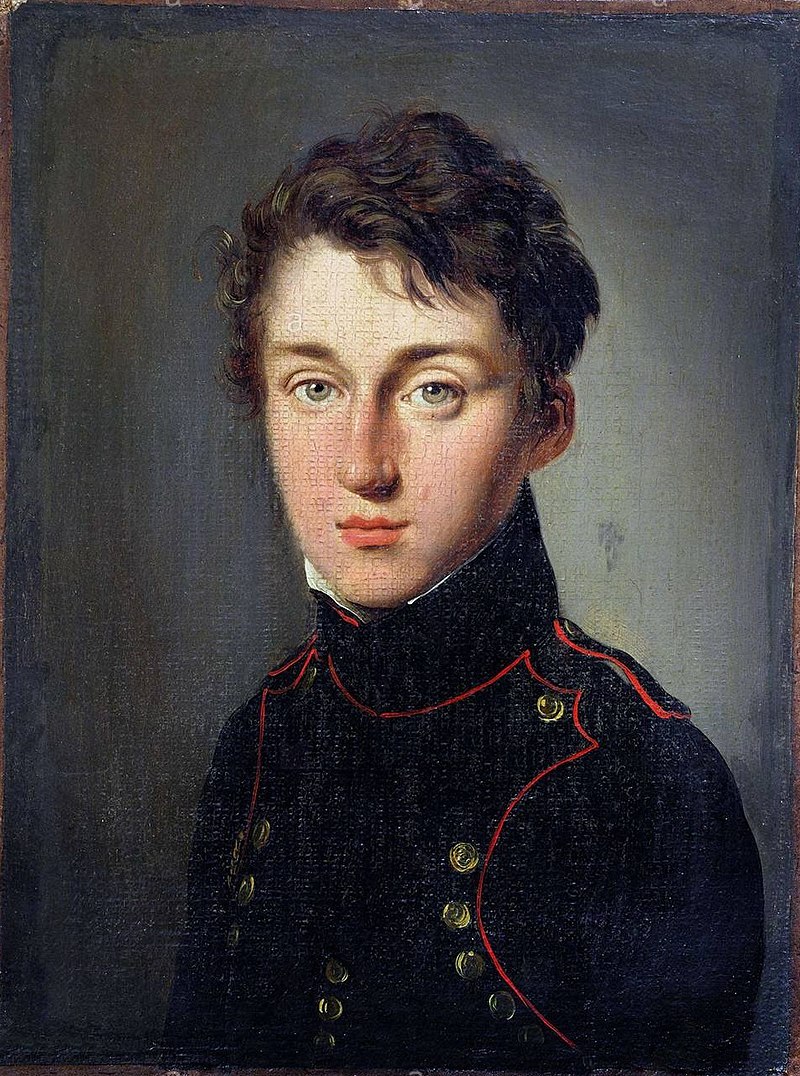
File:Sadi_Carnot.jpeg · Wikimedia Commons · See Wikimedia Commons
Nicolas Carnot
Sign in to saveAlso known as Sadi Carnot, Nicolas Leonard Sadi Carnot, Nicolas Léonard Sadi Carnot, Leonard Sadi Carnot
French physicist, the "father of thermodynamics" (1796–1832)
Nicolas Carnot was a French physicist who lived from 1796 to 1832 and is remembered as the founder of thermodynamics, the science of heat and energy. His groundbreaking work laid the foundation for understanding how heat engines work and helped establish fundamental principles about energy that remain central to physics and engineering today.
AI-generated from the Wikipedia summary — may contain errors.
Wikidata facts
- Instance of
- human
- Gender
- male
- Citizenship
- France
- Place of birth
- Paris
- Place of death
- Paris
- Father
- Lazare Carnot
- Sibling
- Hippolyte Carnot
- Occupation
- military engineer
- Languages spoken
- French
- Notable work
- Carnot heat engine
- Family
- Carnot family
- Doctoral advisor
- Siméon Denis Poisson
- Student of
- Siméon Denis Poisson
- Field of work
- thermodynamics
- Image
- Sadi Carnot.jpeg
Show 12 more facts
- Commons category
- Nicolas Léonard Sadi Carnot
- date of birth
- 1796-06-01
- date of death
- 1832-08-24
- cause of death
- cholera
- manner of death
- natural causes
- name in native language
- Nicolas Léonard Sadi Carnot
- writing language
- French
- different from
- Sadi Carnot
- on focus list of Wikimedia project
- Wikipedia:Vital articles/Level/4
- maintained by WikiProject
- WikiProject Mathematics
- Commons Creator page
- Nicolas Carnot
- relative
- Sadi Carnot
Sources (2)
via Wikidata · CC0
~27 min read
Encyclopedic overview
Nicolas Léonard Sadi Carnot ( French: [nikɔla leɔnaʁ sadi kaʁno]; 1 June 1796 – 24 August 1832) was a French military engineer and physicist. A graduate of the École polytechnique, Carnot served as an officer in the Engineering Arm (le génie) of the French Army. He also pursued scientific studies, and in June 1824 published an essay titled Reflections on the Motive Power of Fire. In that book, which would be his only publication, Carnot developed the first successful theory of the maximum efficiency of heat engines.
Carnot's scientific work attracted little attention during his lifetime, but in 1834 it became the object of a detailed commentary and explanation by another French engineer, Émile Clapeyron. Clapeyron's commentary in turn attracted the attention of William Thomson (later Lord Kelvin) and Rudolf Clausius. Thomson used Carnot's analysis to develop an absolute thermodynamic temperature scale, while Clausius used it to define the concept of entropy, thus formalizing the second law of thermodynamics.
Excerpted from Wikipedia’s “Nicolas Carnot” article, available under the CC BY-SA 4.0 licence.
Gallery (9)
Available in 71 languages
- Español
- Français
- Deutsch
- 中文
- 日本語
- Русский
- Português
- Italiano
- العربية
- हिन्दी
- Albanian
- Armenian
- Asturian
- azb
- Bahasa Indonesia
- Bangla
- Basque
- Belarusian
Show 52 more
- Bosnian
- Bulgarian
- Catalan
- Central Kurdish
- Croatian
- Czech
- Danish
- Egyptian Arabic
- Esperanto
- Finnish
- Galician
- Georgian
- Greek
- Haitian Creole
- Hebrew
- Hungarian
- Icelandic
- Ido
- Irish
- Kannada
- Kazakh
- Latin
- Latvian
- Madurese
- Malagasy
- Malayalam
- Mingrelian
- Moroccan Arabic
- Nederlands
- Nepali
- Norwegian
- Norwegian Nynorsk
- Occitan
- Piedmontese
- Polski
- Romanian
- Serbian
- Serbian (Latin)
- Slovak
- Slovenian
- Svenska
- Tamil
- Tiếng Việt
- Türkçe
- Ukrainian
- Uzbek
- Waray
- Wu Chinese
- zh_yue
- فارسی
- ไทย
- 한국어
via Wikidata sitelinks · CC0