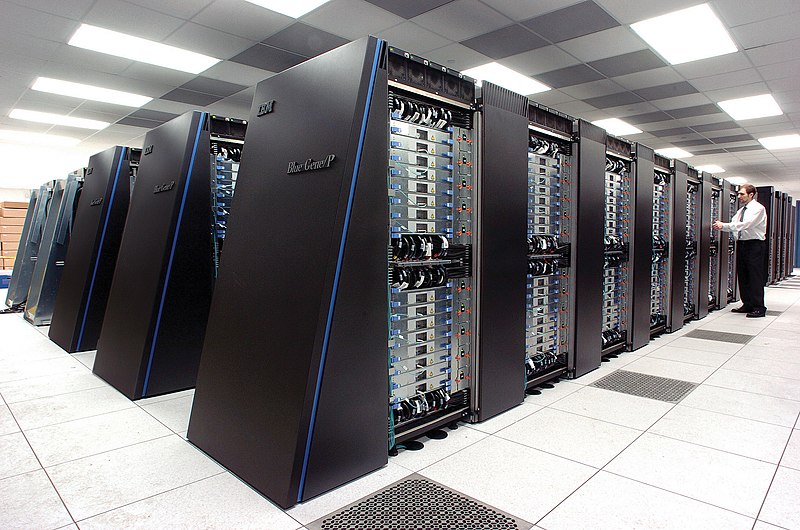
File:IBM_Blue_Gene_P_supercomputer.jpg · Wikimedia Commons · See Wikimedia Commons
parallel computing
Sign in to saveAlso known as parallelism, parallel processing, parallelization, parallel computation, parallel execution
programming paradigm in which many calculations or the execution of processes are carried out simultaneously
Parallel computing is a way of programming where many calculations or tasks run at the same time instead of one after another. This matters because it allows computers to solve large, complex problems much faster by dividing the work among multiple processors working together.
AI-generated from the Wikipedia summary — may contain errors.
Wikidata facts
Show 2 more facts
- Commons category
- Parallel computing
- Stack Exchange tag
- stackoverflow.com/tags/parallel-processing
Sources (6)
via Wikidata · CC0
~40 min read
Article
Large supercomputers such as IBM's Blue Gene/P are designed to heavily exploit parallelism.
Parallel computing is a type of computation in which many calculations or processes are carried out simultaneously. Large problems can often be divided into smaller ones, which can then be solved at the same time. There are several different forms of parallel computing: bit-level, instruction-level, data, and task parallelism. Parallelism has long been employed in high-performance computing, but has gained broader interest due to the physical constraints preventing frequency scaling. As power consumption (and consequently heat generation) by computers has become a concern in recent years, parallel computing has become the dominant paradigm in computer architecture, mainly in the form of multi-core processors.