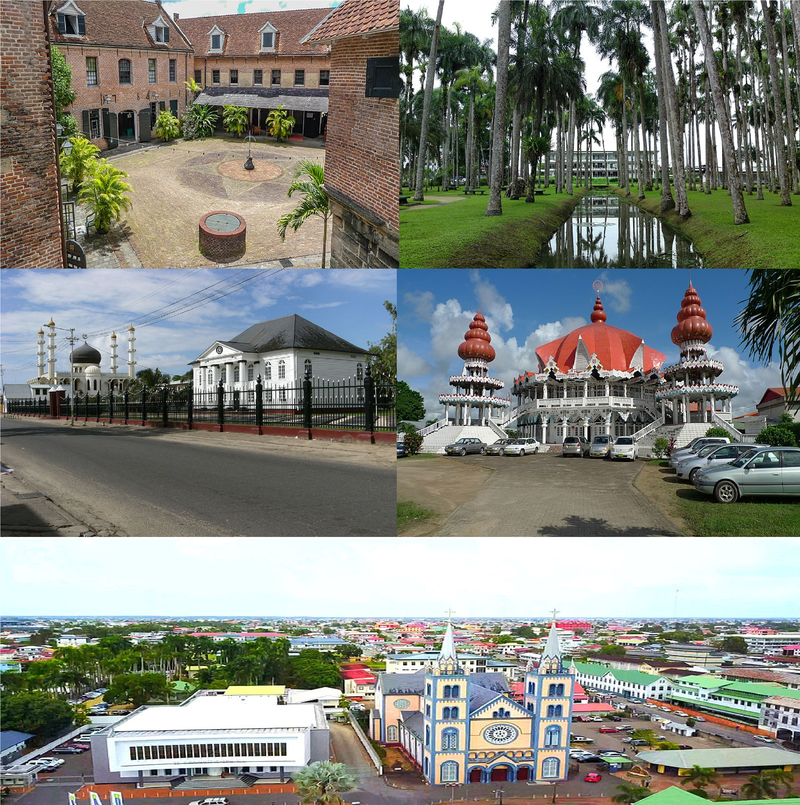
File:Paramaribo_city_collage.png · Wikimedia Commons · See Wikimedia Commons
Paramaribo is the capital and largest city of Suriname, home to nearly a quarter million people who make up almost half of the country's total population. The city's historic inner district has been recognized as a UNESCO World Heritage Site since 2002, reflecting its cultural and architectural significance.
AI-generated from the Wikipedia summary — may contain errors.
via Open-Meteo
via · GeoNames
thumb|Once a symbol of Dutch colonial power, the monumental former Governor's mansion on Independence Square now serves as the Presidential Palace of Suriname The name Paramaribo is probably a corruption of the name of an Indian village called Parmirbo (or Parmurbo or Parmarbo). The Dutch settled a trading post in 1631 which fell into English hands when the Dutch abandoned it. The British built a fort called Fort Willoughby. In 1667 the area was conquered by a Zeeland expedition. They called the fort Zeelandia and re-named Paramaribo to New Middelburg, a name that never caught on. Paramaribo grew after the abolition of slavery in 1863 as it attracted many former slaves to the city.
These days 48% of the population of Paramaribo is Christian, 14% Hindu, Muslim 9%, 4% have a different religion, 4% have no religion and 21% did not answer this question in the last census.
In two-thirds of the households, Dutch is the most spoken language and in most other households it is spoken as a second language. Other commonly spoken languages are Sranantongo, Sarnami Hindustani and Javanese. About 2% use English as their first language; however English is widely spoken by many inhabitants.
The old colonial centre mostly lies directly behind the Waterkant and most of the main sights, including the fort, the palm garden, colonial officers' houses and the central market are easily explored on foot.
thumb|321px|Old officer houses near fort Zeelandia thumb|Neve Shalom Synagogue at 82-84 Keizerstraat The Jewish community in Paramaribo is reputed to be the oldest continuing Jewish community in the Americas and the current wooden Neve Shalom (Hebrew: בית הכנסת נווה שלום; literally "Oasis of Peace" or "Valley of Peace") synagogue dates from 1835 and replaced the building constructed in 1719 by Ashkenazi Jews. The original Jewish settlers were descendants of Jews fleeing persecution by the Spanish Inquisition in Holland, Portugal and Italy and came here via Brazil. Just one of the unique features of this Synagogue is its floor of sand rather than boards or tiles. This floor is supposed to be both a reminder of the 40 years in the desert that the Hebrews were forced to endure after their exodus from Egypt, and the times that marranos had to muffle their prayers and footsteps with sand so as not to be discovered by the Inquisition and put to death. There are several beautiful Torahs that are hundreds of years old and the carved woodwork exhibits fine craftsmanship.
Paramaribo är huvudstad i Surinam. Staden hade 242 946 invånare vid folkräkningen 2004, på en yta av 182 km². Staden ligger vid , ungefär 15 kilometer från Atlanten. Från Paramaribo exporteras bauxit, sockerrör, ris, kakao, kaffe, rom och tropiska träslag. I staden produceras cement, målarfärg och öl. Britterna började bebygga området 1630 och 1650 blev Paramaribo huvudstad i den nya engelska kolonin. Från 1815 till Surinams självständighet 1975 styrdes staden av Nederländerna. Invånarna består idag till största delen av ättlingar till indiska, inhemska, afrikanska och holländska folkgrupper. Paramaribo har ett museum, en katedral, fort och kanaler som är lämningar från den holländska perioden. I januari 1821 förstördes mer än 400 byggnader i stadens centrum i en eldsvåda. En andra eldsvåda i september 1832 förstörde ytterligare 46 hus.
Abstract from DBpedia / Wikipedia · CC BY-SA
3 mapped locations
Discovered by embedding cosine similarity (sentence-transformers MiniLM, 384-dim).
via Wikipedia infobox
via Wikidata · CC0
Stroll through the historic centre with its old wooden houses. thumb|Neveh Shalom Synagogue next to the Keizerstraat Mosque Walk to the Keizerstraat where a mosque and a synagogue are built adjacent to each other. Not far from this place are also a Catholic church and a Hindu temple.
Visit Waterkant, share a djogo (1 litre) Parbo, the national beer, and enjoy the sunset. Visit the flea market on Sunday and the daily lively Central Market. Visit the flower expo at the Letitia Vriesdelaan which is scheduled every other Sunday. They sell different type of orchids, cacti, and other plants. In the north of Paramaribo is the Blauwgrond quarter. On this former plantation live Javanese people. Sit down at a warung (Javanese for small restaurant or shop) and try one of the lovely dishes. Bike or take a taxi to Weg naar Zee (Road to the Sea) which is a Hindustani open air cremation site north of the Kwattaweg. You're permitted to attend a ceremony. Nearby is a pilgrimage sanctuary.
thumb|A butcher stall near the market. Paramaribo is packed with small shops, boutiques and markets stalls, selling anything from Western brand clothing (plus at least as many fake versions) to cheap daily amenities, great hammocks, illegal DVD copies and Chinese jewellery. It remains a fairly cheap place for foreign visitors, which makes shopping for souvenirs a fun way to spend an afternoon.
The Centrale Markt, on the far east side of the Waterkant, is in many ways the heart of the city. A colourful range of street stalls and sellers mark the entrance of the covered market area, supposedly the largest one of its kind in the Caribbean. It's a two story market tucked away in a massive warehouse, with stalls selling anything from fresh vegetables and meat on the ground floor to T-shirts and hair extensions on the second floor. A visit to town is hardly complete without a quick visit to this bustling place and if you're not interested in any of their goods, you might be in one of the many tasty snacks for sale. Open for business daily except Sunday, from early morning until 15:00, but coming early is advised. The Flower Market around the Kleine Waterstraat is another colourful experience, and set nicely against a colonial background.
The Maagdenstraat is your best bet when you're interested in Chinese jewellery. Most of the jewellers are specialised in labour-intensive handmade jewellery. You can also have your own jewels cleaned, returning the glow they used to have, or have…
thumb|As Suriname gained independence, the bronze 1923 statue of Dutch Queen Wilhelmina was moved from what's now the Independence Square to this place next to Fort Zeelandia, where she now looks out over the river. Paramaribo's many restaurants reflect its diverse culture and strong Chinese, Javanese and Hindustan influences. Small food stalls serve inexpensive traditional snacks at the markets and along the Waterkant. If you're looking for Javanese style food, consider driving out to the Blauwgrond area of town. This Javanese part of the city is known for its many small restaurants, typically unpolished places with simple plastic outdoor furniture but great food.
However, for the travel weary visitor there's a Kentucky Fried Chicken around and a few places that cater to the much less spiced Dutch taste. Food is typically cheap by western standards, with full 3 course meals anywhere between SRD25 and SRD60 and simple mains around SRD20. If you follow the locals to smaller places you'll be able to eat for SRD10. Most of the small restaurants are quite casual in style. For a somewhat more formal experience, the upmarket hotels in town usually have their own restaurants, serving both traditional and international cuisine for obviously higher prices.
On the Waterkant, between the street and the river, are a number of pavilions with simple, but atmospheric, terraces. There's no service and you have to get your drinks yourself. Music is everywhere and while adults pour out a djogo in cups, children play between the tables and teens hang out near the quay wall. There's always something happening on the Waterkant. Just next to the pavilions are 3 more upscale restaurants (JiJi, De Waag and Brotik - see the "Eat" section above) with good bars, followed by a 24/7 bar that also has a nice terrace that overlooks the river.
thumb|350px|Waterkant As Paramaribo's tourist economy develops, hotels and guesthouses are popping up while older ones get restyled. There's plenty of choice now to fit your budget, from €15 single rooms in a basic guesthouse to €100 and more for a stay in one of the upmarket resorts. If you're travelling with a family or group, apartments are a good option and often cheaper while more convenient than multiple rooms. VAT and service charges are typically included in hotel prices and almost all of them can arrange tours to other towns or the country's tight jungle backlands. Note that many hotels charge their prices in either US dollars or euros. Usually they will accept Surinamese dollars, but check in advance.
The country code for international calls to Suriname is 597. There are no trunk or area codes.
Many hotels and Bed and Breakfasts offer their guests a Wi-Fi connection, mostly for free. The number of internet cafés in the city is declining due to the usage of smart phones and tablets.
thumb|The beaches near Galibi are one of the main nesting grounds for protected Leatherback sea turtles. As nice as Paramaribo is, it would be an absolute pity to leave Suriname without at least one or two trips to its other destinations, jungle villages, remote resorts or sandy beaches. Getting around on your own can be challenging, especially when heading into the dense Amazon rain forest. Fortunately, tour operators seem to be available at every corner in Paramaribo, ready to make any arrangement you might dream of. Look around and negotiate, as there are fine trips to be found for every budget. Whether you're looking for a helicopter trip to a protected sea turtle nesting beach, a week-long boat trip down the Maroni river or just a day trip to the Jodensavanna, Paramaribo's tour operators will make it happen.
Albina (East Coast) - a small town on the Maroni river. Directly across the river lies the French-Guianian town of Saint-Laurent-du-Maroni. It's a good starting point for boat trips down the Maroni river, and a transport hub for Galibi. Awarradam (Surinamese Rainforest) - In upper Suriname, on an island in the Gran Rio River, is a beautiful and comfortable resort, built by the government. This is a great place to contact Marroon people and to experience the jungle. Galibi (East Coast) - large groups of protected leatherback sea turtles visit the beaches close to this small town to lay their eggs. The Galibi Natural Reserve is one of the most important nesting areas …
Travel guide from Wikivoyage (CC BY-SA 4.0)
via Wikidata sitelinks · CC0