Hegg, Danilo;Morgan-Richards, Mary;Trewick, Steven A.
Pharmacus
Sign in to savePharmacus is a genus of cave wētā in the family Rhaphidophoridae, endemic to New Zealand. All species are alpine adapted and found at high elevations in the South Island. They live among rocks on high mountain ridges, often well above glaciers and vegetation. Pharmacus has a geographical range that extends from Nelson south to central Otago and Fiordland. They are small insects with a body length of approximately 14-20mm. In this genus, females are larger than males. All species exhibit dark brown to black pigmentation of the body and legs. They have a dense clothing of setae and a serrated ov
Species
GENUS
- KingdomAnimalia
- PhylumArthropoda
- ClassInsecta
- OrderOrthoptera
- FamilyRhaphidophoridae
via GBIF
~3 min read
Encyclopedic overview
6 sectionsContents
- Taxonomy
- Morphology
- Diet
- Distribution
- Species
- References
Pharmacus is a genus of cave wētā in the family Rhaphidophoridae, endemic to New Zealand. All species are alpine adapted and found at high elevations in the South Island. They live among rocks on high mountain ridges, often well above glaciers and vegetation. Pharmacus has a geographical range that extends from Nelson south to central Otago and Fiordland. They are small insects with a body length of approximately 14-20mm. In this genus, females are larger than males. All species exhibit dark brown to black pigmentation of the body and legs. They have a dense clothing of setae and a serrated ovipositor. When active they are lively jumpers. For example, Pharmacus montanus is known as the Mount Cook flea because of its habit of leaping out of rock crevices on to mountain climbers.
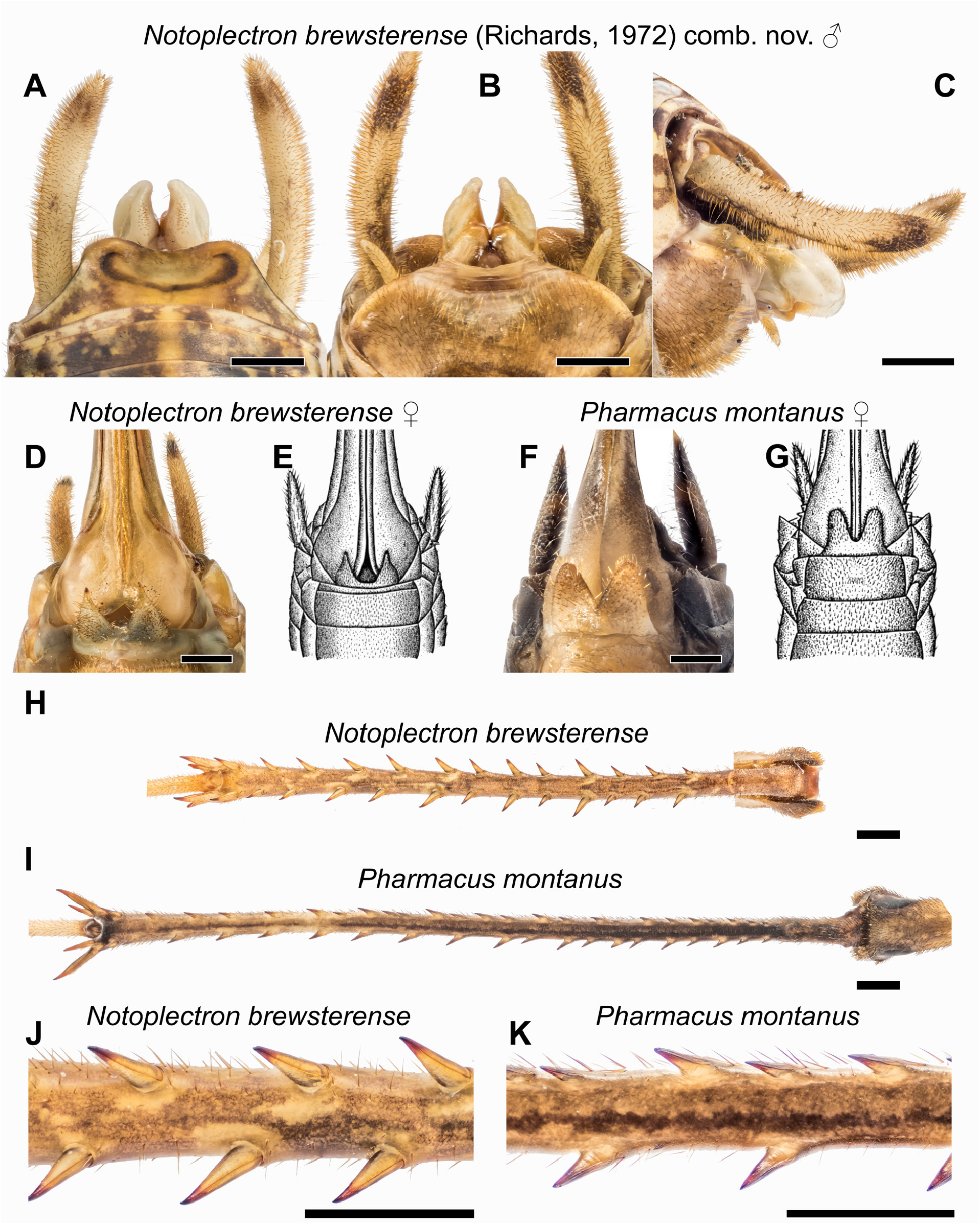
== Taxonomy == The genus Pharmacus was first described by Pictet and de Saussure in 1893 as a monotypic taxon. Pharmacus montanus was thought to be the only species in this genus. However, three species were added to the genus by Richards in 1972. These were Pharmacus brewsterensis (now moved to another genus), P. chapmanae and P. dumbletoni (both synonyms). Six new species and three new subspecies have been recently added in 2022 by Hegg, Morgan-Richards and Trewick. The six new species are Pharmacus concinnus, P. cristatus, P. notabilis, P. perfidus, P. senex, P. vallestris. Three new subspecies of Pharmacus cochleatus have been described and are known as P. cochleatus rawhiti, P. cochleatus fiordensis, P. cochleatus nauclerus.
Excerpted from Wikipedia’s “Pharmacus” article, available under the CC BY-SA 4.0 licence.