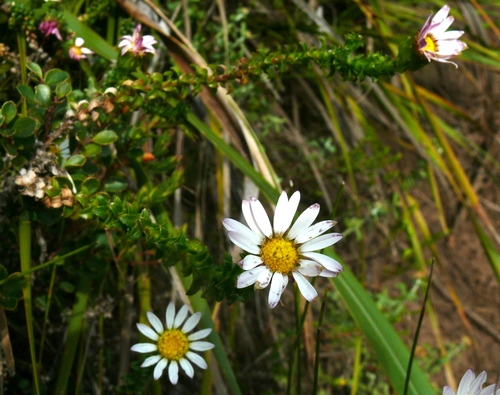
(c) Tony Rebelo, some rights reserved (CC BY-SA), uploaded by Tony Rebelo · cc-by-sa
Polyarrhena
Sign in to savePolyarrhena is a genus of low, branching shrublets that is assigned to the daisy family (Compositae or Asteraceae). Its stems are alternately and densely set with entire or somewhat toothed leaves. Like in almost all Asteraceae, the individual flowers are 5-merous, small and clustered in typical heads, and which are surrounded by an involucre of in this case three whorls of bracts. In Polyarrhena, the centre of the head is taken by yellow disc florets, and is surrounded by one single whorl of white ligulate florets that have a pinkish-purple wash on the underside. These florets sit on a common
Species
GENUS
- KingdomPlantae
- PhylumTracheophyta
- ClassMagnoliopsida
- OrderAsterales
- FamilyAsteraceae
via GBIF · Kew POWO
Museum specimens
- Specimen records
- 3
- With media
- 3
- Family
- Asteraceae
- Collections
- K
- Recorded in
- South Africa
Wikidata facts
- Instance of
- taxon
- Parent taxon
- Asteraceae
- Image
- Polyarrhena reflexa subsp. reflexa 1DS-II 3-8077.jpg
Show 5 more facts
- taxon name
- Polyarrhena
- taxon rank
- genus
- topic's main category
- Category:Polyarrhena
- Commons category
- Polyarrhena
Sources (1)
via Wikidata · CC0
~6 min read
Encyclopedic overview
6 sectionsContents
- Taxonomy
- Description
- Differences between the species
- Convergent evolution
- Conservation
- References
Polyarrhena is a genus of low, branching shrublets that is assigned to the daisy family (Compositae or Asteraceae). Its stems are alternately and densely set with entire or somewhat toothed leaves. Like in almost all Asteraceae, the individual flowers are 5-merous, small and clustered in typical heads, and which are surrounded by an involucre of in this case three whorls of bracts. In Polyarrhena, the centre of the head is taken by yellow disc florets, and is surrounded by one single whorl of white ligulate florets that have a pinkish-purple wash on the underside. These florets sit on a common base (or receptacle) and are not individually subtended by a bract (or palea). The species occur in the Cape Floristic Region. Polyarrhena reflexa has long been cultivated as an ornamental and is often known under its synonym Aster reflexum.
== Taxonomy == In his famous work Species Plantarum, Carl Linnaeus described Aster reflexus, which was the first valid scientific description of a species that is now assigned to the genus Polyarrhena. Carl Peter Thunberg thought this species would be better placed in Chrysocoma. In the Dictionnaire des Sciences Naturelles, volume 56, that was published in 1828, French Asteraceae specialist Henri Cassini erected the genus Polyarrhena, and named the type species Polyarrhena reflexa, that was based on Aster reflexus. The genus name is a contraction of "many", and "male", which Cassini chose because he said it fitted this genus. Christian Friedrich Lessing in 1832 assigned P. reflexa to his new genus Elphegea, with two other species that have sterile disc florets, E. bergeriana (now Felicia bergeriana) and E. ciliata (now Zyrphelis taxifolia), Nees von Esenbeck in the following year retained Polyarrhena, but Augustin Pyramus de Candolle included P. reflexa in Felicia in 1835, while Irish botanist William Henry Harvey in 1865 reenlisted the species under Aster. Jürke Grau in his review of the genus extended Polyarrhena by reassigning Felicia imbricata, and describing two new species, Polyarrhena prostrata and P. stricta, and two new subspecies, P. reflexa subsp. brachyphylla and P. prostrata subsp. dentata.
Excerpted from Wikipedia’s “Polyarrhena” article, available under the CC BY-SA 4.0 licence.
Gallery (3)
Available in 12 languages
via Wikidata sitelinks · CC0