File:Clade-grade_II.svg · Wikimedia Commons · See Wikimedia Commons
polyphyly
Sign in to saveAlso known as polyphyletic, polyphyletic group
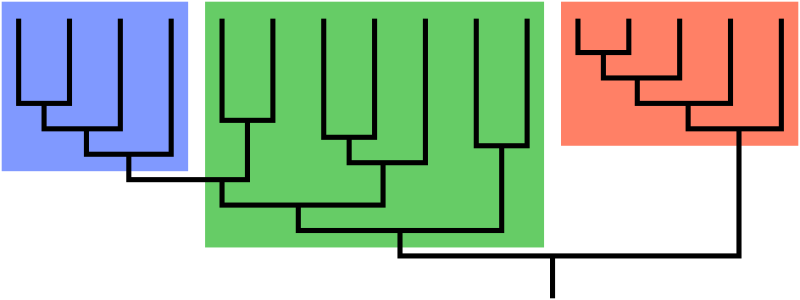
thumb|300px|In this phylogenetic tree, the blue and red groups (which are both monophyletic) do not share an immediate common ancestor. If they are grouped together because they share characteristics which appear to be similar, then their combination forms a polyphyletic group. thumb|300px|Cladogram of the [[primates, showing a monophyly (the simians, in yellow), a paraphyly (the prosimians, in cyan, including the red patch), and a polyphyly (the night-active primates, the lorises and the tarsiers, in red).]] thumbnail|300px|Phylogenetic groups: A monophyletic taxon (in yellow, the clade Sauro
Wikidata facts
Show 4 more facts
- Commons category
- Polyphyly
- topic's main category
- Category:Polyphyly
- facet of
- phylogenetics
- different from
- paraphyly
Sources (3)
via Wikidata · CC0
~6 min read
Encyclopedic overview
7 sectionsContents
- Etymology
- Avoidance
- Polyphyletic species
- See also
- References
- Bibliography
- External links
thumb|300px|In this phylogenetic tree, the blue and red groups (which are both monophyletic) do not share an immediate common ancestor. If they are grouped together because they share characteristics which appear to be similar, then their combination forms a polyphyletic group. thumb|300px|Cladogram of the [[primates, showing a monophyly (the simians, in yellow), a paraphyly (the prosimians, in cyan, including the red patch), and a polyphyly (the night-active primates, the lorises and the tarsiers, in red).]] thumbnail|300px|Phylogenetic groups: A monophyletic taxon (in yellow, the clade Sauropsida grouping "reptiles and birds") contains a common ancestor and all of its descendants. A paraphyletic taxon (in cyan, the "reptiles") contains its most recent common ancestor, but does not contain all the descendants of that ancestor. A polyphyletic taxon (in red, the group [[Haemothermia containing warm-blooded tetrapods) does not contain the most recent common ancestor of all its members.]]
A polyphyletic group is an assemblage that includes organisms with mixed evolutionary origin but does not include their most recent common ancestor. The term is often applied to groups that share similar features known as homoplasies, which are explained as a result of convergent evolution. The arrangement of the members of a polyphyletic group is called a polyphyly . It is contrasted with monophyly and paraphyly.
Excerpted from Wikipedia’s “polyphyly” article, available under the CC BY-SA 4.0 licence.