File:Clade-grade_II.svg · Wikimedia Commons · See Wikimedia Commons
paraphyly
Sign in to saveAlso known as paraphyletic, paraphylesis, paraphyleticity, paraphyletism
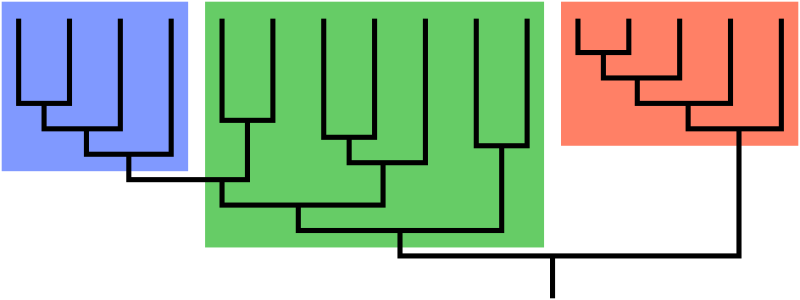
thumb|300px|In this phylogenetic tree, the green group is paraphyletic; it is composed of a common ancestor (the lowest green vertical stem) and some of its descendants, but it excludes the blue group (a monophyletic group) which diverged from the green group.
A paraphyletic group is a set of organisms that includes a common ancestor and some—but not all—of its descendants, leaving out other descendant groups that branched off from it. Scientists generally avoid using paraphyletic groups in formal classification because they don't cleanly represent the actual branches of evolutionary history the way more complete groupings do.
AI-generated from the Wikipedia summary — may contain errors.
Wikidata facts
Show 5 more facts
- opposite of
- monophyly
- different from
- paraphilia
- facet of
- phylogenetics
- topic's main category
- Category:Paraphyly
- Commons category
- Paraphyly
Sources (3)
via Wikidata · CC0
~12 min read
Encyclopedic overview
12 sectionsContents
- Etymology
- Phylogenetics
- In cladistics
- Examples
- Paraphyly in species
- Uses for paraphyletic groups
- Linguistics
- See also
- Explanatory notes
- References
- Bibliography
- External links
thumb|300px|In this phylogenetic tree, the green group is paraphyletic; it is composed of a common ancestor (the lowest green vertical stem) and some of its descendants, but it excludes the blue group (a monophyletic group) which diverged from the green group.
Paraphyly is a taxonomic term describing a grouping that consists of the grouping's last common ancestor and some but not all of its descendant lineages. The grouping is said to be paraphyletic with respect to the excluded subgroups. In contrast, a monophyletic grouping (a clade) includes a common ancestor and all of its descendants.
Excerpted from Wikipedia’s “paraphyly” article, available under the CC BY-SA 4.0 licence.
Gallery (9)
Available in 55 languages
- Español
- Français
- 中文
- 日本語
- Русский
- Português
- Italiano
- العربية
- हिन्दी
- Afrikaans
- Aragonese
- Asturian
- Bahasa Indonesia
- Bangla
- Basque
- Bosnian
- Catalan
- Chuvash
Show 36 more
- Czech
- Danish
- Egyptian Arabic
- Esperanto
- Estonian
- Finnish
- Galician
- Hebrew
- Hungarian
- Interlingua
- Irish
- Javanese
- Kabyle
- Limburgish
- Malay
- Nederlands
- Norwegian
- Norwegian Nynorsk
- Polski
- Romanian
- Saterland Frisian
- Serbian
- Serbian (Latin)
- simple
- Slovak
- Slovenian
- Svenska
- Tamil
- Tiếng Việt
- Türkçe
- Ukrainian
- Walloon
- Western Frisian
- zh_yue
- فارسی
- 한국어
via Wikidata sitelinks · CC0